Introduction to How the Physics of Football Works
|
Physics is the branch of science that deals with the physical world. The branch of physics that is most relevant to football is mechanics, the study of motion and its causes. We will look at three broad categories of motion as they apply to the game:
- Delivery of a football through the air
- Runners on the field
- Stopping runners on the field
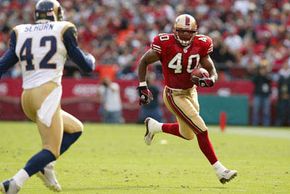
![]() Photo courtesy San Francisco 49ers Fred Beasley of the 49ers running the ball. See more football pictures. |
Watching a weekend football game could be teaching you something other than who threw the most passes or gained the most yards. Football provides some great examples of the basic concepts of physics -- it's present in the flight of the ball, the motion of the players and the force of the tackles. In this article, we'll look at how physics applies to the game of football.
Throwing the Football
|
- The velocity or speed at which the ball leaves his foot
- The angle of the kick
- The rotation of the football
The rotation of the ball -- spiral or end-over-end -- will influence how the ball slows down in flight, because the ball is affected by air drag. A spiraling kick will have less air drag, will not slow down as much and will be able to stay in the air longer and go farther than an end-over-end kick. The velocity of the ball and the angle of the kick are the major factors that determine:
- How long the ball will remain in the air (hang-time)
- How high the ball will go
- How far the ball will go
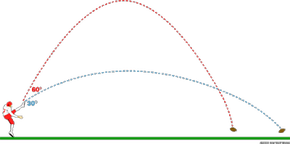
![]() The angle of a kick helps determine how far it will travel. |
When the ball leaves the punter's foot, it is moving with a given velocity (speed plus angle of direction) depending upon the force with which he kicks the ball. The ball moves in two directions, horizontally and vertically. Because the ball was launched at an angle, the velocity is divided into two pieces: a horizontal component and a vertical component. How fast the ball goes in the horizontal direction and how fast the ball goes in the vertical direction depend upon the angle of the kick. If the ball is kicked at a steep angle, then it will have more velocity in the vertical direction than in the horizontal direction -- the ball will go high, have a long hang-time, but travel a short distance. But if the ball is kicked at a shallow angle, it will have more velocity in the horizontal direction than in the vertical direction -- the ball will not go very high, will have a short hang-time, but will travel a far distance. The punter must decide on the best angle in view of his field position. These same factors influence a pass or field goal. However, a field goal kicker has a more difficult job because the ball often reaches its peak height before it reaches the uprights.
If you are not interested in the details of calculating the hang-time, peak height and range of a punt, click here to skip the following page.
|
Punting: Hang-Time, Peak Height and Range
The parabolic path of a football can be described by these two equations:- y = Vyt - 0.5gt2
- x =Vxt
- y is the height at any time (t)
- Vy is the vertical component of the football's initial velocity
- g is acceleration due to Earth's gravity, 9.8 m/s2
- x is the horizontal distance of the ball at any time (t)
- Vx is the horizontal component of the football's initial velocity
- The velocity must be broken into horizontal (Vx) and vertical (Vy) components according to the following formulas:
- Vx = V cos(theta)
- Vy = V sin(theta)
- The hang-time (ttotal) must be determined by one of these two formulas:
- ttotal = (2Vy/g)
- ttotal = (0.204Vy)
- Once you know the hang-time, you can calculate maximum range (xmax):
- xmax = Vx ttotal
- You can calculate the time (t1/2) at which the ball is at its peak height:
- t1/2 = 0.5 ttotal
- And you can calculate the peak height (ymax), using one of these two formulas:
- ymax = vy(t1/2) - 1/2g(t1/2)2
- ymax = vy(t1/2) - 0.49(t1/2)2
- Vertical and horizontal components of velocity:
- Vx = V cos(theta) = (27.4 m/s) cos (30 degrees) = (27.4 m/s) (0.0.87) = 23.7 m/s
- Vy = V sin(theta) = (27.4 m/s) sin (30 degrees) = (27.4 m/s) (0.5) = 13.7 m/s
- Hang-time:
- ttotal = (0.204Vy) = {0.204 (13.7m/s)} = 2.80 s.
- Maximum range:
- xmax = Vx ttotal = (23.7 m/s)(2.80 s) = 66.4 m
- 1 m = 1.09 yd
- xmax = 72 yd
- Time at peak height:
- t1/2 = 0.5 ttotal = (0.5)(2.80 s) = 1.40 s
- Peak height:
- ymax = Vy(t1/2) - 0.49(t1/2)2 = [{(13.7 m/s)(1.40 s)} - {0.49(1.40 s)2}] = 18.2 m
- 1 m = 3.28 ft
- ymax = 59.7 ft
Runners on the Field
When we look at runners on the field, several aspects can be considered:- Where they line up for a play
- Changing directions
- Running in an open field
When we look at the positions of the backs, both offensive and defensive, we see that they typically line up away from the line of scrimmage on either side of the offensive and defensive linemen. Their positioning allows them room, or time, to accelerate from a state of rest and reach a high speed, to either run with the ball or pursue the ball carrier. Notice that the linebackers have far more room to accelerate than the linemen, and the wide receivers have far more room than the linebackers. So linebackers can reach higher speeds than linemen, and wide receivers can reach the highest speeds of all.
Changing Directions on the Field
Let's look at an example of a running play in which the quarterback hands the ball off to a running back. First, the running back starts from the set position, at rest, and accelerates to full speed (22 mi/h or 9.8 m/s) in 2 s after receiving the ball. His acceleration (a) is:
- a = (vf - vo)/(tf - to)
- vf is final velocity
- vo is initial velocity
- tf is final time
- to is initial time
- a=(9.8 m/s - 0 m/s)/(2 s - 0 s)
- a= 4.9 m/s2
- Stop his motion to the right
- Accelerate him upfield
- As he plants his foot to slow his motion, the coefficient of friction between the turf and him is reduced by the water on the surface.
- The reduced coefficient of friction decreases the frictional force.
- The decreased frictional force makes it harder for him to stop motion his to the right.
- The runner loses his footing and falls.
- a = (0 m/s - 9.8 m/s)/(0.5 s - 0 s)
- a = -19.6 m/s2
- *The negative sign indicates that the runner is accelerating is in the opposite direction, to the left.
|
The force (F) required to stop him is the product of his mass (m), estimated at 98 kg (220 lbs), and his acceleration:
- F = ma = (98 kg)(-19.6 m/s2) = 1921 Newtons (N)
- 4.4 N = 1 lb
- F = ~500 lbs!
Running in an Open Field
When running in an open field, the player can reach his maximum momentum. Because momentum is the product of mass and velocity, it is possible for players of different masses to have the same momentum. For example, our running back would have the following momentum (p):
- p = mv = (98 kg)(9.8 m/s) = 960 kg-m/s
Blocking and Tackling
Tackling and blocking runners relies on three important principles of physics:- Impulse
- Conservation of momentum
- Rotational motion

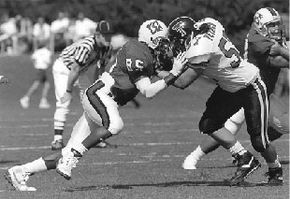
Photo courtesy North Carolina State University
Players use physics to stop each other on the football field.
When Runner and Tackler Meet
When our running back is moving in the open field, he has a momentum of 960 kg-m/s. To stop him -- change his momentum -- a tackler must apply an impulse in the opposite direction. Impulse is the product of the applied force and the time over which that force is applied. Because impulse is a product like momentum, the same impulse can be applied if one varies either the force of impact or the time of contact. If a defensive back wanted to tackle our running back, he would have to apply an impulse of 960 kg-m/s. If the tackle occurred in 0.5 s, the force applied would be:
- F = impulse/t = (960 kg-m/s)/(0.5 s) = 1921 N = 423 lb
In any collision or tackle in which there is no force other than that created by the collision itself, the total momentum of those involved must be the same before and after the collision -- this is the conservation of momentum. Let's look at three cases:
- The ball carrier has the same momentum as the tackler.
- The ball carrier has more momentum than the tackler.
- The ball carrier has less momentum than the tackler.
- If the ball carrier and tackler have equal momentum, the forward momentum of the ball carrier is exactly matched by the backward momentum of the tackler. The motion of the two will stop at the point of contact.
- If the ball carrier has more momentum than the tackler, he will knock the tackler back with a momentum that is equal to the difference between the two players, and will likely break the tackle. After breaking the tackle, the ball carrier will accelerate.
- If the ball carrier has less momentum than the tackler, he will be knocked backwards with a momentum equal to the difference between the two players.
The Tackling Process
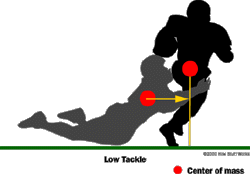
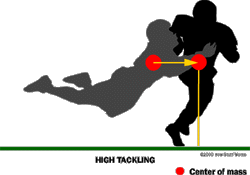
Coaches often tell their players to tackle a runner low. In this way, the runner's feet will be rotated in the air in the direction of the tackle. Let's look at this closely:
![]() |
![]() |
|
| |
|
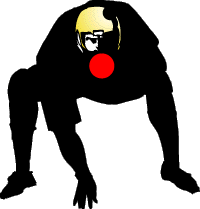
![]() A lineman crouches low so that his center of mass is closer to the ground. This makes it hard for an opposing player to move him. |
Similarly, coaches often advise linemen to stay low. This brings their center of mass closer to the ground, so an opposing player, no matter how low he goes, can only contact them near their center of mass. This makes it difficult for an opposing player to move them, as they will not rotate upon contact. This technique is critical for a defensive lineman in defending his own goal in the "red" zone, the last 10 yards before the goal line.
We have only touched on some of the applications of physics as they relate to football. Remember, this knowledge appears to be instinctive; Most often, players and coaches don't consciously translate the mechanics of physics into their playing of the sport. But by making that translation, we can understand and appreciate even more just how amazing some of the physical feats on the football field really are. Also, applying physics to football leads to better and safer equipment, affects the rules of the sport, improves athletic performance, and enhances our connection to the game.
For more information on football physics and related topics, check out the links on the next page.
Lots More Information
Related HowStuffWorks Articles
- How NFL Equipment Works
- How the First-Down Line Works
- How Force, Power, Torque and Energy Work
- How EyeVision Works
- How Performance-Enhancing Drugs Work
- How do they superimpose the first down line onto the field on televised football games?
- How are the college football rankings determined?
- How does the NFL's salary cap work?
More Great Links
- NCSU: The Science House
- Exploratorium: Sport! Science
- American Institute of Physics: Football Physics
- Football Physics: a Series of Short Quick-Time Vignettes by University of Nebraska Physics Professor Tim Gay