
Torch Construction
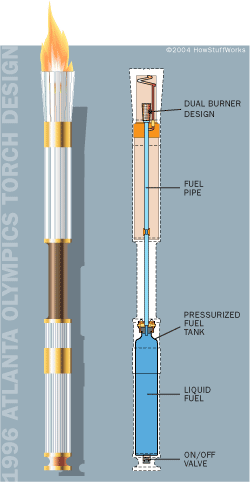
To get an idea of how a torch is constructed, let's look at two recent Olympic torches.

This is the torch designed for the 1996 Atlanta Summer Olympics. Its aluminum base houses a small fuel tank. As fuel rises through the handle, it is pushed through a brass valve with thousands of tiny openings. As the fuel squeezes through the small openings, it builds pressure. Once it makes it through the openings, the pressure drops, and the liquid fuel turns into a gas for burning. The tiny holes maintain a high pressure in the fuel to keep the flame going through harsh conditions.
Advertisement
The 1996 torch was fueled by propylene, which produced a bright flame. But because propylene contains a high level of carbon, it also produced a lot of smoke -- not a plus for the environment.
In 2000, the creators of the Sydney, Australia, Olympic torch came up with a more lightweight, inexpensive, and environmentally friendly design. To fuel their torch, they decided on a mixture of 35 percent propane (the gas used to heat home stoves and barbecue grills) and 65 percent butane (cigarette lighter fuel), which ignites a strong flame without making a lot of smoke. Because the propane/butane mix can be stored as a liquid under relatively light pressure, it can be kept in a lightweight container. It then burns as a gas under normal atmospheric pressure.
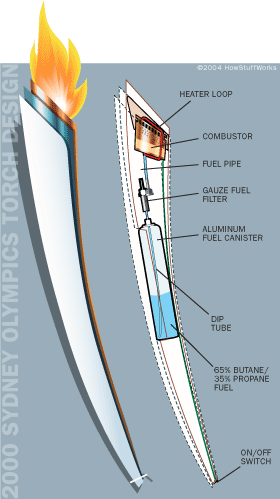
The liquid fuel is stored in an aluminum canister located about halfway up the torch. It flows up to the top of a torch through a pipe. Before leaving the pipe, the liquid fuel is forced through a tiny hole. Once it moves through the hole, there is a pressure drop, causing the liquid to turn into a gas for burning. The torch moves the liquid fuel at a consistent rate to the burner, so the flame always burns with the same intensity. The torch can stay lit for about 15 minutes.
The engineers behind both the 1996 and 2000 torches included a burner system that utilized a double flame, helping it to stay lit even in erratic winds. The external flame burns slowly and at a lower temperature than the internal flame. This flame is big and bright orange, so it can be seen clearly; but it is unstable in winds. The interior flame burns hotter, producing a blue flame that is small but very stable, because its internal location protects it from the wind. It acts like a pilot light, able to relight the external flame should it go out.
For the 2000 torch's underwater journey across the Great Barrier Reef, a specially designed flare was fitted inside the torch to keep the flame burning both in the water and on land.
Future torch design will continue to evolve as technology improves and new fuels provide even greater safety and reliability.
Now let's see how the torch is lit to start the Olympic relay.