The Lighting of the Olympic Torch

Photo courtesy ANA/Orestis Panagiotpu
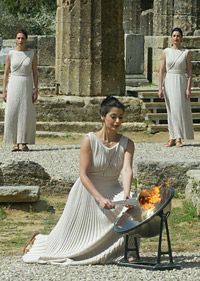
Actress Thaleia Prokopiou ignites the Olympic Flame with the use of a parabolic mirror during a Torch Lighting practice session outside the Temple of Hera in Ancient Olympia, 2004.
|
The Olympic torch is lit several months before the start of the actual games. The flame begins its journey at the site of the original Olympic Games -- Olympia, Greece. It is lit, just as it was in ancient times, at the
Temple of Hera.
An actress dressed as a ceremonial priestess, in the robes of the ancient Greeks, lights the torch via the same technique used in the original Games. She uses a parabolic mirror to focus light rays from the sun. The parabolic mirror has a curved shape. When it is held toward the sun, the curvature focuses the rays to a single point. The energy from the sun creates a great deal of heat. The priestess holds a torch in the center of the parabolic mirror, and the heat ignites the fuel in the torch, sparking a flame.
If the sun is not shining on the day of the lighting ceremony, the priestess can light the torch with a flame that was lit on a sunny day before the ceremony.
The flame is carried in a fire pot to an altar in the ancient Olympic stadium, where it is used to light the first runner's torch. For the Winter Games, the relay actually begins at the monument to Pierre de Coubertin (the man who founded the modern Olympic games in 1896), which is located near the stadium.
Then, the relay begins.
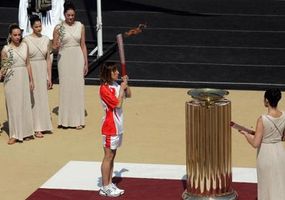
Louisa Gouliamaki/AFP/Getty ImagesThe last Torchbearer, Greece's Olympic silver medalist Chrysopygi Devertzi holds the Olympic torch at the Panathinaikon stadium during the handover ceremony to China on March 30, 2008.
Notable Routes
The torch always begins in Greece, but from there its path changes from Olympics to Olympics. Here are a few notable torch routes from the past:
- 1936 - First official torch relay at the Summer Olympics, Berlin, Germany: The torch traveled 1,895 miles (3,050 km) through seven countries, carried by 3,331 torchbearers. On one leg of the trip, the torch crossed a river in a canoe.
- 1952 - Summer Olympics, Helsinki, Finland: The relay traveled 4,890 miles (7,870 km) through Greece, Denmark, Sweden, and Finland, carried by 3,372 torchbearers. The final torchbearer was Finnish athlete Paavo Nurmi.
- 1976 - Summer Olympics in Montreal, Canada: The relay traveled through Greece and Canada. The Olympic flame was converted to an electronic pulse and traveled via satellite from Athens, Greece, to Ottawa, Canada.
- 2000 -Summer Olympics, Sydney, Australia: The torch traveled 17,000 miles (27,359 km) around Australia and the South Pacific, carried by about 12,000 torchbearers. One of the torchbearers was a diver, who carried a special underwater torch across the Great Barrier Reef.
- 2004 - Summer Olympics, Athens, Greece: The torch traveled 48,000 miles (77,249 km), going from Greece, around the world, and back to Greece for the Games, carried by 3,600 torchbearers.
|