If your main source of information is the cover of "People" magazine, you might think that everyone in Hollywood is filthy rich. But the median weekly earnings of film industry workers in 2006 was $593, only $25 more than the median weekly earnings of all other industries combined [source: U.S. Bureau of Labor Statistics].

Getty Images
Movie directors and producers earn top dollars. Andrew Warne, left, of Australians on Film interviews director Jennifer Flackett, second from left, producer Mike Levin, center, and producer Paula Mazur, right, all from Nim's Island.
1. Producer
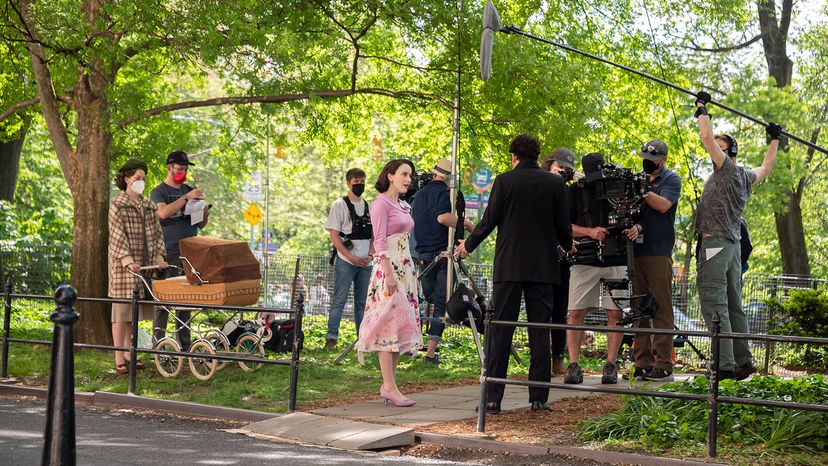
One of the vaguest titles in Hollywood, a producer can be a writer, an investor, an idea man, a manager or all of the above. In film, the head producer is called the executive producer and is responsible for each and every phase of filmmaking: pre-production, production and post-production.
In pre-production, the producer reads scripts and is pitched ideas from writers, directors and agents. After choosing an idea, the producer has to raise money to fund the project. One route is to get the backing of a major movie studio. Another is to go independent and seek funding from individual investors.
Now the producer has to hire a screenwriter, a director, production staff, casting directors, art directors, camera and lighting crews, and editors.
It's the producer's job to make sure that the project stays within budget throughout production and post-production. A good producer not only makes good films, but makes money for the investors.
Like most jobs in the film industry, producers work their way up. You might start as a production assistant or a script reader, learning how to spot a good idea and how to bring it to fruition. Or you can just leap right in and learn by trial and error, making small, low-budget films and working up to bigger ones.
According to 2006 numbers from the Bureau of Labor Statistics, the average annual salary for a film producer is $92,920.
2. Directors
Directors oversee the artistic vision of a film. Directors aren't usually involved in the financial side of filmmaking, unless they're wearing multiple hats as a producer-director.
In pre-production, the director works closely with the screenwriter and the producer to figure out the best way to visually represent the script and its themes. An experienced director will have a preferred list of cinematographers, art directors, cameramen, casting directors and even actors. Even if the producer does much of the actual hiring and location scouting, it's the director who has the final say.
During filming, the director coaches actors on the best way to read their lines and express emotions. He works with the cinematographer to make sure that the action is being faithfully and artistically recorded. And he decides how many takes are necessary before the crew can move on to the next shot.
In post-production, the director sits with the editor to assemble the finished film. He works with a composer and music director to create a score and soundtrack that supports the story. And finally, after months or years of work, he has a finished film.
To succeed as a director requires a persistence of vision and the ability to collaborate with an extensive team to bring that vision to life. They also need to have a deep understanding of film history and technique. Directors usually start with small, independent projects, sometimes as part of film school programs.
The Bureau of Labor Statistics lumps producers and directors together, so the average annual salary of film directors in 2006 was also $92,920.
3. Screenwriters
There are several different ways for a screenwriter to get involved with a film project. One way is to write a full script on spec. The idea is to write the script first and then shop it around to agents or producers who might hire you or buy the script for later development.
Experienced screenwriters don't even have to write the script. Through their agent, they can get appointments with producers to pitch an idea for a script. The producer can then decide whether to just buy the idea or to hire the screenwriter to write a full script or a shorter treatment.
Some screenwriters are hired later in the process, after a producer or director has developed an idea. The screenwriter might be asked to write an adaptation of an existing work, like a novel or a play. Or even punch up another screenwriter's script by adding more jokes or more realistic dialogue. On large studio films, it's not uncommon for several screenwriters to get credit for the same script.
Some screenwriters start as playwrights, journalists, novelists or other professional writers, while others go directly into writing for film and television. It's a notoriously hard industry to break into, so it helps if you have connections.
BLS statistics for 2006 put the average salary of a film screenwriter at $95,250, higher than both directors and producers. That's probably because there are less than 2,000 working screenwriters compared to nearly 22,000 producers and directors [source: U.S. Bureau of Labor Statistics].
4. Film and Video Editors
Editors perform one of the most important, if least glamorous jobs in Hollywood. It's not uncommon for a director to shoot hundreds of hours of footage that needs to be whittled down to a tight, 90-minute film. A skilled editor will select the scenes and individual shots that best tell the story according to the director's specific vision.
Editors spend their days (and some late nights) in front of a console of computer monitors, shaving seconds off of shots and painstakingly editing audio. Larger film projects employ many different editors, each with a specific task (rough cut editor, dialogue audio editor, special effects audio editor, et cetera).
According to BLS, the average annual salary for a film editor is $68,980.
5. Actors
Actors are the link between the director's vision, the screenwriter's words and the audience. Being an actor requires an awareness and control of one's movements and expressions that can take years of formal training. The most successful actors, however, look like they're not acting at all. They inhabit the minds and bodies of their characters completely.
Unfortunately, most actors can't earn a living through their acting work alone. The average member of the Screen Actor's Guild makes only $5,000 a year. A lot of actors take restaurant jobs that allow them to work at night and be available during the day for auditions.
According to BLS, the average hourly wage of a film actor is $10.69. The minimum wage for a SAG actor with a speaking part is $759 a day. Of course, the top handful of actors can command salaries as high as $20 million for a single film. But only about 50 of the nearly 100,000 SAG members would qualify as stars [source: U.S. Bureau of Labor Statistics].
For lots more information about careers in the film industry and related topics, check out the links on the next page.