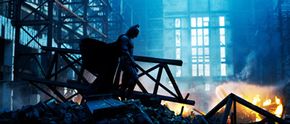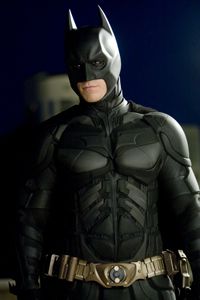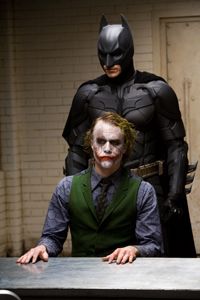
Three years after "Batman Begins" reinvigorated the ailing Batman franchise to the tune of $352 million in worldwide box office earnings, Christian Bale is back in the Batsuit to battle forces of evil in Gotham City in director Christopher Nolan's "The Dark Knight," a highly anticipated sequel.
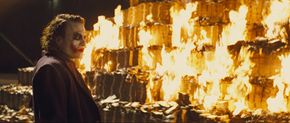
With our masked vigilante hero experiencing a crisis of conscience in a city thrown into chaos by an anarchist villain, the movie is packed with action, much of it shot in IMAX. Sadly, it's also the final completed performance by Heath Ledger, who died in January. Ledger plays the fearless and ferocious The Joker.
Advertisement
"He's the elemental bad guy, with no cause and no motivation, so he's a much more frightening villain," says screenwriter Jonathan Nolan, who wrote the script with his brother Christopher and David S. Goyer. Ledger created the ultimate nemesis in a role that may bring him a posthumous Oscar nomination.
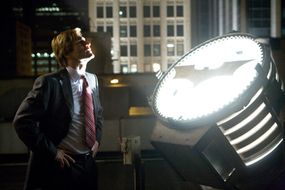
Christopher Nolan reassembled his "Batman Begins" cast including Bale, Gary Oldman as Lt. Gordon, Michael Caine as Alfred and Morgan Freeman as Lucius Fox, adding Ledger, Maggie Gyllenhaal as Rachel Dawes (taking over the role from Katie Holmes) and Aaron Eckhart as D.A. Harvey Dent, who eventually transforms into the vengeful Two-Face.
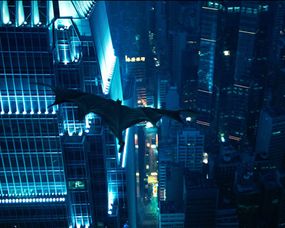
Production began in April 2007, with the bank robbery prologue shot in Chicago, where the bulk of the exterior and action sequences were filmed. There were also trips to Hong Kong and the U.K. for additional exterior and interior work.
"Moving back and forth between three different countries is an unusual way to make a film, but it's what we needed to do to get the size and scope of what we needed, to shoot as much as possible in real places, on real locations," says Nolan, who also endeavored to make the movie with as many practical effects as possible, using CG only when absolutely necessary.
Of course, shooting huge action sequences in busy cities and executing stunts like flipping a 40-foot truck, imploding a building and blowing up the beloved Batmobile took a lot of planning and effort, with the IMAX format adding an extra degree of difficulty, as the filmmakers explain in the following sections.
Advertisement