Introduction to How the Batsuit Works

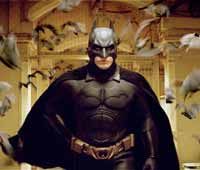
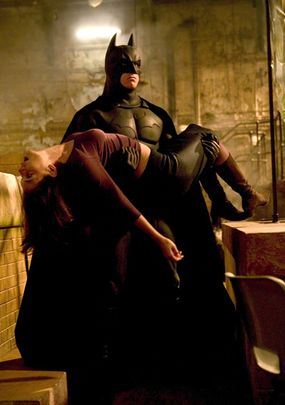
Night in and night out, Batman keeps the streets of Gotham City safe from crime and villainy. One of the most extraordinary things about Batman is this: Despite the fact that he's a superhero, he doesn't actually posses any super powers. Instead of relying on unearthly abilities, Batman uses ingenuity, deception and clever gadgetry to give him an edge over Gotham's criminal element. Nothing instills fear in the hearts of Gotham's wrongdoers more than Batman's menacing appearance, and that appearance is all about the Batsuit.


Courtesy Warner Bros.; Photo: David James
The Batsuit provides protection and identity. See more Batman pictures.

The Batsuit does a lot more for Batman than make him look scary. On its own, the suit is a pretty impressive piece of technology. The Batsuit combines armor, communications and combat technologies into one state-of-the-art crime-fighting system.

In this article, we'll look at the different components of the Batsuit, explain how they work and see how Batman uses them to keep the streets safe at night.
"Batman Begins" Production Notes

"I looked at the great comics and graphic novels through the history of Batman to try and distill the essence of what those extraordinary pictures and drawings were saying about what Batman should look like."

    - "Batman Begins" director Christopher Nolan on creating a new Batsuit

The Armor

The main element of the Batsuit is a modified, advanced infantry armor system called the Nomax Survival Suit. Like many pieces of the Batsuit, the Nomax Suit was developed by the Applied Science Division of Wayne Enterprises. (The exact nature of Batman's relationship with Wayne Enterprises is unclear at this point.)


Courtesy Warner Bros.; Photo: David James
Batman's armor consists of several components attached to a light-armor undersuit.

"Batman Begins" Production Notes
Because the matte black finish of the Batsuit got visibly dirty so easily, two crew members had to constantly follow actor Christian Bale around the set wiping smudges off the suit during filming.
The base of the Nomax Survival Suit is a neoprene undersuit, much like a SCUBA diver wears. This undersuit basically functions as waterproof, light armor with temperature-regulating elements that maintain the body's temperature and keep muscles from freezing up in the field. There are six pieces of over-armor that attach to the undersuit:
  • Knee guards
  • Calf guards
  • Leg armor
  • Arm guards
  • A full-torso vest
  • A spine guard
Batman has augmented the over-armor with his custom-designed, scalloped-brass forearm gauntlets (painted matte black, of course). These gauntlets, along with his Kevlar gloves, make Batman's arms a viable defensive or offensive weapon. His gauntlets allow him to protect himself against bladed weapons like swords or knives. The armor and scalloped blades also add extra power and pain to Batman's strikes.

"Batman Begins" Production Notes
The Batsuit for "Batman Begins" was created by costume designer Lindy Hemming ("Harry Potter and the Chamber of Secrets," "Lara Croft: Tomb Raider"). Costume design was such a huge part of the production that the film crew built a village of trailers just for costumers and chemists to do their work in. This village came to be known as "Cape Town."

The Cowl

"Batman Begins" Production Notes
Unlike the Batsuits from previous films, the new design allows the actor portraying Batman to turn his head. In the other films, Batman has to turn his entire torso to look to the left or right.
Batman replaced the traditional helmet that accompanies the Nomax Suit with his distinctive cowl, which does more than simply add to his daunting appearance.

Batman's cowl is sculpted from an impact-resistant, graphite-composite exterior. There is also bullet-proof Kevlar plating that shields sections of Batman's head and protects it from small-arms fire. Bundled into the "ears" of the cowl are high-gain microphones and a radio antenna. The radio antenna allows Batman to monitor police and emergency-services radio frequencies so that he can always be "first on the scene."


Courtesy Warner Bros.; Photo: David James
The design of Batman's cowl is a balance of form and function.

The microphones in the ears are combined with special earpieces in the cowl that give Batman superior hearing in the field. The microphones can also be used to amplify Batman's voice and broadcast it through a discreet speaker in the suit. This is what gives Batman's voice that distinctive, disembodied and unearthly sound.

"Batman Begins" Production Notes
During production, actor Christian Bale had one consistent assessment of the Batsuit: "It's hot, dark and sweaty and it gives me a headache." Costumers had this put on their crew t-shirts. Bale explains how he used that discomfort to his advantage: "It induced headaches and would send me into a foul mood after a half an hour ... I used the pain as fuel for the character's anger ... you become a beast in that suit."

The Cape

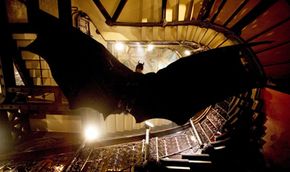
Batman's cape was also developed by the Applied Science Division of Wayne Enterprises. Based on a nylon derivative, the special memory fiber, can billow and flow like any fabric -- but when an electric charge is applied to the fiber, it becomes stiff and takes on a distinctive shape. For instance, Batman's cape has been sculpted into a kind of glider than can slow his falls or even allow for short flights.


Courtesy Warner Bros.; Photo: David James


Courtesy Warner Bros.; Photo: David James
The memory fiber that makes up Batman's cape allows for short, glider-like flight.

"Batman Begins" Production Notes
The real costuming challenge was creating a Batman cape with the right look and movement on screen. To accomplish this, the crew got help from the British Ministry of Defense. Ministry technicians taught the crew a technique that is used on police gear to lower night-vision detection, called electrostatic flocking.

The crew brushed nylon parachute fabric with glue and dropped a very fine, hair-like material onto it. Then an electrostatic charge was run under the fabric. This process gave the cape a seamless look and a distinctive, velvety sheen. The idea was to make the cape in the film look more like what we've seen in the comic book.

The Utility Belt

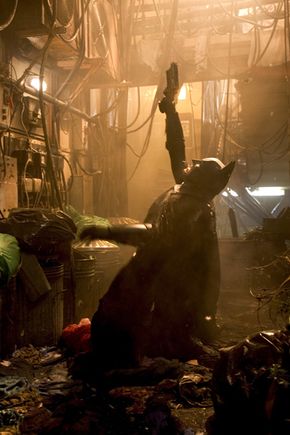
Batman's utility belt is a modified, Wayne Enterprise prototype climbing harness. With an innovative gear-attachment system, Batman can grab and replace anything on the belt quickly and easily.


Courtesy Warner Bros.; Photo: David James
The magnetic grappling gun is just one of the useful gadgets Batman carries on his utility belt.

Batman carries a variety of non-lethal deterrents and other field equipment on his belt for crime fighting. The utility belt features:

  • Magnetic grappling gun with monofilament decelerator climbing line
  • Flexible, fiber-optic periscope (to see around corners)
  • Razor-sharp alloy, shuriken-style throwing stars (hand-ground into the distinctive Batarang shape)
  • Ninja spikes for the hands and feet (used to climb sheer walls)
  • Mini-mines and various non-lethal explosives (used to stun or confuse enemies)
  • A mini cell phone with an encrypted signal
  • Medical kit


Courtesy Warner Bros.; Photo: David James
The Batsuit blends aesthetics and technology to function as a total crime-fighting system.

Though it's not on his belt, one of Batman's most innovative and effective gadgets is the sonic device he carries in the heel of one of his boots. This device can be used to summon swarms of bats instantly to create mass chaos at any scene. This allows Batman to create hellish diversions or make dramatic escapes.

"Batman Begins" Production Notes
Before Christian Bale was cast as Batman, many other actors were considered or read for the role. These actors include Guy Pearce, David Boreanaz, John Cusack, David Duchovny, Hugh Dancy, Joshua Jackson, Eion Bailey, Billy Crudup, Cillian Murphy, Henry Cavill and Jake Gyllenhaal.

For more information on the Batsuit, Batman and related topics, check out the links on the next page.

Lots More Information

Related HowStuffWorks Articles

More Great Links

Sources