Introduction to How the First-Down Line Works
In the United States, football is a major pastime. Kids play Pop Warner football, some progress to high school football, some of those play college football, and a select few play professional football in either the NFL or CFL. And on the last Sunday in January, people all over the world gather to watch the Super Bowl, the championship game of American professional football.
One of the main objectives in American football -- and a necessary one to score points -- is to gain a first down. In order to get a first down, the offense must gain 10 yards within a series of four plays. One problem that football players and officials have always had to deal with is how to measure the 10 yards needed. Even with all of our technology, the NCAA and the National Football League still uses a length of metal chain attached between two poles!
![]() Photo courtesy SporTVision SporTVision's "1st and Ten" line |
Television viewers have always been at a disadvantage in knowing where the first-down line is in reference to where the offense is. A small arrow located below the end pole isn't usually visible on the television screen. But if you've watched any football games in the last few years, you probably noticed the fluorescent yellow or orange line extending from one side of the field to the other -- seemingly painted on the field. In fact, the line is computer generated, representing exactly the spot that the offense must get to for a first down.
Sportvision, a company based in New York City, debuted its "1st and Ten" system on September 27, 1998, and football fans everywhere rejoiced! Sportvision provides ESPN and Fox Sports with the ability to enhance their football telecasts with this technology (you can view images from actual games that used the first-down line on their Web site). In this article, we'll look at how the 1st and Ten system works.
The Technology
One of the funniest things about computer-generated video effects is the amount of effort it takes to do seemingly simple things. The most basic concepts can sometimes take a gigantic amount of effort to implement (see How Centropolis FX Creates Visual Effects and How Industrial Light & Magic Works for interesting background).Painting a virtual first-down line on a football field is an excellent example of this process. The idea to paint a first-down line across the field on people's TV screens sounds so simple. As it turns out, implementing this is incredibly complex. It takes a tractor-trailer rig of equipment, including eight computers and at least four people, to accomplish this task!
Here are some of the problems that have to be solved in order for this system to work:
- The system has to know the orientation of the field with respect to the camera so that it can paint the first-down line with the correct perspective from that camera's point of view.
- The system has to know, in that same perspective framework, exactly where every yard line is.
- Given that the cameraperson can move the camera, the system has to be able to sense the camera's movement (tilt, pan, zoom, focus) and understand the perspective change that results from the movement.
- Given that the camera can pan while viewing the field, the system has to be able to recalculate the perspective at a rate of 30 frames per second as the camera moves.
- A football field is not flat -- it crests very gently in the middle to help rainwater run off. So the line calculated by the system has to appropriately follow the curve of the field.
- A football game is filmed by multiple cameras at different places in the stadium, so the system has to do all of this work for several cameras.
- The system has to be able to sense when players, referees or the ball cross over the first-down line so it does not paint the line right on top of them.
- The system also has to be aware of superimposed graphics that the network might overlay on the scene.
A key piece of hardware used in the system is a special camera mount that holds the television cameras. This mount encodes all of the camera's movement (such as tilt, pan, zoom and focus). This data enables the computers to understand exactly what each camera is doing in real-time.
Another key piece is a computerized 3-D model of the field. The computers know exactly where the cameras are located in the 3-D model and can orient the virtual first-down line on the field accordingly. The model also accounts for things like the crest of the field and the location of the yard lines on the field.
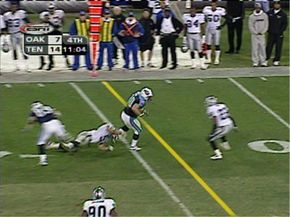
The color palettes are also critical to the system. The computers must be able to distinguish between grass, on which the line should be painted, and everything else (players, referees, the ball, etc.), on which it should not. Color palettes solve this problem. You can see the palettes at work in this frame:
![]() Photo courtesy SporTVision Players seem to run over SporTVision's "1st and Ten" line. |
The player does not have the line painted over his jersey because of the color palettes.
All counted, there are eight computers used in the system:
- Four SGI computers
- One PC
- Three special computers used in conjunction with the television cameras
Drawing the Line
In order to determine where the line should go, a central computer utilizes several pieces of information:- The virtual field modeled from measurements of the field (done before the game), and the data from the camera mounts showing what each camera's range of view is
- The raw video feed from the camera that is currently on-air (which is determined by a separate computer in the Sportvision production truck)
- Two distinct color palettes, one representing the on-field colors that should be changed to yellow, and another representing those colors that should not be changed (like colors in the players' and officials' uniforms -- this allows a player to appear to "obscure" the line, making the line appear as if it were really painted on the field)
Once the computer determines exactly which pixels should be colored yellow, this information, along with the raw video feed of the tallied (on-air) camera, is sent to a computer whose job it is to draw the yellow line 60 times per second. The line is then sent to a linear keyer to superimpose the yellow line onto the program video. Since it takes time for all this to occur, the program video is sent through several frame delays so that the generated yellow line and delayed program video can be synchronized and turned into what you see on your TV screen.
On game day, it takes four people to run the system:
- A spotter and an operator work together to manually input the correct yard line into the system. The spotter is in the press box and the operator is in the production truck physically keying in the correct number.
- Two other Sportvision operators are on hand to make any adjustments or corrections necessary during the course of the game. These adjustments might include adding colors to the color palettes due to changing field conditions, such as snow or mud.
For more information on the 1st and Ten system and related topics, check out the links on the next page.
Lots More Information
Related HowStuffWorks Articles
- How Racef/x Works
- How Digital Television Works
- How Television Works
- How NFL Equipment Works
- How the Physics of Football Works
- How Camcorders Work