As an art student in Paris, Claude Monet studied the skills an aspiring painter needed to compete for coveted exhibition space at the annual Salon. The government-sponsored exhibition was the only respected venue for contemporary art. By showing works in the official Salon, a young artist could build a reputation and attract notice in the press as well as interest collectors in his work.
But the jury that selected the works for exhibition had strict and often old-fashioned standards, making it difficult for a young artist with new ideas to find an audience for his work. Monet made his debut at Salon in 1865, and his work established him as a marine painter able to render the motion of the waves, the volatile sky, and the brilliant quality of light on the water.
Advertisement
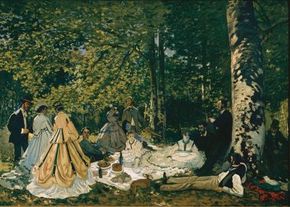
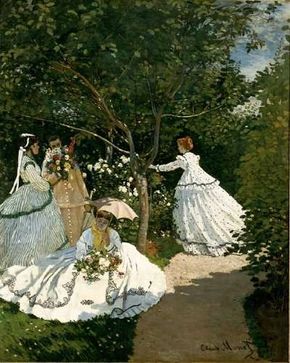
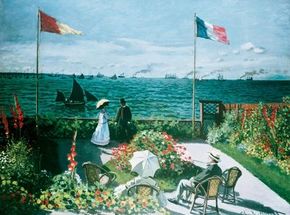
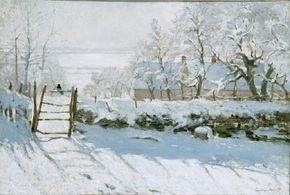
But Monet also responded to another innovative development in the Parisian art world. In works such as Dejeuner sur l'herbe (1866) and Women at the Garden at Ville d'Avray (1866-1867), Monet painted his friends in their fashionable attire, enjoying the pleasures of Paris in the open air. Working outdoors allowed Monet to observe the fugitive effects of light. He adopted a high-keyed palette of brilliant colors, often applied as pure unmixed pigment straight from the tube, as seen in the vivid red, sparkling blues, and cool greens he used in Garden at Sainte-Adresse (1867). His desire to capture the widest range of atmospheric effects inspired him to work outdoors in every type of weather, and, in The Magpie (1868), he explored the subtle tonal variation of low winter light on snow-covered ground.
But the greatest challenge he faced was to express what he called "instantaneity" -- the specific but fleeting appearance of light on a surface in a single moment. He developed a technique that was swift, deft, and spontaneous, using color rather than line and shadow to create forms in space.
Whether painting his wife and son in their garden, the mists and fog over the River Thames, or boats bobbing on the water near the banks of the Seine, the sensations of nature were the sole inspiration of Monet's art.
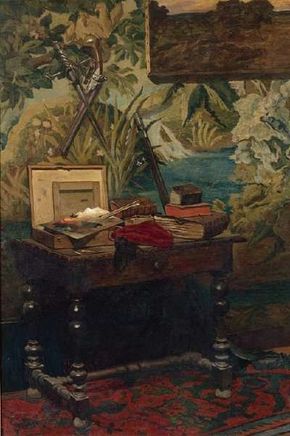
- Corner of the Studio: In Corner of the Studio, Monet traded his usual nature scenes for a look at the gear commonly found in an artist's studio.
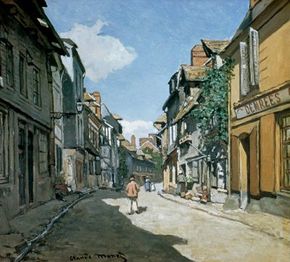
- Rue de la Bavolle, Honfleur: This painting captures the streets of Honfleur, a haven for marine painters.
- Dejeuner sur l'herbe: In this ambitious masterwork, Monet shows figures in contemporary dress enjoying an outdoor setting.
- Women at the Garden at Ville d'Avray: Monet continued to show modern figures on a grand scale in Women at the Garden at Ville d'Avray.
- Garden at Sainte-Adresse: In Garden at Sainte-Adresse, Monet captures motion and color in addition to his family members relaxing on a terrace.
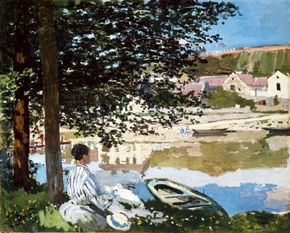
- On the Bank of the Seine, Bennecourt: Monet explored light and reflection in this piece to capture the mood of the setting.
- The Magpie: In this snowy, stark painting, Monet showcases the bright whites and striking contrasts of a wintry scene.
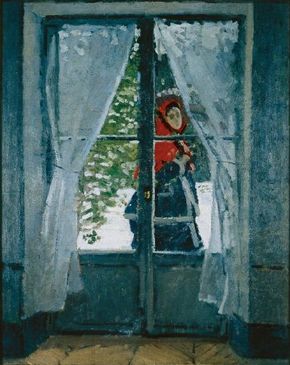
- The Red Kerchief: Portrait of Mrs. Monet: This painting, completed in Argenteuil, shows Monet's desire to capture the simple pleasures of his private life.
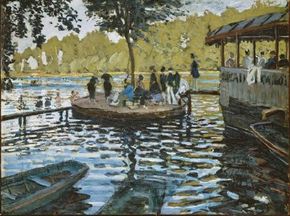
- La Grenouillere: In La Grenouillere, Monet once again shows himself to be a master of portraying the complexities of water using oil and canvas.
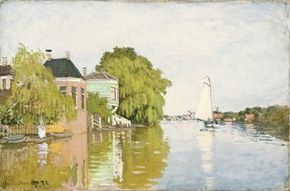
- Landscape Near Zaandam: Landscape Near Zaandam shows a serene marine scene in Holland, where Monet's family made an extended visit.
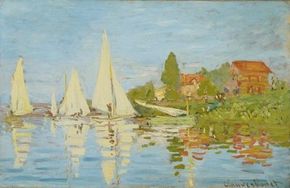
- Regatta at Argenteuil: Like many of Monet's paintings from this period, Regatta at Argenteuil shows familiar subjects found in the town of Argenteuil.
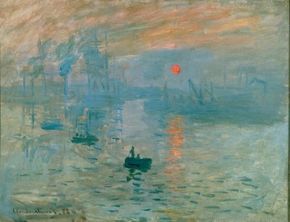
- Impression Sunrise (1872): With this striking painting of a blood-red setting sun, Monet gave a name to the Impressionist movement.
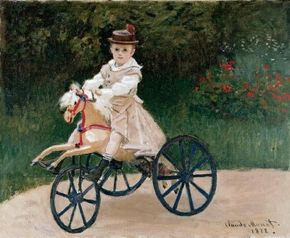
- Jean Monet on His Hobby Horse: Monet often painted members of his family, as in this informal portrait of his young son.
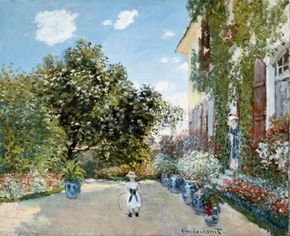
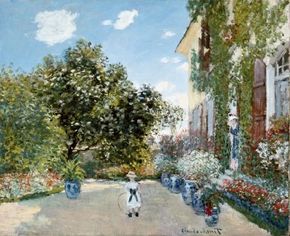
- The Artist's House at Argenteuil: Monet's house in Argenteuil was the setting for many of his paintings during this period of time; his garden was a lifelong passion and favorite painting subject.
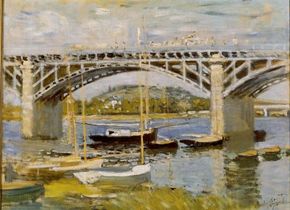
- Bridge at Argenteuil: The contemporary bridge at Argenteuil offended the sensibilities of some, but Monet didn't shy away from painting scenes of the world around him, whatever it might hold.
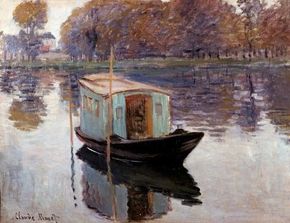
- The Studio Boat: While living in Argenteuil, Monet used this converted boat both as a floating studio and as a subject with which to study light and reflection in his paintings.
Continue to the next page to see Corner of the Studio, a still life in which Monet shows us the tools of his trade.
To learn more about art, famous artists, and art history, check out:
Advertisement