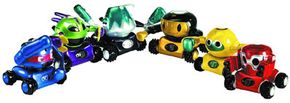
Rumble Robots were one of the most popular toys to hit the shelves in 2001. While there's no revolutionary machinery involved in their design, they do combine several familiar technologies in an innovative way. The main hook of these toys is their gaming element: Players collect special cards to activate different fighting moves and increase their bot's power level.
In this edition of HowStuffWorks, we'll look at the various components that make a Rumble Robot work. As you'll see, the basic elements in a Rumble Robot are simply modified versions of common electronic devices we use on a daily basis.
More Radio and Remote Control Toys
Visit Consumer Guide and check out remote control cars, remote control boats, remote control hovercrafts, remote control tanks, remote control planes, remote control helicopters and even remote control insects. Or build your own with a remote control toy kit.
Most remote control toys are operated by a radio transmitter. When you move the controls, the transmitter sends a radio signal, at a particular frequency, to a radio receiver inside the toy. The radio signal includes a distinctive set of electromagnetic pulses, which represents a particular command. The toy recognizes this command and carries it out. (See How Radio Controlled Toys Work for details.)
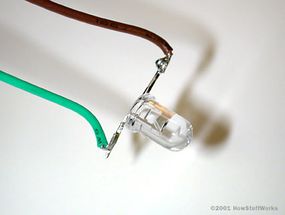
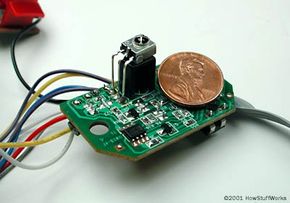
Rumble Robots operate on a similar system, but they use infrared light instead of radio waves. An infrared remote control is like a miniature Morse code lamp. It transmits messages by flashing a small light-emitting diode (LED) in a distinctive pattern of long flashes and short flashes. The infrared light emitted by the LED is invisible to our eyes, but not to the robot's light-sensitive panel. The sensor picks up the signal and deciphers the message.
Advertisement
The LED from a Rumble Robot controller
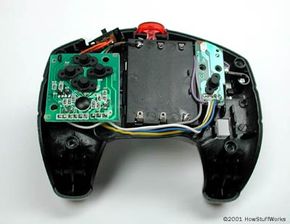
This is the same principle used in standard television remote controls. In fact, the Rumble Robot controller looks a lot like a TV remote on the inside. The plastic controller housing contains:
Rumble Robots (as well as most other modern electronics) use printed circuit boards. A printed circuit board is a thin piece of fiberglass with thin copper "wires" etched onto its surface. These wires connect a number of electrical components together in a complex circuit.
The circuit boards in a Rumble Robot controller include:
A number of transistors, resistors, diodes and capacitors
Several buttons
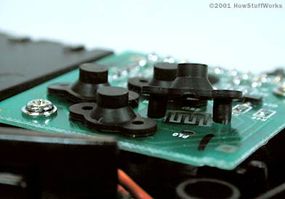
When you move the plastic pads on the controller, they push down on the circuit board's buttons. The buttons are just pieces of rubber that hold small conductive plates. Pressing the button pushes the conductive metal piece up against a contact point on the circuit board. Normally, each contact point is an open section of the circuit between the battery and the integrated circuit. In other words, the etched wires do not connect, so the electric current cannot flow to the microchip. Pressing the conductive plate down on the wires closes the circuit -- the current flows across the plate from one wire to the next, and moves on to the microchip.
When you press down on the buttons in the controller, they complete a circuit.
The integrated circuit sorts out which buttons are depressed, generates an appropriate command signal and passes it onto a transistor. The transistor amplifies the signal and activates the infrared light. The controller will keep sending the signal as long as buttons are depressed.
In the next section, we'll see what happens when this signal reaches the robot's light sensor.
Advertisement
Message Received
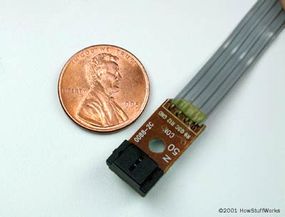
The robot's infrared sensor
In the last section we saw that the Rumble Robot controller transmits commands via infrared light. Each controller has an A setting and a B setting. When you switch between the settings, the microchip changes the flash pattern of the infrared signal.
The robot has A and B settings as well. When you switch the robot from A to B, it will ignore the A-pattern signals, but will register the B pattern signals. If you have two robots of the same model, you have to set one on B and one on A. Otherwise, one controller would activate both of them. Different models use different patterns, to make battling easier.
Advertisement
The central element of the infrared receiver is a small photocell, an electrical component that responds to light. Photocells are one widespread application of the photoelectric effect, the emission of electrons by certain materials in response to certain frequencies of light.
The typical photocell consists of a light-sensitive semiconductor layer, sandwiched between two electrodes. The battery sends a constant electrical current across the two electrodes, whether the photocell is exposed to light or not. When you expose the photocell to the right kind of light, the boost in electrons amplifies the current flowing across the electrons. If the light flashes on and off, the current will increase and decrease in the same pattern. In this way, a photocell translates the light signal into an electrical signal (see How Solar Cells Work for more on this process).
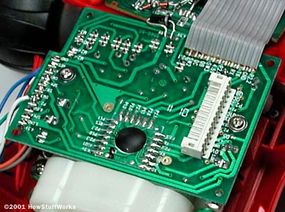
The central circuit board in the Rumble Robot
The electrical signal passes on to the robot's central integrated circuit. Based on the digital pattern of this signal, the integrated circuit carries out certain actions, such as moving forward, turning or throwing a punch. In the next section, we'll look at the components involved in these actions.
Advertisement
Fight the Good Fight
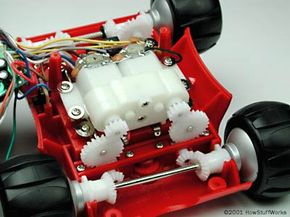
The robot's wheels are driven by two electric motors.
Just like a radio-controlled car, a Rumble Robot has four wheels, which are powered by electric motors. As you can see in the picture below, the Rumble Robot has two driving motors, which spin a series of gears to move the robot’s wheels. These motors are housed in the bottom half of the robot.
When the integrated circuit receives the appropriate signal, it sends an electric current to one or both of the motors. Each motor can spin in two directions, depending on the direction of the current. (See How Electric Motors Work for details.)
Advertisement
By reversing the current flowing to either motor, the integrated circuit can change the robot's direction. If both motors receive positive current, all wheels will spin the same way and the robot will move forward. If both receive negative current, the robot will move backward. If one motor receives positive current and the other receives negative current, the wheels on each side will spin in opposite directions, and the robot will turn. If the currents are then switched for both motors, the robot will turn in the opposite direction.
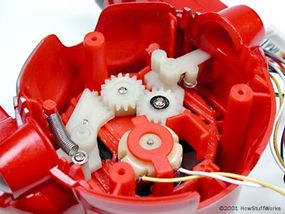
The robot has a third motor in its head that moves the arms back and forth. As you can see in the picture below, this punching mechanism consists of two rack-and-pinion gears. The motor turns the central gear, which turns a connected gear that moves the racks.
The punching gear mechanism in Lug Nut
In this design, the base of each gear is notched on two sides; that is, it has two sections with teeth separated by two smooth sections. The sections with teeth engage the teeth of the racks, which are attached to the robot's arms. When the teeth are engaged, the gear will slide the rack (and the arm) backward. When the gear revolves around to the smooth section, it releases the rack. The racks are spring-loaded, so they punch forward on release.
This is the particular mechanism at work in "Lug Nut." Other Rumble Robots have different punching styles, with different gear arrangements, but the basic elements are fairly similar.
The object of a Rumble Robot game is to get your robot to land effective blows against your opponent's robot. In the next section, we'll see how Rumble Robots register these hits.
Advertisement
A Very Palpable Hit
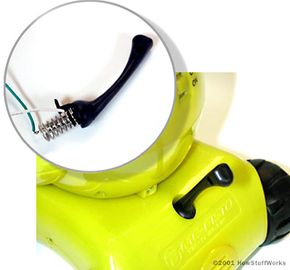
The terminate switch in a Rumble Robot: At the base of the switch, there is a small metal spring surrounded by a larger metal spring. When you press the switch, the two springs come into contact, completing a circuit. Closing this circuit tells the integrated circuit that the robot's switch has been hit.
In a Rumble Robot match, the object is to score hits on the opposing bots. There are three ways to score hits:
Hit the robot's terminate switch - Rumble Robots have a small bumper switch just behind the head. When the robot is pushed against the wall, or when another robot hits it from behind, the switch is pushed closed. This completes a circuit, which tells the integrated controller a hit has been scored.
Tip the robot over - Each robot model has an internal gravity switch. The gravity switch has a pendulum element, which closes an electrical connection when you tilt the robot more than 60 degrees on its side. If one robot knocks another one over, the switch registers a hit.
Drain the robot's power points with your laser - The laser is actually just a light-emitting diode, like the one in the controller. When you pull the fire trigger, the integrated circuit activates this light. Each robot also has a photocell on its base, which works the same way as the one on its head. This laser LED and photocell are calibrated to a different frequency than the controller transmitter and receiver, so the two systems don't interfere with one another. When the laser receiver picks up the infrared from another robot’s light beam, it tells the integrated circuit that the robot has been hit.
The robot's "laser unit": An infrared LED to shoot light beams and a photocell to receive them
To use the laser, enable the punching mechanism or increase a robot's power, players have to collect the right cards. In the next section, we'll see how Rumble Robots read these cards.
Advertisement
Advertisement
Play Your Cards Right
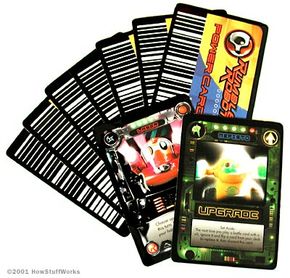
Rumble Robots come with a deck of power cards.
The main thing that sets Rumble Robots apart from other remote control toys are the power cards. Each Rumble Robot comes with a set of power cards, and additional cards are available in separate packs.
By sliding the right sequence of cards through a slot in the robot's head, players can activate the robot's laser defense, punching mechanism, speed and power points.
Advertisement
Each Rumble Robot has a card scanner slot on the back of its head.
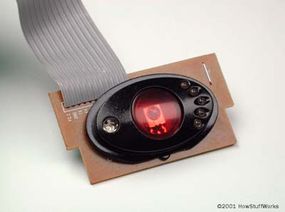
The card reader works just like a barcode scanner at a grocery store. It has a tiny light positioned right next to a tiny light sensor. Each card has a distinctive pattern of black and white lines. When you slide the card through the slot, the beam of light passes over the line pattern. The white lines reflect a lot of light back to the sensor, but the black lines absorb most of the light (see How Light Works to find out why this happens).
The Rumble Robot's barcode scanner
Just like the infrared detector photocell, the scanner sensor translates the light pattern into an electrical signal. The robot's integrated circuit reads this signal and enables the new move or boosts the robot's power level. When the robot is defeated, or the power cuts off, the integrated circuit is reset. It has to "learn" the moves all over again.
With the popularity of Rumble Robots, we're sure to see many similar fighting toys in the future. Like Rumble Robots, these toys will combine a standard remote control system with a host of interactive features. To learn more about Rumble Robots and similar machines, check out the links on the next page.