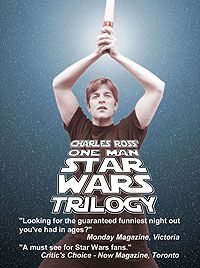
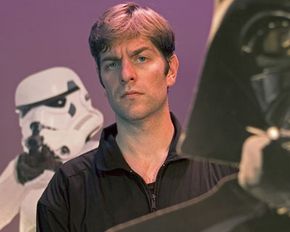
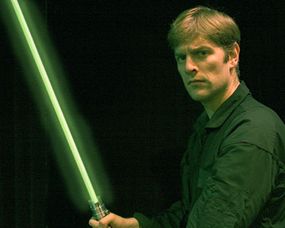
When people hear about Charles Ross and his "One Man 'Star Wars' Trilogy," they often leap enthusiastically to the same conclusion. Surely he's some sort of stereotypical uber-nerd who decided to take his obsession on the road. Even "Star Wars geeks," who might embrace him as one of their own, sometimes wonder whether he's taking his love of the trilogy too far.
But that assumption -- that Ross is a gangly, awkward geek who took a party trick on tour -- couldn't be more wrong. He's a geek, but he's also an actor. He has a Bachelor of Fine Arts in performance, and putting the show together required the same sort of writing, direction and rehearsal that all stage plays do.
Advertisement
We had an opportunity to interview Ross while he was in Stone Mountain, Georgia performing the "One Man 'Star Wars' Trilogy." We invited him to our office, where he answered all our questions about conceiving, developing and touring with the show. In this article, you'll learn about
Ross, his one-man shows and his love for geeks and "Star Wars."
Charles Ross is certainly a "Star Wars" fan. He grew to love the films, particularly "A New Hope, as a child. "If you grew up in a smaller town, which I did -- it was only 90,000 people -- Star Wars played in the movie theater for a year. And it was sold out for at least half a year, every night it was sold out...We tried to go see it numerous times and couldn't get in. My dad was working on condominiums in Waikiki, and every once in a while he'd take us there, so it was in Waikiki that I first saw 'Star Wars.'" When the film aired on television, Ross recorded it. "We only owned three films. We had 'Blue Lagoon,' 'Shogun' and 'Star Wars'...I watched 'Blue Lagoon' a lot of times, too, but I don't think anybody would come out to see a one-man 'Blue Lagoon.'"
In addition to being a lover of 'Star Wars,' Ross is an actor. When he was 17, he quit his job at a 7-11 store to work as a performer. "I was making less money than I'd been making at 7-11, but I was doing Summerstock theater...It was the sweetest check I ever, ever received, and I thought, 'If I can do this and make a living at it, then there's nothing else in the world for me.' Nothing compares."
Advertisement
Ross's desire to make a living in the world of theater led him to study performance at the University of Victoria in British Columbia, Canada. Although he didn't write the "One Man 'Star Wars' Trilogy" until much later, the idea for the show began to form while he was still in college. Conversations and games with fellow student T.J. Dawe eventually grew into the inspiration for the show. While talking about condensing plays down to three minutes, a common task in theater school auditions, the two talked about abridging Star Wars. "Condensing 'Star Wars' down...do you condense it down to a minute? That was the gist of our conversation? Can you imagine trying to make 'Star Wars' into a minute? What would you leave in there? What would you take out?"
The idea for a one-man show also grew, in part, from a Frisbee game. According to Ross:
I think we were trying to add different elements to the game...what we decided we were going to do is...say a line from "Star Wars" and throw the Frisbee. And the next person had to be saying the next line that follows in the film [while] catching the Frisbee. And we played and did this for a long time. Enough so that we realized that, man, we really know this film well.
The conversations and games that eventually grew into the one-man show started in 1994, about seven years before its first performance. Ross wrote the show, and Dawe became its director. We'll look at how the two men pared "Star Wars" down to 58 minutes next.
Charles Ross on Being a Geek
"Part of being a geek in my mind is actually loving something so much, being unabashedly in love with it, in a way that it opens yourself up to ridicule. And there are people that are extremely obvious human beings, and those are the people that bully. They can't allow themselves to be vulnerable. They can't allow themselves to love something and have anybody possibly put them down for it. And it comes from a place of fear, obviously, bullying, but being a geek is, in a sense, being…either envied or feared or just loathed because you've found something you relate to."
Advertisement
Always Two There Are ... a Director and an Actor
Charles Ross: "I've met more Darth Vaders and Stormtroopers and Boba Fetts than you can possibly imagine."
Charles Ross decided to create a one-man show in part because he hoped to find autonomy and success an actor. "As an actor, if people know who you are, then you're a successful actor. You don't have to explain to people who you are or what you do. So I guess I was in the position of working as an actor but not really making any gains [in terms of success]. And I didn't want to...jump into television or film because I think you can kind of get lost in that." A one-man show would give Ross independence and control over the direction of his career. "Making a one-person show was about creating my own work, creating my own niche."
But writing the show wasn't as simple as arbitrarily cutting 321 minutes of material out of the original trilogy. Ross and T.J. Dawe had to work together to create a show that was short, funny and understandable. One person had to be able to perform it alone, without the aid of props, sets or costumes. "The actual feat of doing it is akin to what a child would do when they're playing, if they're acting out 'Star Wars.' You want to tell the story, you want to tell your favorite parts, but you're not going to use any exposition. It's just going to be lines. You are the character."
Advertisement
Ross states that when he sat down to write the show, he wanted to tell the story the way a bard might. He imagined performing the show for people who had never seen "Star Wars," and tried to determine the best way to show them what the trilogy was about. "It wasn't until later that I realized that this is what C-3PO does when he's telling the Ewoks the story...you recognize certain things that he's doing, and that, in essence, is what this show is."
Like most theater pieces, the "One Man 'Star Wars' Trilogy" started with a written script. Ross had a thorough knowledge of the original trilogy already, so "the writing aspect of it took about eight hours [including revisions]." But a script alone wasn't enough. "Eventually I had to get rid of the script and put it on its feet, because the lines are not enough. It's how are you going to be able to act this out...sort of standardizing a way you play as a child."
Once Ross had a sense of what to include in the show, he had to figure out how he would perform each part. "I had to choreograph the show, and that's where T.J. was absolutely instrumental, because I couldn't see myself. I wasn't going to do it in front of a mirror, because then [I'd] spend all of [my] time watching [my]self."
Fortunately, Ross and Dawe didn't have to start from scratch when they choreographed the show. "It's actually framed up so that things on stage happen the way that they actually happen in the film. So it's only a matter of mimicking what's already there. But how do you make a transition [from] lightsaber fighting to kissing? You have to make it, or you have to something to bridge those two jumps."
It took three days of rehearsals, working four to five hours per day, to complete the show. Ross performed while Dawe gave feedback. The final product hits the highlights of the trilogy, but keeps enough detail for the show to make sense. "[The show] doesn't even begin to touch the subtle things that are there, but I don't want to be the films. I mean, the films are going to be what they are...you don't want to supplant the film, you want to emulate it in some way."
Fifteen hours of rehearsal may not sound like much, but the show is extremely strenuous from start to finish. We'll look at what a performance of the show is like next.
More From Charles Ross
In addition to the "One Man 'Star Wars' Trilogy," has written and performs other one-man shows, including "One Man 'Lord of the Rings'" and "One Man 80s Blank Tape." He is currently developing shows that revolve around Muppets and a 7-11 store. He's also considered adapting other trilogies, like "Indiana Jones" and "The Matrix," and hasn't yet dismissed the possibility of either.
Advertisement
A Trilogy at Point Five Past Light Speed
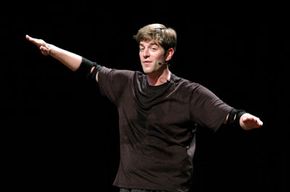
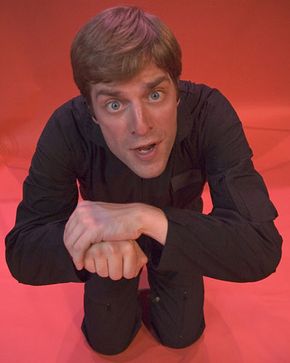
The one-man show has no props, sets or costumes.
Photo courtesy PKF Productions
When developing the "One Man 'Star Wars' Trilogy," Charles Ross briefly considered incorporating props and costumes:
Once you start down that path, forever will it dominate your destiny. If you start with that kind of thing, costumes and sets, it just opens up a whole new world of hurt. And frankly, this show is just extremely portable, in that I don't need a costume, other than I wear black clothes. And I do have a microphone...if it's a big auditorium, it needs to have some sort of amplification. But aside from that, nothing. Just me. And it's great because this show is made to tour.
In addition, one of his goals was to keep everything simple. "Why would you encumber yourself with something that you have to ship around when you're doing a show that's all about paring it down and really just humanizing the whole experience?"
Advertisement
The result is a fast-paced, 58-minute "long-form impression" of "Star Wars," "The Empire Strikes Back" and "Return of the Jedi." Dressed all in black and wearing knee and elbow pads, Ross is on the move from the beginning of the show to the end. He pauses for only a few seconds between each of the three films to get a sip of water. He imitates all of the characters, the score and even the opening crawl of yellow text using facial expressions, vocal impersonations, gestures and movements. It's strenuous -- Ross runs, jumps, leaps and rolls from beginning to end. When the show is over, he's sweaty and exhausted. After a performance in Stone Mountain, Georgia, he said to the audience, "My blood sugar's always a little low [after the show]. It's like I've had a stroke. A stroke of dorkiness."
His impressions of some characters rely more on his hands than his voice. He cups his hands over his ears to represent Leia's earmuff hairstyle, and he puts his hands over his eyes, palms facing out, to suggest Admiral Ackbar's distinctive eyes. To recreate Nein Numb's jowly look, he pulls at his cheeks. Others impressions, like Chewbacca and R2-D2, sound eerily like their film counterparts. "It's kind of a live form of 'Mystery Science Theater 3000,' or something like that, minus the film itself."
Although the show has a set script and choreography, Ross does make some adjustments depending on the audience. "It calls on different things you develop when you're an actor. Sometimes you develop a bag of tricks, as they call it, so while you're in front of a live audience, when certain things happen or certain things don't happen, you know how to adjust what you're doing to compensate for it, to draw people in. If it's a group of kids, it's going to be different than a group of seniors."
He also has fun with the audience, taking advantage of opportunities that present themselves during the course of the show. "If somebody's cell phone goes off or they get up to go to the washroom at the wrong time, I react to it. It also helps...that I've been doing the show for long enough to be able to deal with stimuli other than the stimuli that should be there. It actually kind of makes it fun for me, and that's the only way I think I've been able to continue doing the show for as long as I have." For example, at the same Stone Mountain performance, a train passed by the theater just as R2-D2 and C-3PO reached Jabba's palace. Ross quipped, "We could have taken the train."
It's a quirky show that simultaneously pays homage to and satirizes the trilogy, particularly its more memorable moments:
Some people love ["Star Wars"] in the way that you love a parent that maybe annoys you. It springs from a place of love, and so you make fun of them for the way they put things all the time or the way they always get on your case...but it's part of what you love. So that's, I think, part of the point where we can laugh, because we love it, but because it annoys us or we've always thought about it before. It's like observational humor, but instead of making an observation, you're accentuating what's already there.
Even though the show itself is playful and Ross has fun while performing, touring with the show is work. Next we'll take a look at what happens on tour.
Thoughts on the Emperor
When asked about his favorite moments in the show, Ross talked about the Emperor's role in the trilogy: "To me, [the Emperor] is the perfect introduction. We have a little introduction of him in Empire, and you hear about him in [A New Hope], so it's kind of like the rule about having a gun on stage. If you see a gun onstage, it's going to be used in the show at some point. And if you consider Star Wars not as three separate films but as one piece of work, you hear about the Emperor, you see him for the first time, and then he arrives. So, it's like the gun. You see it, you hear about it again, and then finally it comes out…He's a devastating character."
Advertisement
Being on Tour Ain't Like Dusting Crops
Charles Ross as Luke Skywalker after losing his arm in Cloud City.
Photo courtesy PKF Productions
Charles Ross performed the "One Man 'Star Wars' Trilogy" for the first time in Toronto, Ontario in January 2001. Since then, he has spent a lot of time touring, mainly in the United States and Canada. Ross has refined the show a little in that time and added a few lines to take advantage of events in the original trilogy that are explained more fully in "Revenge of the Sith."
The show is immensely portable, but touring with it takes a lot of work. In the theaters, Ross works with technical staff to light the stage and test the sound. But he also spends a lot of time outside the theater, doing interviews to publicize the show. On the day he visited our office, Ross woke well before dawn for a radio interview. He'd performed the show the night before, and he had another show to perform that evening, plus other interviews during the day.
Advertisement
Performances are fun, but "if the audience is not getting it, it does very quickly become work. Whereas if the audience is getting it, there's just nothing like it." Even when they run smoothly, the shows themselves require a lot of physical effort. To stay healthy while performing, "You don't smoke, you don't drink...you've got to watch what you eat, which is kind of weird. I know my calorie intake
is very different when I'm doing the show and when I'm not."(Ross runs, dives, jumps and pauses throughout the show, much like a person does while playing baseball. Using that comparison and adding the energy used for speaking and singing, we estimate that he burns a minimum of 400 calories during the show.)
After the show is over, Ross usually goes back to his hotel room to recover. After the show, Ross rests and calls his girlfriend:
For me, that links me back to what my life actually is. And in a way it's almost like having two lives. There's the life where you're off on your own touring around doing the show and trying to sustain your pep and your spirit...It's kind of a weird mix between trying to keep positive and keep out there and keep doing the show when so much in your heart you just want to be home. You almost want to have a normal life. So, it's a strange dichotomy.
Sometimes, his girlfriend is able to tour with him, "and that's fantastic, because that's a wonderfully grounding thing. I mean, she for me is my home."
But even though it's caused some homesickness, touring has also allowed Ross to have some pretty amazing experiences.
From Han and Leia to Darcy and Elizabeth
"I think there are certain fan bases out there that would be amazing to try to tap into," says Ross. "I don't mean tap into [in] a money sense, but to be able to find out they're there by doing something like the 'One Man "A&E's Pride and Prejudice"' or something like that. Because I love that, that whole series is fantastic, but would it work? I have no idea."
Charles Ross's show has gone from a piece performed mostly at fringe festivals to a touring show with sold-out crowds and television appearances. He's been on NBC's "Late Night with Conan O'Brien" and CBS's "Late Late Show." Sir Ian McKellen attended one of his performances of "One Man 'Lord of the Rings'" and wrote about it in his blog, and Ross performed the show for Vin Diesel and the rest of the cast on the set of "The Chronicles of Riddick."
Ross has also performed the show at large gatherings of "Star Wars" fans. He was the emcee and entertainer at the Third Annual "Star Wars" Fan Film Awards at Comic-Con in 2004. He also performed "One Man 'Star Wars' Trilogy" at Celebration III, an enormous, official party for fans before the release of "Revenge of the Sith" in 2005. "That was extremely rewarding in so many ways. That, honestly for me, has been the best experience with this show that I have ever had. And not to take away from all the other shows I've had. It was just from a sheer size, 3,500 people...They are just fantastic."
Advertisement
It may seem odd that a one-man satire could end up being performed at an official event. Ross suspected initially that Lucasfilm might someday shut his show down. But instead of a cease and desist order, Ross received a license from Lucasfilm to perform the show. "If anybody was ever to try to do something like I've done here, I would highly recommend that you go to the source, the company, the person that owns the right to it, first of all. I didn't think this show would be...as successful as it is. And out of success breeds the necessity for things like a license."
So far, Ross's idea of taking control of a career with one-man shows has worked -- he makes his living performing the show. "It all comes down to how much do you really need to get by? What kind of stuff do you have to pay off? What kind of stuff do you own? There was a time when I was nothing but in the red, and I've been in the black for five years now. And it's not just due to the Star Wars show, it's just due to I think an attitude...don't take on any more than you can handle, even if it means you're still taking on a lot."
Ross plans to keep touring with his show "until people get bored or I grow too old and feeble." At that point, he might seek permission to distribute the show on DVD. He'd need additional permission from Lucasfilm to do it.
Check out the links that follow for more information.
Critical Views
Theater critics don't always appreciate "One Man 'Star Wars' Trilogy," and sometimes they go so far as to criticize the audience as well. But fans of the films tend to enjoy themselves. "If I come to a town where people are just theater-goers and they're not really 'Star Wars' fans, they'll come and see it for its theatrical aspects," Ross says. "But are they going to get it the same way that a 'Star Wars' lover would? Probably not. But it is made for 'Star Wars' fans."