Introduction to How Olympic Timing Works

stopwatch
2008 HowStuffWorks
A stopwatch used to measure time. See more Olympic pictures.

Olympic timing technology has come a long way since the last time the Olympic Games were held in Athens, Greece. More than 100 years later, the site of the first modern Olympics is trading stopwatches for a selection of high-tech timekeeping devices including high-speed digital cameras, electronic touch pads, infrared beams and radio transmitters, just to name a few.

Thanks to today's advanced timing technology, Olympic athletes can win or lose by a margin of only 1,000th of a second -- 40 times faster than the blink of an eye. Such accuracy requires first-rate technology, and currently only two companies in the world meet the standards of the Olympic Committee. Omega is Official Timekeeper of the 2006 Winter Games in Torino, Italy (it also held that title for the 2004 Summer Games in Athens, Greece). This title means the company provides technology and personnel for the timing of more than 150 events during the biennial competitions. The other company, Seiko, held the title during the 2002 Winter Games in Salt Lake City, Utah.

In this article, we'll look at the mechanics of determining split-second wins and false starts, as well as methods of instant scoring. We'll also recount some of the technological breakthroughs that made it all possible.

­

Sport by Sport: Winter Games

The Olympic Games are held every two years, alternating between summer and winter athletic events. Because of the distinctions between these events -- from distance considerations to weather concerns -- the timing technology can vary greatly from sport to sport. Let's start with winter events.

Sledding

Photo courtesy USALuge.org

Because Olympic sledding competitors travel at speeds up to 90 miles per hour (145 kph), they win by some of the narrowest margins. When accuracy to the 1,000th of a second or better is key, and timing equipment has to withstand temperatures as low as -30 degrees Fahrenheit (-34 C), special technology is required.

The starting and finish lines at sledding events are equipped with a 0.5-inch to 1-inch infrared beam, which is focused at a receiver that starts or stops the clock when the beam is severed. Laser technology, while effective in the track environment, was replaced by infrared beams for the 2002 Olympics in Salt Lake City after research revealed that falling snow often tripped the laser beam and frost clouded the electric eye, reducing accuracy.

Speed Skating
The timing technology for speed skating is much like that of short-distance track events. The clock is started by the starting gun, and an electric eye sends a signal to the timing computer when each competitor crosses the laser beam at the finish line. Because speed skaters reach speeds up to 30 miles per hour (48 kph), and a skater can win by as little as the tip of a boot, two slit video cameras scan the finish line, time-stamping each image at 2,000 frames per second and sending the complete image to the judges to help determine the winners.

Skiing
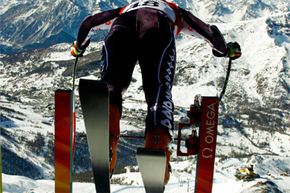
Downhill skiing competitors begin their races at starting gates. When these gates open, they send an electronic signal to the timing console to start the clock. Like in the sledding events, an infrared beam is tripped at the finish line to stop the clock.

For the long-distance skiing events, such as cross-country and Nordic, RFIDs attached to each skier's boot send individual signals to antennas buried beneath the snow at the starting line, finish line and points in between. In this way, a skier's starting time, finishing time and progress are all tracked, recorded and broadcast, taking any time penalties into consideration.

Sport by Sport: Summer Games

Check it Out!
Look through the eyes of the photo-finish camera -- check out the FinishLynx simulation at the Lynx System Developers Web site.

Track
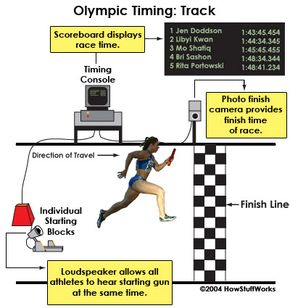
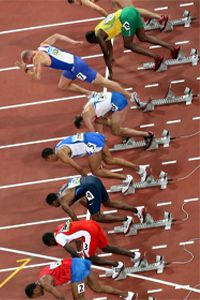
In sprint races like the 100-meter dash, which can last as few as 10 seconds, timing is of the essence. Therefore, every aspect of timekeeping is electronic, even the starting gun.

Once the runners are crouched with both feet on the pads on their starting blocks, a timing official pulls the gun's trigger, sending an electrical current through the attached copper wire cable to the starting blocks and a separate timing console. The current sets off a quartz oscillator in the timing console, while the sound of the gun is simultaneously amplified through speakers on each runner's starting block (so all competitors hear it at the same time).


At the other end of the race, a laser is projected from one end of the finish line to the other, where a light sensor, also known as a photoelectric cell or electric eye, receives the beam. As a runner crosses the line, the beam is blocked, and the electric eye sends a signal to the timing console to record the runner's time.


Photo courtesy Omega


Photo courtesy Omega

Meanwhile, a high-speed digital video camera aligned with the finish line scans an image through a thin slit up to 2,000 times a second. When the leading edge of each runner's torso crosses the line, the camera sends an electric signal to the timing console to record the time. The timing console sends the times to the judges' consoles and an electronic scoreboard. The images themselves are sent to a computer, which synchronizes them with the time clock and lays them side-by-side on a horizontal time scale, forming a complete image. The computer also draws a vertical cursor down the leading edge of each runner's torso at the time the finish line was crossed.

This composite image can then be broadcast on a video display within 30 seconds of the race's end to help make a decision on a close finish.


Photo courtesy Omega

In longer races, such as the marathon, the clock is still started with an electric gun. However, the large number of competitors makes it impossible for all the runners to leave the starting line simultaneously, and dozens of runners can cross the finish line at a time. Because of these considerations, marathons require a more individual system of timing -- radio-frequency tags (RFIDs).

Small RFID transponders are attached to each runner's shoe, sending out a unique radio frequency. Have you ever noticed the mat that stretches over the starting line at a marathon? It contains loops of copper wire than function as an antenna, picking up each runner's signal and sending the identification code and start time to the timing console. Mats are placed at 5-kilometer intervals to track each runner's progress, automatically displaying the best times on the scoreboard. Another mat is placed at the finish line to record each runner's finish time. Each competitor's time is then compared with the time clock, which was initiated by the starting gun and stopped running when the first runner crossed the finish line.

This technology is also used at the Boston, New York City and Los Angeles marathons, provided by companies such as Texas Instruments.

Cycling
Because cycling events face timing challenges similar to that of marathons, the technology is much the same.


Photo courtesy Athens News Agency

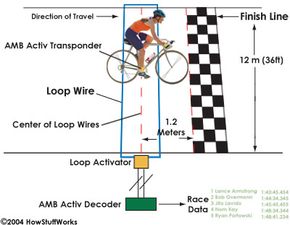
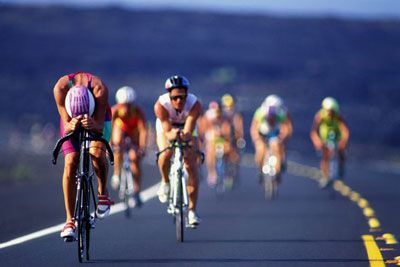
A radio transponder, attached to each bicycle behind the leading edge of the front tire, emits an identification code to antennas placed at the starting line, finish line and along the road. These antennas register each rider's time and send it to the timing console for comparison. Up to three high-speed photo-finish cameras are set up at the finish line, including above the track, to provide a time-sequenced visual record of the winners, including a vertical cursor delineating the front edge of each rider's tire, to be used in case of a close finish.


This technology is also used at cycling events such as the Tour de France, provided by Matsport out of Grenoble, France.

Aquatics
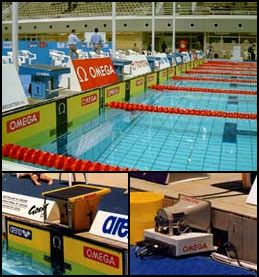
Similar to the short-distance track events, each swimmer's starting block has an attached speaker to announce the activation of the clock by the timing official, or starter. In an event like the relay, the swimmer in the water must "tag" the next teammate by pressing on a touch plate located on the pool wall. The contact plates -- made of thin stacks of PVC and horizontal strips that register focused pressure (as from a swimmer's hand) but not dispersed pressure (as from waves in the pool) -- then send a signal to the timing computer to record the first swimmer's time, denote the start of the second swimmer's time and report the time to the scoreboard.


Photo courtesy Omega
Clockwise from top-left: Starting blocks; speaker; starting block and touch pad

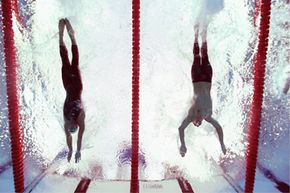
The process works the same for the individual events such as breaststroke, freestyle and backstroke, during which the swimmer registers his or her time by pressing on the contact plate at the end of the run. Aquatics also use photo-finish technology similar to track events, recording an image of the finish at 100 frames per second.


Photo courtesy Athens News Agency

Keeping it Real

Although most times are only published to the 100th of a second, Olympic timing standards require that timekeeping be accurate to the millisecond. With such a small margin of error, timekeepers must plan for the worst. Here is how timekeeping officials keep the scores accurate:


  • Photo courtesy USALuge.org
    "Smart" systems - In case a cable is cut or a piece of equipment stops working, each timekeeping system has up to four back-up systems. These systems kick in automatically when a piece of equipment fails so that no scores are lost (there are no "do-overs" in an Olympic event). Some redundant systems back up the data by printing it out on a time-synchronized printer, while others ensure that times can still get to the audience and the media via scoreboards and the Internet. In addition, the laser and infrared beams at starting and finishing lines are not steady; instead, they quickly flash on and off so as not to be tricked by changes in background light or falling snow. A signal is sent to the clock only after the beam is blocked for several pulses in a row.

  • False-start fail-safes - Because many athletes "jump the gun," timekeepers must also be referees of a sort to preserve the accuracy of competitors' scores. Scientists have measured that an average human takes one tenth of a second to react to a stimulus, such as the starting gun; in the Olympics, there is a system that stops the clock if an athlete starts sooner than a tenth of a second after the signal is given, because this means he began to "react" before the gun was fired.

    To measure this, the starting blocks used in both track and swimming events have electronic pressure plates where the athlete's feet rest. At the first sign of pressure (when the competitor pushes off), the starting block sends a signal to the timing console. If the reaction time is determined to be less than one tenth of a second, the clock is stopped and an alarm is sent to the timing official's headphones to restart the race. Often, the competitor who started prematurely is disqualified. In aquatic relay events, reaction time is analyzed not only at the start of the race but also as each swimmer "tags" his or her teammate. If the tagged swimmer leaves the starting block less than one tenth of a second after the first swimmer touches the contact plate in the water, the second swimmer is disqualified for a false start. In both cases, high-speed video cameras also record the action on a horizontal time scale in case of any disputes.

  • Disputes and development - Because the official Olympic timekeeper provides heavily redundant systems and multiple timing devices with both numerical and visual data, timing disputes are usually solved quickly by analysis. However, when a valid complaint is made, this almost always leads to research and advancement of the existing timing technology. For instance, after Silke Kraushaar's gold-medal luge win in 1998, it was discovered that the photoelectric sensors had a margin of error of exactly two milliseconds -- the span of time Kraushaar won by. In response to concerns about the system's accuracy, then-U.S. Olympic Committee Principal Engineer Tom Westenburg developed the high-modulation, triply-redundant system in current use, which is accurate to less than half a millisecond.

Olympic Timing History

Although the history of the Olympic Games stretches back as far as 776 B.C.E., the history of Olympic timing technology began just over 100 years ago. These are the major breakthroughs:

  • 1896: Athens, Greece

    • First "modern" Olympic Games
    • Stopwatches used to determine winners' times

  • 1912: Stockholm, Sweden

    • Electrical timing and photo finish first used

  • 1920s: Antwerp, Belgium; Paris, France; Amsterdam, Holland

    • Chronographs first used to measure to the 100th of a second

  • 1932: Los Angeles, California

    • Omega, currently a member of Swatch Group, named the first Official Timekeeper of the Olympic Games (The watch company, a favorite of James Bond, holds the record with 22 designations as Olympic timekeeper.)
    • "Kirby camera" introduced, which simultaneously photographed the finish line and a chronometer to time-stamp each shot

  • 1948: Saint Moritz, Switzerland

    • Cellular photoelectric eye first used
    • Slit camera used for photo finishes

  • 1952: Helsinki, Finland

    • Omega Time Recorder first to use a quartz clock and print out results, earning the company a prestigious Cross of Merit from the Olympic Committee
    • Clocks added to slit cameras for automatic time-stamping, accurate to the 100th of a second

  • 1964: Tokyo, Japan

    • Competitors' times first shown live on television
    • Seiko, designated for the first time as Official Timekeeper of the Olympic Games, links the starting gun with a quartz clock and photo-finish camera

  • 1968: Mexico City, Mexico

    • Contact plates first used to time aquatic events

  • 1972: Munich, Germany

    • Reaction times first measured and taken into consideration during timing
    • Official times recorded to the 100th of a second rather than the 10th of a second

  • 1976: Montreal, Canada

    • Electronic scoreboards used for display of real-time scores

  • 1988: Seoul, Korea

    • Officials process the timing data for the first time in addition to recording it

  • 1992: Albertville, France

    • Electronic photo-finish technology fully integrated with timing systems

  • 1996: Atlanta, Georgia

    • Radio transponders first used in cycling and marathon events

  • 2002: Salt Lake City, Utah

    • Infrared beams replace photoelectric cells in sledding events
    • Radio transponders first used in long-distance skiing events

  • 2004: Athens, Greece

    • Photo-finish takes 1,000 pictures per second
    • Radar guns added to beach volleyball

For more information on Olympic timing technology and related topics, check out the links on the next page.

Lots More Information

Related HowStuffWorks Articles