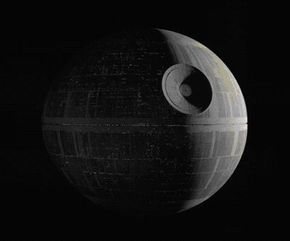
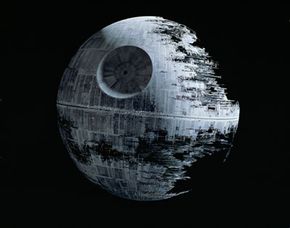
The Death Star battle station was the brainchild of Imperial bigwig Grand Moff Tarkin. It was the centerpiece of Tarkin's Doctrine of Fear proposal that created sweeping reform in the structure of the Empire. It was also the final step in solidifying the Emperor's total authority.
The largest change to the Empire made by the Doctrine of Fear was the dissolution of the Imperial Senate. Tarkin's policy put power directly in the hands of the regional governors. The governors, who ruled over several planetary systems, now answered directly to the Emperor under the Doctrine of Fear. This new organization greatly reduced the bureaucracy in the Empire and greatly increased the power of regional governors like Tarkin.
Opponents to the Doctrine of Fear (and there were many in the Empire) claimed that this new policy would rip the Empire apart and that planets would revolt without direct representation in the Senate. Tarkin's answer to any potential dissonance was the Death Star.
Tarkin intended to make an example of a rebellious system as soon as the Death Star was capable. He believed that after the total annihilation of a planet, fear would spread throughout the galaxy and maintain order.
The development and construction of the Death Star had begun long before the first debate ever took place about the Doctrine of Fear. In fact, the Doctrine of Fear was ratified by the Emperor the very same day the second successful firing of the Death Star destroyed the planet of Alderrann.
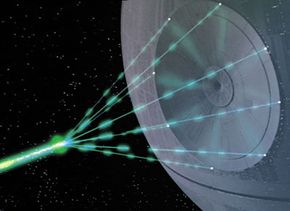
Visionary scientists and engineers like Qwi Xux, Tol Sivron and Bevel Lemelisk were conscripted by the Empire to develop the space station. They all worked in a top secret facility, code-named Maw, hidden deep in one of the most inhospitable regions of the galaxy. A prototype Death Star was built at Maw but was little more than a spherical frame with an untested Superlaser. It was much smaller than the Death Star would eventually be and had no propulsion system.
The construction phase of the Death Star project took place in orbit around the planet Despayre and was primarily handled by defense contracting company Sienar Systems. Sienar had worked on a prototype of a similar space station many years earlier for the CIS, was contracted by Tarkin to do work on the Death Star project. (It should also be noted that Sienar Systems CEO Raith Sienar was "coincidentally" an old friend of Grand Moff Tarkin).
For years, the Empire used prison labor to mine Despayre for materials. Prison laborers also handled the more menial and dangerous aspects of the station's construction.
The inspiration for the Death Star came from a Separatist super-weapon called the Great Weapon. The Great Weapon was a moon sized-space station with a large laser cannon developed by the Trade Federation, Geonosians, and Techno-Union for use in their war against the Old Republic. It was never put to use and was captured by the newly formed Empire after the Clone Wars. The Great Weapon was never completed.
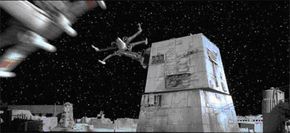
The original Death Star was destroyed in the Battle of Yavin by rebel pilot Luke Skywalker. Skywalker fired a proton torpedo into a reactor vent shaft. The ensuing chain reaction caused a critical overload of the reactor, destroying the entire station and killing everyone aboard.