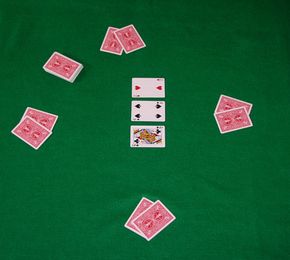
Whenever there's money involved, there are people willing to cheat. When poker was first played on Mississippi riverboats, it was often referred to simply as, "the cheating game." So it should come as no surprise that cheaters have gone to great lengths over the decades to give themselves an upper hand. Many cheating methods require a confederate, a partner at the table to help you put the plan into action. Usually, the dealer must be involved; considering the surveillance in place at modern casinos, finding a crooked dealer there is increasingly rare. However, at a less formal poker game, where the actual dealer rotates around the table, the two cheaters simply have to wait until one of them has the deal to put the plan into action.
Second Dealing and Bottom Dealing
This cheating method requires a lot of practice to be done effectively. Second dealing is the more useful and common of the two, although dealing from the bottom of the deck is probably more famous.
In second dealing, the dealer appears to deal normally form the top of the deck. In truth, the dealer is sliding a card underneath the top card and dealing that card, while holding on to the top card. The top card might be marked, or the dealer might have slipped it on top with a false shuffle. Either way, the dealer's goal is to get that top card to the cheating partner, who will then use it to win the hand.
Marked Cards
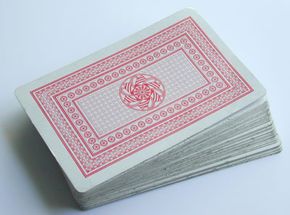
Cards are marked in many ways, but the intent is the same -- to allow a player to identify a card without seeing its face. Sometimes a fingernail or small metal piece is used to make an indentation on the corner of a card during a game. A small piece of charcoal or pencil lead can also be used to put a tiny smudge on a card back. Sometimes, the cards are marked elaborately before the game, with subtle alterations of the pattern on the card back. They might be trimmed and shaved along the sides, so that one card, or one rank of card (the Aces, for example), can be found by the dealer by simply feeling along the edge of the deck.
Shiners
A shiner is something reflective that a player can use to see the face of a card, usually when it's being dealt. Shiners might be found on rings, cigarettes, fingernails, or an ashtray on the table.
Holdouts
A holdout is any device used to secretly bring a card from outside the game into the player's hand. Often, the cheater will pull the card out of the game and into the holdout for later use, to be sure the holdout card matches the rest of the deck being used. These can be placed inside sleeves ("an Ace up your sleeve," and "What have you got up your sleeve?" -- two more expressions for which we can thank the world of poker), under the table, on a chair, or in a player's shirt. Some are elaborate mechanical device; some are simply a pocket where the cheat can store the card using slight of hand.
False Cuts and Shuffles
These are methods by which the dealer appears to randomize the deck through cutting and shuffling, but in reality is manipulating the deck for his own benefit.
Cold-decking
To cold-deck means to secretly slip a stacked deck into the game, replacing the real deck.
Collusion
This form of cheating requires at least two partners and a series of signals. The cheats use their signals to let each other know what they're holding, and use this information to deceptively run up the bets of the other players.
In the next section, we'll look at how to stop a cheat.