By: Kevin Bonsor & Dave Roos
|
Updated: Mar 17, 2023
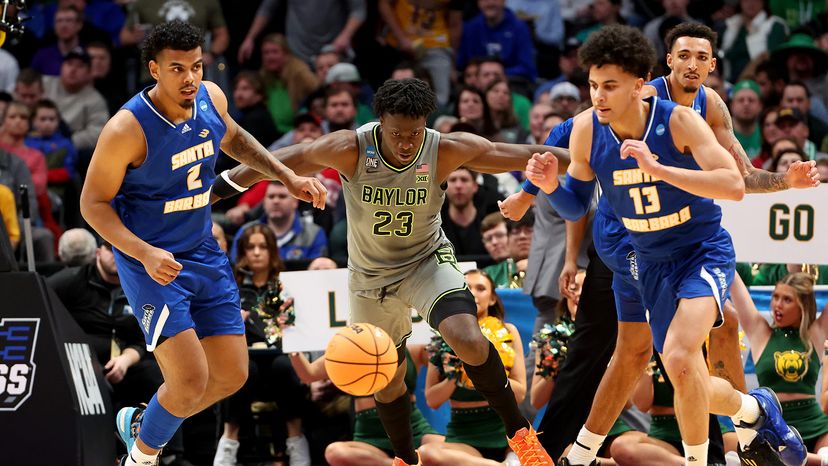
Jonathan Tchamwa Tchatchoua, No. 23 of the Baylor Bears, races after a loose ball against the UC Santa Barbara Gauchos during the first round of the 2023 NCAA Men's Basketball Tournament (aka March Madness) held at Ball Arena on March 17, 2023, in Denver. Justin Tafoya/NCAA Photos via Getty Images
March Madness is a phenomenon that grips the national sports psyche from the second week of March through the first week of April. March Madness is the moniker that is given to the National Collegiate Athletic Association (NCAA) Men's and Women's Basketball tournaments. These tournaments determine the national champions of college basketball.
The men's and women's NCAA basketball tournaments are beloved American sports traditions that send millions of college basketball fans into a synchronized frenzy each year. These are single-elimination tournaments, which means that the championship team has to win at least six games in a row to claim the title. One loss and you're going home.
Advertisement
It's this high-stakes environment — plus the chance to witness a crazy "Cinderella-story" upset — that gives the tournament its March Madness nickname. March Madness is the concentrated hype of 68 men's teams and 64 women's teams vying for college basketball's biggest prize. It's the last-second, buzzer-beating baskets, the euphoria of winning to play another day or the agony of your season coming to an end.
In this article, we'll break down the brackets of the NCAA Basketball Tournament and look at how teams are selected, how they are seeded and how the champions of college basketball are determined.
Ohio State center John Schick makes a basket during the first NCAA Men's Basketball National Championship game held in Evanston, Illinois in 1939. Oregon defeated Ohio State 46-33 to win the first title. NCAA Photos via Getty Images
A single governing body, known as the National Collegiate Athletic Association (NCAA), is charged with overseeing the 1,098 voluntary college and university members that comprise the association. Representatives from the member schools help draft the rules of NCAA competition, and a national NCAA office operates all championships, including March Madness [source: NCAA].
The NCAA member schools are divided into three divisions depending on certain factors like school size, athletic budgets and overall competitiveness. In addition, each division has its own rules for member schools [source: NCAA]:
Advertisement
Division I: These schools must sponsor at least seven sports each for men and women, or six for men and eight for women, with two team sports for each gender. Men's and women's basketball teams must play all but two of their games against Division I teams, and men must play a third of their contests in their designated home arena. Schools have a minimum and maximum number of scholarships they can award. Of the three divisions, Division I is the most prominent and receives the most publicity. The schools in Division I tend to the largest ones and with the largest athletic budgets, often because of lucrative media contracts. Some 350 schools are in Division I, including Duke, UCLA and the University of Kentucky.
Division II: These schools must sponsor at least five sports each for men and women (or four for men and six for women), with at least two team sports for each gender. Men and women's basketball teams must play at least half of their games against Division I or Division II schools. There are no minimum home game requirements for this division. Most of the 310 schools in Division II have enrollments of less than 8,000 students, like Lynn University in Florida. Student-athletes usually receive partial athletic scholarships. There is an emphasis on regional competition in order to reduce missed class time.
Division III: These schools must sponsor at least five sports each for men and women, with two team sports for each gender. Unlike Divisions I and II, Division III schools do not offer athletic scholarships. Division III is actually the largest division of the NCAA, with more than 438 schools participating. Playing seasons are shorter to allow more time for academics. Universities such as Johns Hopkins and Emory are in Division III.
Since the Division I Men's and Women's Basketball tournaments are the most prominent, and the format for all of the tournaments is the same, the rest of this article focuses on the Division I tournament.
Advertisement
The Source of March Madness
Legendary University of Tennessee head coach Pat Summitt urges on her team while they play Michigan State during the semifinal game of the NCAA Women's Final Four tournament in Indianapolis in 2005. John Gress/Icon SMI/Icon Sport Media via Getty Images
Today,the term March Madness is synonymous with the NCAA Basketball Tournament, but the nickname was first used to describe another basketball tournament — the annual Illinois High School Association tournament. Coach and educator Henry V. Porter is credited with coining the phrase in a 1939 essay for the Illinois Interscholastic magazine, titled "March Madness" [source: IHSA].
Describing a typically "afflicted" basketball fan, Porter wrote:
Advertisement
"In everyday life he is a sane and serious individual trying to earn enough to pay his taxes. But he does a Jekyll-Hyde act when the spell is on him ... The thud of the ball on the floor, the slap of hands on leather, the swish of the net are music in his ears ... He is biased, noisy, fidgety, boastful and unreasonable — but we love him for his imperfections ... The writer's temperature is rising. The thing is catching. It's got me! Gimme that playing schedule!"
The nickname March Madness was picked up by Illinois sportswriters, who embraced the new moniker throughout the "Golden Age" of the Illinois high school basketball tournament in the 1940s and 1950s [source: IHSA].
March Madness was not used to describe the NCAA Tournament until 1982, when Brent Musburger, a CBS reporter, used the term during the telecast of a tournament game. Musburger said he got the name from a Chicago auto dealer who did announcements for the local high school tournament [source: Heck]. College basketball fans and the media have been using the term ever since.
Today, after a court battle over the ownership of the term, March Madness is co-owned by the NCAA and IHSA through the March Madness Athletic Association.
Advertisement
Tickets to the Big Dance
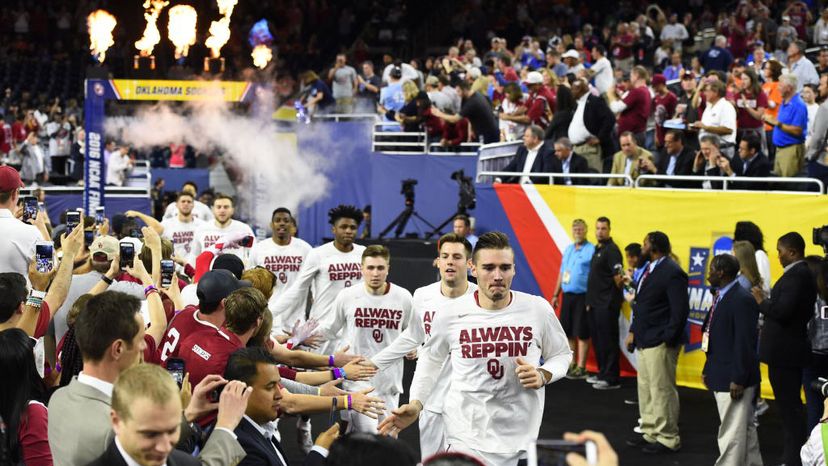
The University of Oklahoma team enters the court before the 2016 NCAA Men's Division I Basketball Championship Final Four held at NRG Stadium in Houston. Brett Wilhelm/NCAA Photos via Getty Images
In 2022-23, there were 350 men's teams and 348 women's teams in Division I college basketball (two military colleges only have men's teams) and each team begins every basketball season with one dream — winning the national championship. But before these teams can win the tourney, they must make the field of teams that are invited to the tournament. Only 68 men's teams and 64 women's teams are granted invitations to what's often called the Big Dance.
A selection committee that comprises different university athletic directors and conference commissioners chooses teams for both the men's and women's tournaments. Each tournament has its own committee. The selection committee meets between the Thursday and Sunday before the date picked for the tournament's first game. Its job is to figure out the teams deserving of an invitation. The decisions are announced on television during Selection Sunday.
Advertisement
Thirty-two teams receive an automatic invite to the tournament, which is their reward for winning their respective postseason conference tournaments. The remaining invites, 36 for men and 32 for women, are left in the hands of the selection committee. Of the teams left in the pool, certain teams are assured a spot in the tournament, others don't make the cut, and then there's a third group, called bubble teams, that could go either way.
How March Madness Teams are Picked
The 10-member men's and women's selection committees are sequestered in a hotel during the selection process, not unlike a jury for an important court case. Members must weigh the evidence provided to them though certain criteria. During the selection process, each member must submit a list of teams that should, without a doubt, be in the tournament. This list cannot include the school that the member represents. If eight members put a team on their list, that team is put into the field of tournament teams.
Here are some of the criteria the selection committees rely on:
Advertisement
Ranking in national polls
Conference record
Road record
Wins versus ranked opponents
A team's regular season record
Replacing the Rating Percentage Index (RPI) is the NCAA Evaluation Tool, or NET, where the committee takes into account game results, the strength of a team's schedule, game locations, scoring margin, and net offensive and defensive efficiency. The scoring margin is capped at 10 points to prevent unsportsmanlike play, such as running up the score in a game which is already lopsided [sources: NCAA, NCAA].
The Women’s Basketball Committee still uses the RPI. The RPI is calculated as 25 percent of a team's winning percentage plus 50 percent of its opponents' average winning percentage plus 25 percent of the opponents' opponents' average winning percentage. A team's winning percentage is determined by dividing a team's wins by the number of games it has played [source: RPIratings.com].
For those teams that aren't invited, there is no appeals process. The committee's decisions are final. The only conciliation for these teams is the possibility of playing in the National Invitation Tournament (NIT), which invites another 32 teams for postseason play. The Women's NIT — which is not run by the NCAA — invites 64 teams [source: Women's NIT].
Now that you've learned how teams are selected, let's go to the next section and look at how teams are seeded by the committee.
Extended Play
The number of teams selected for the men's tournament has grown since the first tournament in 1939, when only eight teams were invited. The men's tournament, as we know it today, began in 1985 when the field expanded to 64 teams. In 2011, that number rose to 68 teams. The last eight teams play for four spots in the "official" 64.
On the women's side, the first tournament was played in 1982. There were 32 teams in that tournament. The tournament expanded to 48 in 1989 and then to 64 teams in 1994, which is where it stands today.
Advertisement
NCAA Basketball Tournament 'Pods' and 'Seeds'
Talking about the NCAA Tournament can sometimes sound like a conversation about gardening. Like gardens, the tournament includes pods and seeds. Seeds refer to the placement of a team in one of four regions, and pods refer to the method of grouping seeds at particular first-round and second-round tournament sites. The same committee that selects teams for the tournament also decides how teams are seeded and where they play.
As we learned earlier, the field of teams is divided into four geographical regions. Each region has between 16 and 18 teams, which are assigned a seed number of one through 18, with the best team in the region awarded the No. 1 seed.
Advertisement
Traditionally, the highest seeds (Nos. 1 through 8) have enjoyed more success than the lower seeds (Nos. 9 through 16). The lower seeds represent potential Cinderellas of the tournament. A Cinderella team is one that unexpectedly achieves success in the tournament. Traditionally, Cinderella's chariot turns back into a pumpkin before getting to the Final Four.
On the other hand, four true Cinderellas have made the men's Final Four in recent years: Virginia Commonwealth University (VCU) (No. 11 in 2011), Wichita State (No. 9 in 2013), Syracuse (No. 10 in 2016), and Loyola Chicago (No. 11 in 2018). And two other borderline Cinderellas — No. 8 Butler in 2011 and No. 7 South Carolina in 2017 — also made surprise appearances in the Final Four [source: Norlander].
Advertisement
Where March Madness Games Are Played
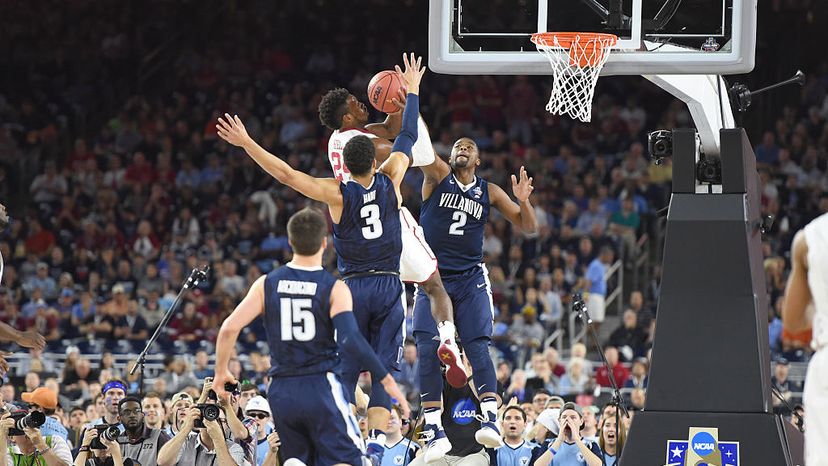
Kris Jenkins, No. 2 of the Villanova Wildcats, blocks the shot of Buddy Hield, No. 24 of the Oklahoma Sooners, during the 2016 NCAA Men's Final Four Semifinal Championship game at the NRG Stadium in Houston. Mitchell Layton/Getty Images
After the committee assigns seeds, it places the top four teams in each region to a first/second round site that is most geographically compatible to those teams, regardless of where the team might play in subsequent rounds. For example, a team from an Eastern state that is seeded second in the West region might play its first- and second-round games at a site in the Eastern part of the country and then play in the West Regional. A Regional is a tournament within a tournament. The four champions from each region comprise the Final Four.
There are eight sites for the first/second rounds. Teams are placed at these sites in groups of four, which comprises a pod, and there are two pods at each site. For each region, there are four pods [source: NCAA].
Advertisement
Each week, teams play at a different site. The Final Four is played at a new venue each year, but it's usually played in a major metropolitan area.
While it sounds complicated, the NCAA tournament is actually pretty simple. The tournament keeps subtracting teams until there is only one. That team is the champion of college basketball.
Advertisement
March Madness Tournament Play
The NCAA Basketball Tournament is played over a period of three weeks, usually beginning on the third Thursday in March. In the men's tournament, play starts with the "First Four," the four lowest-seeded teams fighting for a spot in the top 64. Then the real tournament begins. In the women's tournament, there are no extra teams, so there is no "opening round."
Over the first two full days of the tournament, the field of 64 teams is pared to 32. In the next two days, the field is trimmed to 16, or the Sweet 16, as it is often called. These final 16 teams take a four-day break before resuming play on the next Thursday. During the second week of the tournament, the field is trimmed from 16 to 8 (the Elite Eight) and then to four. Those teams comprise the tournament's Final Four.
Advertisement
In the third and final week of the tournament, the teams that survive the mayhem of March and make it to the Final Four battle it out in April for the crown of college basketball.
During March Madness, many fans fill out bracket forms to try and guess the order of the 64 teams, all the way to the winner. Sometimes, there's some money on the line. In 2023, employment firm Challenger, Grey and Christmas estimated that office workers lost $17.3 billion in productivity taking into account the time lost while workers filled out their brackets. Officially, the NCAA supports bracket contests as long as there's no entry fee to participate. Which sort of defeats the purpose.
For printable versions of the NCAA Basketball Tournament brackets, including dates and locations, visit NCAAsports.com.
Go Huskies!
The University of Connecticut has the most successful women's college basketball team in the U.S. It has won the women's NCAA championship 11 times, including four times in a row between 2013 and 2016. The team's streak of 111 consecutive wins is the most for any college level sports team.
Advertisement
The Final Four
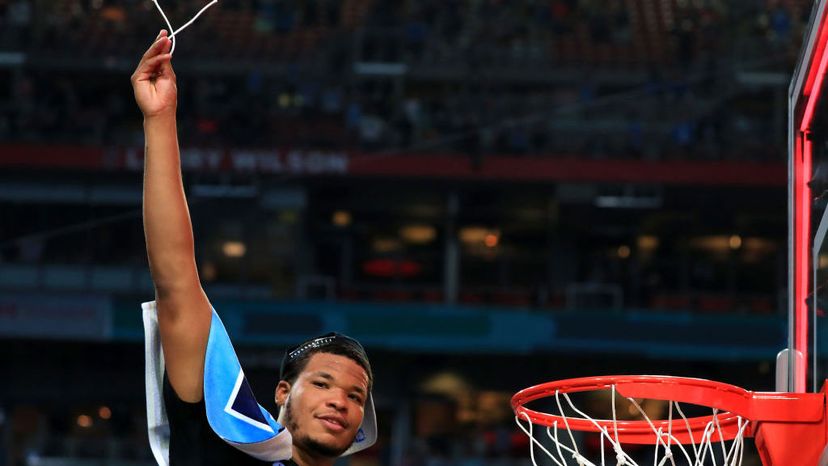
It's a ritual for each player to cuts strand off the net after the winning game, starting with seniors and moving down by class. Here Kennedy Meeks of the North Carolina Tar Heels does the honors after his team wins the championship in 2017. Ronald Martinez/Getty Images
Many sports use a tournament format to decide their champion, including professional sports. The Final Four of college basketball refers to the semifinal round of the Division I Men's or Women's Basketball Tournament. In this round, there are four teams left, and two games are played to determine which two teams will head to the finals.
The words "Final Four" relate only to college basketball. In fact, if you watch college basketball you will frequently hear the term, especially from CBS, which uses the phrase "Road to the Final Four" in its coverage. CBS has been the major TV partner for the NCAA since 1982, but Turner Sports has had a joint contract as well since 2010.
Advertisement
Making it to the Final Four means that a team won its first four tournament games, and it only has to win two more to be the national champions. A team that reaches this point in the tournament is already envisioning the hanging of a national championship banner from the rafters of its home arena, which is a common tradition.
As mentioned before, the Final Four games are played in April, but they are still full of the March Madness syndrome. Typically, the men's semifinal games are played on the first Saturday in April, and the women's are played on the first Sunday. The winners of those games move on to face each other in their respective championship games, which are played on the subsequent Monday.
In 2022, the NCAA announced that it had made $1.14 billion in revenue, $1 billion of which came from March Madness [source: Parker]. Most of this came from TV contracts. The profits go to the participating schools or to the conferences via a formula that gives shares based on team performance, scholarships given out and other factors. The NCAA requests that conferences divide money equally among their member schools. Only about a third of the schools make money off or break even with their basketball programs, so any conference money received helps to cover team expenses. Smaller conferences are more likely to keep a bigger portion of NCAA money to cover their own expenses.
We should add that a 2021 rule change does allow NCAAA athletes to make money off their names and images (for instance, from appearing in a TV commercial) though they can't be paid a salary for playing while in school
[source: Parker] .
Winners and Losers
The team with the most NCAA championship wins in men's basketball is UCLA, with 11 titles. This is followed by the University of Kentucky with eight and the University of North Carolina with six [source: NCAA]. The team with the longest drought between appearances in the NCAA tournament is Harvard, at 66 years (1946 to 2012). Several other schools, including Dartmouth, Yale, Bowling Green and Tennessee Tech, have droughts of at least 55 years and counting [source: Rookie Road].
NCAA. "What is the NCAA?" (March 7, 2018). http://www.ncaa.org/about/resources/media-center/ncaa-101/what-ncaa
Lopresti, Mike. "These 29 things have never happened during March Madness." NCAA.com, March 5, 2018 (March 7, 2018). https://www.ncaa.com/news/basketball-men/article/2018-03-05/these-29-things-have-never-happened-during-march-madness
Norlander, Matt. " Ranking top 10 Final Four Cinderellas and where South Carolina fits." March 29, 2017. (March 7, 2018). https://www.cbssports.com/college-basketball/news/ranking-top-10-final-four-cinderellas-and-where-south-carolina-fits/
Pells, Eddie. "March Madness: Office bracket spending at $2B." Associated Press. March 13, 2017 (March 7, 2018). http://archive.sltrib.com/article.php?id=5051491&itype=CMSID
RPIRatings.com "What is the RPI?" http://rpiratings.com/WhatisRPI.php
Cite This!
Please copy/paste the following text to properly cite this HowStuffWorks.com article: