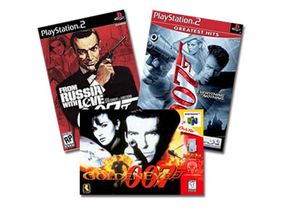
With his dry wit and impeccable style, James Bond has been defying death and ruining the plans of megalomaniacal madmen in service of Queen and country for more than 50 years. From his first appearance in a 1953 novel to his leading role in one of the most successful franchises in film history, Bond has traveled to more exotic locations, romanced more women, escaped from more harrowing death traps and saved the world more times than any other secret agent, real or fictional.
Much about the early life of James Bond remains murky, befitting a secret agent. Even the date of his birth is in dispute -- early accounts suggest various dates in the 1920s, implying that modern-day chronicles of his exploits recount the events of decades past. His Scottish father worked for a British arms manufacturer and was killed while mountain climbing along with Bond's Swiss mother when James was eleven. The orphan attended several prestigious schools before enlisting in the Royal Navy during World War II, where he rose to the rank of commander. Following the War, he entered the British Secret Intelligence Service (SIS), also known as MI6, short for 6th Branch of the Military Intelligence Directorate. His first two assignments were assassinations, which led to his permanent designation as a "double-0" agent, one with a license to kill in the line of duty. As the seventh such agent, he was designated Agent 007.
Advertisement
Bond is no mere foot soldier. His undercover assignments have taken him to exotic locales that include volcanic islands, Las Vegas, Paris, India, Azerbaijan, Tokyo and even a space station in orbit. He usually operates under an alias, usually as a representative of Universal Exports. His charm and charisma are reinforced by his taste for fine suits, fast cars and his signature beverage: a dry martini, shaken, not stirred. Bond's missions bring him into contact with both sophisticated elites and shady underworld figures. In both situations, he has repeatedly demonstrated (and overcome) his one true weakness -- he can't resist a beautiful woman.
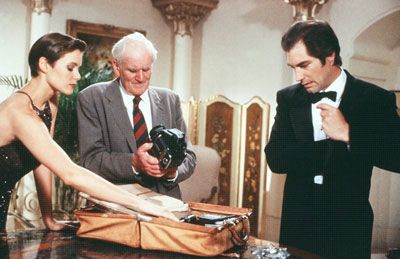
Although Bond is a gifted athlete and well-trained in martial arts, he doesn't have to rely on his wits and physical prowess alone. The Q Branch of MI6 regularly outfits 007 with clever devices, usually in the form of a mundane object that hides an explosive, a gun or another key item. He also has access to heavily modified experimental vehicles, and often carries a hidden escape device or a means of communicating with his handlers in an emergency. When all else fails, he keeps a Walther PPK .32 caliber handgun tucked into a shoulder holster, though he also uses other weapons when needed.
Bond's missions have varied wildly, but one thing is always consistent: MI6 deploys him when nothing else matters more than getting the job done. Bond is considered a "blunt instrument" of the crown, a man who can accomplish difficult missions regardless of the political, financial or personal consequences. When the fate of the world is on the line, his superiors know that Bond can't take time to worry about offending an ambassador -- or blowing up an embassy.
Advertisement