Lasers, Sound and Strange New Lifeforms

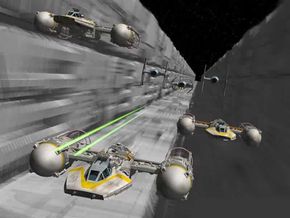
The various Star Wars fighters (e.g. X-wing, TIE, Death Star) fire laser or pulsed laser cannons. In "Star Trek," the Enterprise fires its phasers at enemy space ships. In both "Star Wars" and "Star Trek," people fire hand-held laser or phaser weapons. In all of these scenes, we see the laser beams travel and hit their targets. The problem with this is that you cannot normally see a laser beam.

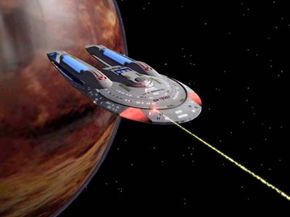
The Enterprise firing phasers
Image courtesy Axeman3D
Fire phasers!

A laser is a highly focused beam of light with the photons traveling in one direction. None escape to hit your eye and make the beam visible. In a vacuum, you would only see the beam light up where it hit the target (light is scattered by the matter in the target). There is nothing in the path to make the beam visible. You can demonstrate this with a laser pointer or flashlight in a clear room. Point the laser/flashlight at the wall and you will only see the spot on the wall. To make the beam visible, you must place fine particles in its path to scatter the light (such as chalk dust or baby powder).

I don't know of even one sci-fi film or TV series that demonstrates the proper functioning of the laser beam. Most make the beams visible through special effects because it would be unsatisfying for the viewer to see a character fire a laser and not see anything.

Hey, Hey What's that Sound?
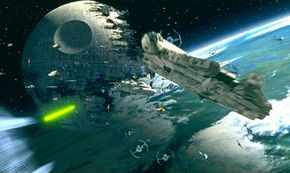
When the rebel forces destroy the Death Star in "Star Wars Episodes IV" and "VI," each Death Star goes out with a loud explosion. Such explosions happen in many sci-fi movies and TV series, such as when "Star Trek"'s Enterprise destroys an enemy vessel, or when the Nostromo self-destructs in "Alien." The problem here is that sound does not carry in space.

Sound is an example of a longitudinal wave. The sound energy moves along by vibrating molecules of gas, liquid or solid. When the bell in the above animation flexes away, it pulls in on the surrounding air particles. This creates a drop in pressure, which pulls in more surrounding air particles, creating another drop in pressure, which pulls in particles even farther out. Each vibrating air molecule passes its vibration on to the next air molecule between the bell and your ear to make the sound wave propagate. When the vibrating air in you ear canal hits your eardrum, it causes the eardrum to vibrate with the same frequency as the sound wave. The bones of the middle ear transmit this vibration to the inner ear, where the vibration sets up a standing wave in the fluid of the inner ear. The wave vibrates certain hair cells in the inner ear, which transmit nerve signals to the hearing center of your brain and you sense the sound. The important part of this process is that air molecules propagated the sound wave from its source to your ear. The same thing happens when you hear sounds underwater or through walls (liquids and solid propagate the sound waves as well). However, in the vacuum of space, there are no molecules to propagate sound waves and you don't hear anything. The movie poster of "Alien" was correct with its tagline, "In space, no one can hear you scream!"

Death Star
Image courtesy © Lucasfilm Ltd. & TM. All Rights Reserved.
When the Death Star II exploded, the sound was tremendous.

One example of the correct depiction of the lack of sound in space is Stanley Kubrick's classic film, "2001: a Space Odyssey." We see shots of the inside of spacecraft (Discovery, pods, moon vehicles) with sounds of machinery and alarms. When the scenes cut to the outside of these spacecraft, there are no sounds at all. Most dramatically, there is a scene where astronaut David Bowman must get inside the spaceship Discovery from a space pod without his helmet. He decides to decompress his space pod exposively to propel himself into an open airlock aboard the space ship Discovery. The film shows the explosion and subsequent propulsion of Bowman from the airlock in total silence. Sound only resumes when Bowman manages to close the airlock and let it fill with air. The sci-fi Western "Firefly" and its subsequent film, "Serenity," depicted a lack of sound in space as well. As with the visible lasers, most sci-fi films and TV shows accompany explosions in space with sound because it would be unsatisfying for the viewer to see an explosion and not hear anything.

Serenity under attack
Image courtesy Zoic Studios/© 2005 Universal Studios
Serenity was attacked by the Reavers and Alliance ships without a sound.

With Aliens, Size Matters
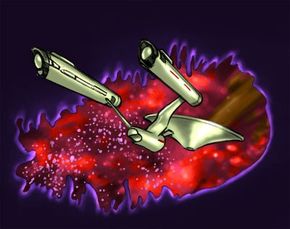
In an episode of the original Star Trek series titled "The Immunity Syndrome," the Enterprise encounters a gigantic single-celled organism resembling an amoeba. The organism is perhaps thousands of kilometers across, much larger than the Enterprise. In fact, the Enterprise penetrates the organism's cell membrane and goes into its cytoplasm to destroy it. Could such an organism be possible?

A single cell depends upon the process of diffusion to get materials across its membrane and move materials within it. Diffusion is the movement of a substance from an area of high concentration to an area of low concentration. You can smell an onion cut in the kitchen in another room because odor molecules from the onion move from an area of high concentration (the onion) to an area of low concentration (the kitchen and other rooms). For cells, diffusion works most efficiently over short distances (1 to 100 microns, 1 micron is 1 millionth of a meter).

The Enterprise vs. an amoeba
The Enterprise faces off against a large amoeba-like alien.

In addition to short distances, cells need a large surface area for diffusion to be efficient. Most cells are spherical or cuboidal. Let's look at an example of a spherical cell with a radius (r). The volume of a sphere is given by the formula V = 4/3 r3, while the surface area is given by the formula A = 4 r2. As the cell grows and r increases, the volume gets much larger than the surface area (volume is a cubic function of r, while, surface area is a square function of r). As the cell grows, diffusion can no longer bring materials into the center of the cell because the distance becomes too great. So, a practical limit on the size of a single cell is about 100 microns in diameter or less. Gigantic single cells like that depicted in the Star Trek's "The Immunity Syndrome" could not survive. Large organisms, including humans, are made of many small cells and use circulatory systems to deliver oxygen and nutrients to cells and to remove carbon dioxide and wastes from them.

On a related note, several 1950s films such as "Them" depict large insects like ants and spiders that are as large or larger than a man. Even "Harry Potter and the Chamber of Secrets" has a huge spider and many spiders the size of dogs. Insects have no active ventilation system (such as lungs) to bring in air. Instead, they rely on a system of branching tubes called trachioles to bring air close enough to each cell in their body and rely on diffusion of air through these tubes. The larger the insect, the greater the distance the air must travel and the less efficient diffusion becomes. So, this is why you do not see gigantic spiders and ants roaming the planet.

A wolf spider with spiderlings
Image courtesy Steve Clark
For most people, regular-sized spiders are
scary enough.

Another reason for not seeing large insects is that their long thin legs would not support large bodies in normal Earth gravity. So, the alien from the "Alien" movie series would probably not be able to walk around in normal gravity. The largest land animal is the African elephant and it has four large, broad legs to support its body weight. The appearance of large aliens is still a popular attraction in many sci-fi films, but you do not see large single-celled aliens much anymore.

Science continues to evolve and new discoveries are made all of the time, so someday we may look back on some of these mistakes with the amused nostalgia that viewers of films like "Robinson Crusoe on Mars" feel today. But as long as the science is plausible, the film doesn't push our willingness to suspend disbelief and (some would say, most importantly) the story is engaging, we can always enjoy science fiction.

For lots more information about science fiction and related topics, check out the links on the next page.

Alien Appearance and Languages
Star Trek's Universal Translator
A "Star Trek: The Original Series" universal translator. By "The Next Generation," universal translators were incorporated into communicator pins.
For most of sci-fi movie and TV history, aliens had to be played by human actors in alien costumes. This made it difficult for aliens to have shapes other than humanoid. However, the advances in animatronics and computer animation, made it possible to make aliens look very different from humans. You cannot make an alien look too different from a human because the audience must recognize the character as an alien. Psychologically, we are very good at recognizing humanoid shapes, so an alien shaped like a coffee table would not be very effective in a film.

Likewise, many aliens speak English in sci-fi films (unless you want to read subtitles, which many moviegoers do not). This is generally accounted in stories by the use of some translation device (such as Star Trek's universal translator and the Babel fish in "Hitchhiker's Guide to the Galaxy"). It would be unlikely for an alien species to speak English or even develop language as we know it. "Contact" handles the idea of deciphering alien communications well: the radio message is mathematically encoded and translated with a symbolic primer. An episode of "Star Trek the Next Generation" titled "Darmok" also handles it well. In Darmok, the aliens used metaphor to communicate, which couldn't be understood by the universal translator.