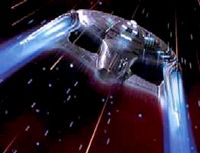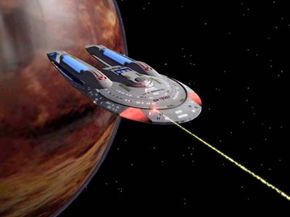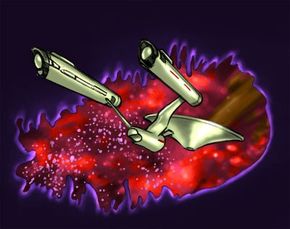
![]() Image courtesy HOLDFAST Visitor Center The Enterprise in warp. |
The problem is not that antimatter exists or that it can produce power. The problem is that, for reasons unknown to physicists, very little antimatter exists in our universe. Theoretically, when the universe was formed, there should have been equal amounts of matter and antimatter; however, our universe consists primarily of matter. So, what happened to all of the antimatter? This is a major area of research in theoretical physics (such as quantum physics and cosmology). Tiny amounts of antimatter can be produced in particle accelerators, but it is expensive to produce. In "The Physics of Star Trek," Lawrence Krauss points out that it takes far more energy to produce antimatter today than you get from the annihilation reactions of this antimatter. In the time of "Star Trek", antimatter is common or commonly produced; we assume that humans have found an inexpensive method of producing antimatter by that time. This is a case of willing suspension of disbelief.
Gravity, Gravity Everywhere
|
|
Weightlessness has been depicted in many sci-fi films. In George Pal's classic "Destination Moon," the crew experiences weightlessness and use magnetic boots to attach themselves to the spacecraft's floor and walls. One crewmember even remarks that he can't swallow well without gravity (This is not true because swallowing relies on muscle contractions of the esophagus rather than gravity. You can swallow quite well in weightlessness.). The absence of gravity does not cause weightlessness, as is often thought. Instead, the occupants of the spacecraft are in a state of freefall with the spacecraft itself. Most sci-fi films depict weightlessness by having the actors attached to wires and pulleys during filming. In Ron Howard's film "Apollo 13," the weightless scenes were shot on board NASA's KC-135 "Vomit Comet" aircraft. This plane flew parabolic arcs repeatedly where the occupants (actors, camera operators, director) experienced many brief, 30-second periods of free-fall. Weightlessness causes many adverse effects; short-term effects include nausea and vomiting, while long-term effects include bone loss, muscle atrophy, fluid loss,and anemia (see How Weightlessness Works).
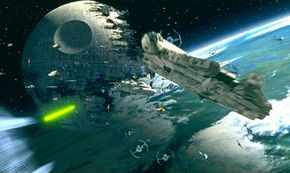
On spaceships, such as "Star Trek"'s Enterprise or Star Wars' "Millennium Falcon," there is some type of artificial gravity field that allows the occupants to experience normal gravity in flight. This is important to counteract the adverse effects of prolonged weightlessness. It is also easier to film a movie without having to make the occupants appear weightless. How these artificial gravity fields are generated are unknown (remember, sci-fi writers are free to extrapolate). Currently, the only known means of producing artificial gravity is spinning the astronauts in a wheel-like environment. Centripetal acceleration towards the center of the wheel produces centripetal force. The reaction to this acceleration (often called centrifugal force) throws the occupants against the wall and feels like gravity (many amusement parks have rides like this). The films "2001: a Space Odyssey, " "2010: The Year We Make Contact," and "Mission to Mars" all depict this type of artificial gravity correctly.
When you apply a force to an object, it accelerates. Newton's Second Law describes this relationship as F = ma, where F is the force, m is the mass of the object and a is the acceleration. In Star Trek and Star Wars, spacecraft often accelerate from rest or sub-light speed to light speed or more in a matter of seconds. The crews of these spacecraft would experience huge forces of acceleration (G-forces), even more than the G-forces experienced by jet fighter pilots when they accelerate and maneuver their aircraft. To compensate for this, Star Trek writers came up with the idea of inertial dampers, which counteract the forces of acceleration. In "The Physics of Star Trek," Lawrence Krauss speculates how these devices might work, but to date no such device exists.
Captain, We Must Go Through the Black Hole! In contrast to weightlessness, some sci-fi films tackle an object where gravity is extremely high: a black hole. Near the end of "Galaxy Quest," helmsman Tommy Laredo tells Capt. Jason Nesmith that the NSEA Protector must go through a black hole to return to Earth. In Disney's "The Black Hole," a spaceship crew goes through a black hole and ends up in another place far away. The problem is that you cannot go through a black hole.
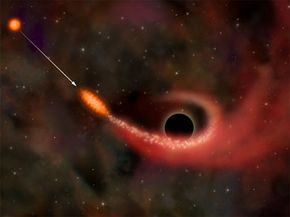
![]() Image courtesy NASA/CXC/M.Weiss A supermassive black hole ripping apart a star and consuming a portion of it. |
A black hole is caused by the collapse of a star at the end of its life (The star must be at least three times more massive than the Sun). The core of the collapsed star becomes so dense and the gravitational forces so great that nothing, not even light, can escape. A black hole is not a tunnel. Any object that enters the edge or event horizon of the black hole falls into it. The gravitational forces inside would rip any matter apart.
One misconception about black holes is that they suck everything nearby into them like a huge vacuum cleaner. This is not necessarily true; only objects that fall within the event horizon go into the black hole. They will attract objects by virtue of their mass and gravity just as the star that bore them did (remember that the black hole has the same mass as the star, just more compact, or dense). If the Sun were to instantly become a black hole, many people think that it would suck the Earth into it (Although the Sun does not have enough mass to become a black hole). But if you examine Newton's law of gravity above, neither the mass of the Sun nor the Earth changes, and neither does the distance between them. So, the Earth would experience the same gravitational attraction to the Sun if it became a black hole as it does now. The Earth would merely orbit the black hole, just as it orbits the Sun now (The loss of sunlight would cause severe problems for life on Earth, however).
Next, we'll look at how science fiction has handled lasers, sound and aliens.
More Options: