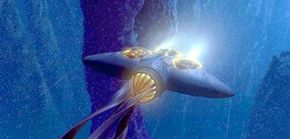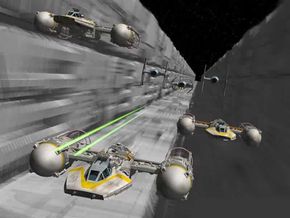
![]() Image ©1999 Lucasfilm. LTD. & TM All rights reserved. Journey through the center of Naboo |
In our solar system, we have small rocky planets (Mercury, Venus, Earth, Mars) and gas giants (Jupiter, Saturn, Uranus, Neptune). The planets formed when material from the early solar disk (planetismals) collided and clumped together to form the planets. The material in the inner solar system was mostly rock, dust and metal that could exist in the warm environment. The planetismals in the outer solar system were mostly gas, water ice and dust that could exist in the cold environment. As the planets formed, gravity held the aggregated planetismals together and caused them to spin. Naboo is an Earth-like planet, so let's look at the formation of the Earth.
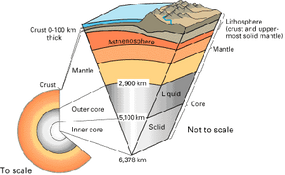
On the early Earth, collisions of planetismals produced heat that melted the material, which was not uniform. In this molten medium, materials of different densities settled. Iron and nickel within the molten Earth were the densest and sank to the center to form the core. Less dense materials settled above to form layers (outer core, mantle, crust). Geologists refer to this process as differentiation. (Note: In the outer gas giant planets, the cores may be composed of dust and water ice with liquid gas layers around them).
![]() Image courtesy U.S. Geological Survey The structure of the Earth |
Water is less dense than nickel, iron and rocks. It would float on these substances. So, you would not find water in the center of the Earth. Similarly, Naboo would not have a liquid water core.
In her book "The Science of Star Wars," Jeanne Cavelos states that Naboo supposedly is made of irregular rock aggregates with watery caves between them. However, gravity would attract these pieces and they would heat up. Any caves would collapse, water would disappear and Naboo would assume a spherical shape with differentiation just like the Earth.
In "The Core," scientists discover that the Earth's inner core has stopped rotating. This disrupts the Earth's magnetic field leaving the Earth vulnerable to deadly microwave radiation (Bad science alert: the Sun does not put out enough energy in the microwave band to be a danger and the Earth's magnetic field does not deflect microwaves). To correct this situation, the scientists travel through the mantle and the molten layers of the outer core and attempt to jumpstart the core's rotation with nuclear bombs. While the depiction of the Earth's structure is better than other movies, "The Core" has many other science problems (see detailed reviews on Bad Astronomy and Insultingly Stupid Movie Physics).
Mars in the Movies
Mars has long been a fascinating subject and Hollywood has tried to respond. In the 1950s, "The Angry Red Planet" depicted life on the red planet with scenes where the surface was entirely red and strange rat-spiders attacked the crew. "Robinson Crusoe on Mars" showed Mars as a desert-like planet with a thin atmosphere, and the hero survives there with an alien, human-like companion. We can forgive these movies as they used the famous astronomer Percival Lowell's descriptions of the surface of Mars and came out long before we ever sent a probe to Mars to see what it was like.
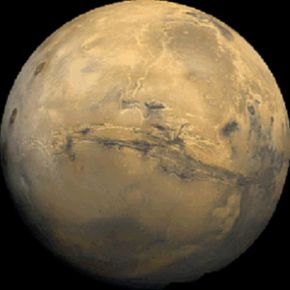
![]() Image courtesy NASA Mars |
Mars is a cold desert planet where we think that water once flowed, and that water may still exist in frozen form at the poles and in the permafrost (for details, see How Mars Works). Two recent films, "The Red Planet" and "Mission to Mars," have a more realistic depiction of Mars based on the information gathered from Mars missions since 1976. However, in "The Red Planet," the astronauts crash on Mars and must walk a great distance across the surface to a habitat module. In the process, their space suits run out of oxygen; one crewmember commits suicide by jumping off a cliff rather than suffocate. In a dramatic scene, the remaining astronauts are suffocating in their suits, when one desperate astronaut opens the visor of his helmet and breathes. He miraculously discovers that Mars has oxygen. He tells remaining crew to do the same and they all survive by breathing the Martian air. Couldn't they have known that Mars had oxygen even prior to the crash?
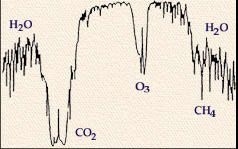
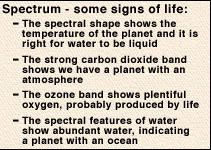
![]() ![]() Photo courtesy NASA Simulated infrared-absorption spectrum of an Earth-like planet (top) and how it could be interpreted for signs of life (bottom) |
Mars has a thin atmosphere composed mainly of carbon dioxide. At present, there is no oxygen to support humans. In addition, when heated or illuminated with light, elements and compounds absorb and radiate energy in various forms of electromagnetic radiation such as infrared. (See How Light Works for more information). The infrared spectrum is frequently used to determine what molecules exist in the atmosphere of a planet and how abundant they are. Earth-based telescopes equipped with infrared spectrometers can detect elements in the atmospheres of other planets and even planets around other stars. With these techniques, surely the astronauts in "The Red Planet" would have known that oxygen was present on Mars long before they even traveled there.
There has been research and proposals that it might be possible to terraform Mars in the future to make it more Earth-like (see How Mars Works). This has been the basis of Kim Stanley Robinson's sci-fi novels ("Red Mars," "Green Mars," "Blue Mars," "The Martians").
Tell Me, Asteroid...What Are You Really Like?
In the movie "Armageddon," astronomers spot an asteroid that will hit the Earth in a matter of days. The asteroid is the size of Texas and the impact will cause total annihilation of life on Earth (or at least the people on it). A crew of astronauts and oil drillers must land on the asteroid, drill 800 feet into it, implant a nuclear bomb, liftoff from the asteroid and detonate the bomb. The explosion will fracture the asteroid and send the pieces on either side of the Earth in a near miss that will save humanity. This rousing action-adventure story has little scientific basis.
In the movie, when they land on the asteroid, the astronauts have special thrusters on their spacesuits to help them walk normally in the low gravity environment. Okay, fair enough. But inside the spacecraft that lands on the asteroid, the unsuited crewmembers walk around just as normally. Gravity works the same whether they are inside or outside of the spacecraft.
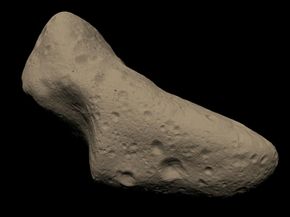
![]() Image courtesy NASA The asteroid Eros |
In Armageddon, the asteroid is the size of Texas; most asteroids are only several kilometers wide (astronomers would spot an asteroid the size of Texas well before it was a few days away from Earth). In the movie, the asteroid is a rough surface with razor-sharp crags and huge canyons. Actual photos of the asteroid Eros from the NEAR spacecraft show the surface to be relatively smooth, albeit cratered.
A similar movie, "Deep Impact," was released at the same time as "Armageddon." The story line was similar, but it involved a comet instead of an asteroid. "Deep Impact" was less of an action-adventure film and handled the human side of what would happen in the event of such an impact. We know that such impacts have happened over the history of Earth and the solar system and even witnessed the impact of comet Shoemaker-Levy 9 into Jupiter (see How Comets Work).
We'll look at how sci-fi has made mistakes with antimatter, gravity and black holes next.
More Options: