Introduction to How Roller Derby Works
Imagine a hockey game, but replace the ice with a roller rink. Swap out the baggy jerseys for fishnet hose and tank tops, and abandon ordinary names in favor of pseudonyms like Tanya Hyde and Demi Gore. What you have is a reasonable facsimile of women's roller derby. The scoring is completely different, but both sports are rowdy, raucous and sometimes punctuated with fights between the players.
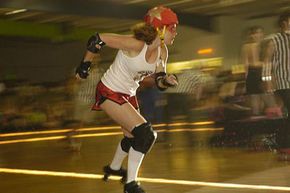
![]() Photo courtesy Frank Mullen / The Atlanta Rollergirls Roller derby was inspired by the fascination of watching skaters collide during races. See more roller derby pictures.
|
Unlike professional hockey players, the vast majority of roller derby participants are unpaid. Most actually spend money on the sport -- they purchase their own equipment and pay monthly dues to support their leagues. Teams usually practice several times a week, and injuries are common.
So why pay money to work, compete and possibly get hurt? Why take the time to re-learn to skate? What makes it fun? We went behind the scenes with the Atlanta Rollergirls to find out. Read on to learn about roller derby's history, its rules and why it's become so important to its players.
|
|
Roller Derby History
|
|
Seltzer organized these races until 1937, when sportswriter Damon Runyon noted that the most exciting moments were the collisions between skaters. Then, the competition changed from an endurance event to game with defensive and offensive skaters. Teams played on a banked track, and women and men played in alternating periods.
![]() Photo courtesy Frank Mullen / The Atlanta Rollergirls New roller derby leagues build on the old sport's reputation for being fast and aggressive. |
Roller derby's popularity grew during the 1940s and '50s. The sport gained a reputation for being rough and aggressive, and players developed intense rivalries. In the early 1970s, the slowing economy and rising fuel costs led to the sport's decline. Televised bouts, some with theatrical elements similar to professional wrestling, could not revive people's interest.
![]() Photo courtesy Frank Mullen / The Atlanta Rollergirls Most new roller derby leagues feature all-female teams |
The current roller derby revival started in 2001. New leagues have kept the same general structure of the game but with distinctive, all-female teams. Next, we'll look at how these leagues have developed and what makes them popular.
|
|
The New Women's Roller Derby
|
|
The first of these leagues formed in Austin, Texas in 2001. Since then, over 30 leagues have appeared across the United States. These organizations are largely skater-
owned and operated. As Atlanta Rollergirls founder Tanya Hyde points out, "It's all about the league working as a team, gathering resources from within the league, making use of the talents that all the women are bringing to the table. The needs of the skaters are first and foremost. [By being skater-owned and -operated] you ensure that the skaters will always be well taken care of."
Participants are building their teams from the ground up, taking inspiration from other leagues as they go. Hot Legs Hooligan explains, "We basically have a start-up company, based around something nobody has really ever seen, staffed entirely by volunteers. It's like starting your own country."
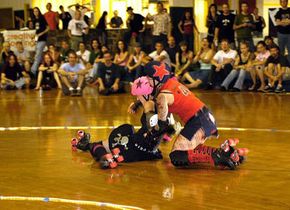
![]() Photo courtesy Frank Mullen / The Atlanta Rollergirls Roxy Razor of the Apocalypstix falls during a bout. |
Women's leagues usually play on the flat surfaces found in most public roller rinks and mark the track with cones and lights, though a few have bought or built banked rinks like those used in the original sport. "[G]irls skated where they could on whatever surface they could find, and flat tracks were simply more available," says Susan B. Agony. "There are probably quite a few girls who are ready and willing to get into how one style is superior to the other, but I think it is the love of the game that had engaged most of us, whether we are skating flat or at an angle."
![]() Floor crew volunteers tape down the lights that mark the track. |
Since every league is the product of its skaters' efforts, no two are exactly the same. But a few traits are common across the board. Skaters tend to wear uniforms that give their team a distinct identity. They also adopt a persona for their competitions, complete with a skate name -- usually a double entendre.
The names and uniforms lead some people to compare roller derby to professional wrestling. According to Big Red, "A lot of people come out and they think it's scripted, and they think that it's like wrestling, but it's not…It's very unpredictable and we don't even know what's going to happen sometimes. Sometimes you don't even realize you fell until you hit the ground."
Next, we'll look at the training and practice that prepares players for this unpredictability.
|
on the Popularity of Roller Derby |
Training
Most women's roller derby leagues have the same philosophy regarding new skaters -- physique is irrelevant, and it doesn't matter if someone hasn't worn skates in years. Leagues hold practice sessions to teach the rules and basic skating techniques, and no one actually competes until the team is confident that they can do so safely. Leagues also encourage players to skate whenever they can in addition to organized practices.The Atlanta Rollergirls practice at least three days a week, and they always begin with stretching and warm-ups to help prevent injuries. Some practices focus on endurance and maneuvering. Big Red explains, "You need to learn to squat, you need to learn how to dodge, you need to learn how to jump over stuff. Jump over people."
![]() Photo courtesy Frank Mullen / The Atlanta Rollergirls Players must frequently dodge fallen skaters during competitions. |
Endurance and skating practices use traditional roller derby drills, modified hockey drills or exercises that the players have developed themselves. In addition to building endurance, these drills reinforce the players' abilities to:
- Start and stop
- Skate at high speeds
- Dodge obstacles
- Dodge other players
- Fall without injury
Other sessions involve scrimmage bouts between the leagues' teams. Many leagues separate the new skaters from the experienced skaters during practice bouts in an effort to make sure that no one gets hurt. Next, we'll look at what happens during a typical bout.
|
The Bout: A Play-by-Play
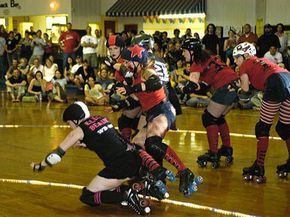
![]() Photo courtesy Frank Mullen / The Atlanta Rollergirls Jammers for the Apocalypstix and the Denim Demons race for the lead. |
The game itself is a series of races between two teams of five players. Each team's jammer is the only player to score points. Three blockers try to stop the other team's jammer while propelling their own jammer forward. Each team's pivot acts like the pace car in a NASCAR race and controls the speed of the pack. She also keeps an eye on the jammers, calls her team's plays and acts as a blocker. Helmet designs differentiate the positions -- jammers wear stars, pivots wear stripes and blockers wear blank helmets.
![]() Photo courtesy Frank Mullen / The Atlanta Rollergirls A referee points out the lead jammer and follows her progress around the track. |
Each race is called a jam and lasts up to two minutes. At the start of the jam, the pivots and blockers gather in formation at the starting line. The referee blows a whistle, and they skate as a pack while the jammers wait at the starting line. When the pack is 20 feet from the starting line, the referee blows the whistle again, and the jammers start to skate.
The jammers try to catch up to the pack, work their way through and come out the other side. No one scores any points during the first lap, but the first jammer to pass the opposing team's pivot becomes the lead jammer. A referee points out the lead jammer and follows her progress around the track. The lead jammer can "call the jam" before the end of the two-minute period by putting her hand on her hips.
![]() Photo courtesy Frank Mullen / The Atlanta Rollergirls A jammer for the Apocalypstix calls the jam by putting her hands on her hips. |
When the lead jammer calls the jam or the two-minute period ends, play stops and the officials calculate the score. Teams get one point for each opposing player the jammer passes during each lap. In general, this is four points per lap -- one for each opposing player. But some rules, which we'll look at in the next section, can change the score.
If the animation above isn't working, click here to get the Shockwave player.
|
|
Bout Rules
|
of Roller Derby |
Some rules directly affect whether the jammers earn points. In most leagues, jammers:
- Must be in bounds when they pass opponents to receive points
- Can pass their responsibilities to their pivot by handing off their helmet covering, although pivots do not gain the ability to call the jam.
- Do not receive a point if they foul the player they are passing or pass a player who is on the way to the penalty box.
- Do not receive additional points if they fall to the back of the pack and pass the same players again.
- Receive additional points for lapping opposing jammers.
- Receive a point for each opposing player in the penalty box if they pass all the other opponents in bounds.
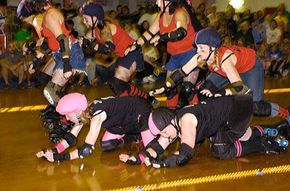
![]() Photo courtesy Frank Mullen / The Atlanta Rollergirls Opposing jammers come to blows during a bout. This major penalty led to time in the penalty box and a backwards-skating race. |
Other rules govern all players' conduct during the bout. Blocking is legal (and encouraged), but players cannot grab, pull or trip one another. They also can't block from behind, "clothes-line" opponents or prevent out-of-bounds opponents from getting back on the track. Although players can use their arms and elbows to block, they can't use their elbows above the shoulder or block with completely extended arms.
Breaking any of these rules can lead to time in the penalty box. Players spend thirty to sixty seconds in the penalty box for minor infractions. This may not sound like much time, but a minute can be more than half of a jam.
![]() Photo courtesy Frank Mullen / The Atlanta Rollergirls The Atlanta Rollergirls' penalty box is a wading pool. Players spin the wheel to determine punishments for major penalties. |
Major penalties can lead to expulsion from the game or comical punishments, like sumo wrestling and backwards-skating contests. Major infractions include deliberately falling in front of other skaters, fighting, fouling skaters who are down, insubordination to officials and other unsporting conduct.
In spite of rules that govern skating and blocking, players can -- and sometimes do -- get hurt. Next, we'll look at roller derby safety and injuries.
Safety
Roller derby bouts involve fast skating and lots of blocking, so it's not surprising that players can get hurt. A lot of players wear their injuries with pride, and several leagues have photo albums documenting injuries on their web pages. These albums usually feature pictures of large bruises and "fishnet burn" -- a stippled effect that comes from falling while wearing fishnet hose. But among the bumps, bruises and scrapes are pictures and X-rays of severe sprains, broken bones and dislocated joints. The Atlanta Rollergirls we interviewed described contusions, split chins, soft tissue injuries and broken bones.
![]() Photo courtesy Frank Mullen / The Atlanta Rollergirls Rollerhate of the Sake Tuyas ices an injured knee. |
A lot of skaters return to the derby as soon as possible after recovering from an injury. For example, Susan B. Agony continues to play after multiple injuries, "I have broken my tailbone twice and had a severe contusion underneath my patella. The tailbone injuries had me out, I couldn't skate, I couldn't do much of anything. It was very frustrating for me, but as soon as I got the medical go-ahead I was back out there. Now I wear crash pads on my butt."
Players protect themselves first with proper skating technique. They fall deliberately during practice to rehearse how to fall correctly and recover quickly, reducing the chance of becoming a hazard to other skaters. Eventually, falling safely becomes second nature.
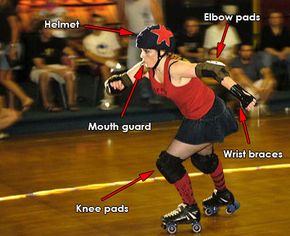
![]() Photo courtesy Frank Mullen / The Atlanta Rollergirls Players must wear a helmet, elbow pads, wrist guards and knee pads. They must also use a mouth guard. |
Players also wear safety gear. In most leagues, helmets, mouth guards, wrist guards, elbow pads and knee pads are required during practice and competition. Other padding, like hip and tailbone pads, is optional.
Most players express a devotion to the sport that keeps them involved in spite of the risk of serious injury. Big Red explains, "I don't know anybody out here who doesn't just absolutely love it."
Follow the links on the next page for lots more information about roller skating and roller derby.
|
|
Lots More Information
Related HowStuffWorks Articles
- How X-Rays Work
- How Emergency Rooms Work
- How NASCAR Race Cars Work
- How Hockey Works
- How Ice Rinks Work
- How American Football Works
- How Bearings Work
More Great Links
- Rollercon
- Wayne's Derby World
- Quad Roller Skating
- Rollersport
- Rollergirls -- page about the A&E series
Sources
September 22, 2005.
http://www.darkhorizons.com/news05/050922b.php
http://www.rollerskatingmuseum.com/derby.htm
http://www.rollerderbyfoundation.org/
http://www.skatelog.com
http://www.popcultmag.com/obsessions/fadsandphenoms/rollerderby/derby1.html