Knowing which
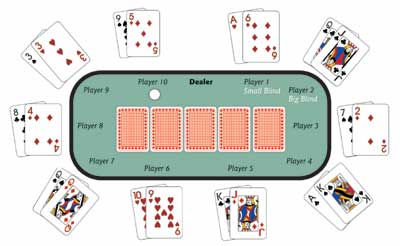
hands to play and which hands to fold is quite complicated and depends on many variables. Here is a quick guide for what to do with your first two (hole) cards.
Early PositionThe following hands are recommended in early
position (seats three, four and five):
AA -- A
pair of aces (
hole cards often called pocket rockets) is the best starting hand in any form of Texas Hold'em. Unless you are a seasoned professional, it is recommended to always enter the
pot with a
raise when you hold a pair of aces. If you raise and are
reraised, raise again. This does two things that are favorable for you: It gets as much money as possible into the pot, and it will often force small drawing hands, such as
suited connectors (for example

4-
5) and small pairs to fold before the
flop. Your goal with pocket rockets is to play either
heads-up (against only one opponent) or, at the most, against two opponents. Three or more opponents greatly reduce your chances of winning a hand, even if you have the best starting hand.

©2006 Publications International, Ltd.
A pair of aces is the strongest possible starting hand.
|
KK -- A pair of kings (often called cowboys) is the second best starting hand in Texas Hold'em. Just like pocket aces, you should always raise with pocket kings when you enter a pot. Your goals are the same as with pocket aces with the additional goal of hoping to force out opponents who hold an ace with a small
kicker. With pocket kings, any flop that contains an ace can be dangerous to you since many low-
limit players play any hand containing an ace.
AKs and AK --The third best starting hand in Texas Hold'em is AK whether suited or not. This is one hand that has a rule that is set in stone: You must raise before the flop with AK. You must force as many opponents as possible to fold before the flop when you hold AK.
This is a drawing hand (meaning the hand needs communal cards to become a winner) and must be protected. Drawing hands must almost always improve to win. Made hands, such as high pairs like AA, KK, and QQ will often win even if they don't improve. Of course, you hope to see at least an A or K on the flop whenever you hold AK. An additional benefit of raising before the flop is that even if you don't hit an ace or king on the flop, your opponents will often respect your pre-flop raise. They will let you see the turn for free by
checking after the flop to see what you are going to do.
QQ -- Pocket queens are a strong starting hand. Some players may enter the pot with a raise and sometimes they will just
limp in (
call) to see the flop. This is a double-edged sword. You may raise to force out opponents holding an ace with a small kicker or opponents who like to play a king with a suited kicker, or you may limp in and hope that neither an ace nor king is in the flop so you can win extra bets from the above-mentioned opponents. How you play pocket queens depends on how well you know your opponents' playing styles and on your position. If a player holds them in middle or late position and is the first one in the pot, they should almost always enter with a raise. Any time you hold them, and an ace or king hits on the flop, you are probably beat, especially against three or more opponents.
JJ -- Pocket jacks can be dangerous to inexperienced players. Because they look good before the flop, many players enter with a raise. The problem is that any ace, king, or queen on the flop forces you to play defensively, and if you face more than one opponent, you are likely to lose. For this reason, unless you think you can isolate an opponent, you should limp in (to enter a hand with a call before the flop) with pocket jacks. Try to look at pocket jacks the same as any other pair below queens: as a drawing hand. Of course, if the flop brings nothing higher than a ten, you should
bet aggressively until you're convinced that someone has a better hand.
AQs, AQ, AJs, KQs --These hands should be played from any position, even calling a single raise before the flop. The exception is if a very
tight and strong player raises from
under-the-gun, then you should consider folding. You should fold everything except AA, KK, and AK if a tight player raises and is reraised before the betting gets to you. Otherwise, these hands are very strong. When you do hit one of your cards on the flop, opponents will often bet as well (give you
action) while holding a smaller kicker. A kicker is a card that breaks a tie between two hands. For instance, if you hold an A-A-5 and your opponent holds an A-A-2, your 5 is the kicker that beats the 2. This is the best situation to be in. This is why solid players rarely play aces with kickers below a T, especially from early position.
AJ, ATs, KQ, KJs -- Depending on the ability of your opponents, you should often fold these hands when you're under-the-gun. You can play them from the fifth position and sometimes from fourth position. These hands are strong, but sometimes an opponent will have a higher kicker when the flop hits you.
Middle PositionThe following hands are recommended in middle position (seats six and seven):
TT, 99, AT, KJ, QJs -- These are drawing hands and will almost always need to improve to win. You should rarely call a raise with these hands. With the pairs (TT and 99), you are hoping to flop a
set (three of a kind, also called
trips). The other three hands can and do win when the flop hits you, but even if you have the top pair after the flop, you may not have the top kicker. With these hands, you should often bet after the flop if you do hit something in order to get an idea of where you are in the hand. If you bet and are reraised, depending on the opponent, you will usually lose. Often though, this bet after the flop will win the hand, and even if it doesn't, it can set up a
bluffing opportunity on the turn.
Late PositionThe following hands are recommended in late position (seats eight, nine, and ten).
88, 77, 66, 55, 44, 33, 22 -- Your main hope is to flop a set with these pairs. As with all of the hands here and below, you should rarely call a raise from a solid player. Most drawing hands prefer to have many opponents so that when you hit your draw, you will be able to collect more than enough money to pay for the times you don't.
KT, QJ -- These two hands usually need to end up being part of a straight, two pairs, or trips (three of a kind) to win a very big pot. If there are a lot of opponents in the pot in front of you, and if you do hit a pair on the flop, there is a good chance you will be out-kicked (an opponent has a better kicker).
For this reason, don't rely too heavily on them just because they are face cards (kings, queens, and jacks are called face cards). Fold them if the action has been raised and reraised in front of you.
A9s, A8s, A7s, A6s, A5s, A4s, A3s, A2s, K9s, QTs, JTs -- With these hands you are hoping to flop a flush or flush draw. Rarely play these in any position except the
button. Note that often the A9s through A6s are not as strong as A5s, A4s, A3s, and A2s since the latter can be part of a straight.
Now that we've examined the different positions, it's time to consider how your play will differ if you are the small or big
blind. We'll examine those different blind strategies in the next section.
For more information about Texas Hold 'Em Poker and other variations, try the following links:

 A
A