Craps Basics: The Table

When you walk into a casino, you can usually spot the craps tables by the raucous crowds gathered around them. Just in case you happen in at a quiet time, just look for the long, usually green, tables with at least four casino workers standing around them. Here's the rundown on what to expect.

The Table
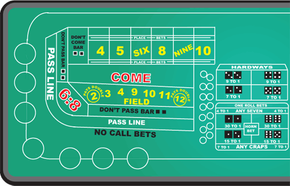
The craps table is covered in felt that is printed with a diagram showing the spaces for the types of bets. There is a center section where Hardways and One Roll bets can be placed. The ends of the table each have sections for the Pass Line, Come, Place, Field, and other bets. The ends of the table are mirror images of each other.


Usually, the felt layout is green with white lettering, but sometimes casinos use other colors.

Craps History
Dice games have been around for more than 2,000 years. Craps evolved from a dice game called hazard. There are a couple of ideas about how it came to be the craps we know today. One story is that Hazard started out as an Arab game referred to only by the Arabic word for die: azzahr. It migrated to France, where it was named hasard, and then to England, where it became hazard. The French eventually adopted the English spelling and brought it to Canada, to a French settlement called Acadia.

When the English took over Acadia (and renamed it Nova Scotia), they banished the French, who moved south, eventually settling in New Orleans. They still played the game of Hazard but began refining the rules to simplify it, and in doing so made the game more mathematically fair. The name evolved, as well. Crabs (also spelled crabes) was the lowest roll in the game. The Louisiana French began to refer to the game by this name, ultimately calling it craps.

Craps spread by way of riverboats and eventually made its way west.