Blue and green screens are great ways to create different backgrounds for videos or movies. peng song / Getty Images
How do they make the impossible happen in movies and make it look totally real? For example:
In the movie ET, how did they make it look completely real when the boys' bicycles began flying?
In the movie Star Wars, how did they make it look completely real when Luke flew his X-wing fighter down the trench of the Death Star with Twin Ion Engine fighters in close pursuit? The X-wing fighter, TIE fighters and the trench were all models...
In the movie Return of the Jedi, how did they make it look completely real when Leia and Luke were flying at 100 mph on their speeder bike through the forest?
In the movie Back to the Future, how did they make it look completely real when the DeLorean car took off and started flying down a suburban street?
Even on the TV news every night, how do they make it look completely real when the weatherperson is standing in front of an animated weather map full of computer graphics?
Advertisement
In all of these cases, the illusion is created by a special effects technique known as traveling matte or blue screen. This technique allows actors and scale models to find themselves in totally imaginary situations -- in space ships, dangling from rope bridges over gorges, flying through the air (a la Superman) -- and have it look completely real in the theater. The technique is used so often now that you don't even realize it. News reporters are made to look like they are on location when they are not, and complete segments in TV shows can be created this way to make it look like the segment was filmed on location when, in fact, no one left Los Angeles.
In this article, you will learn all about the blue screen technique so you can see how all of these different scenes are actually created.
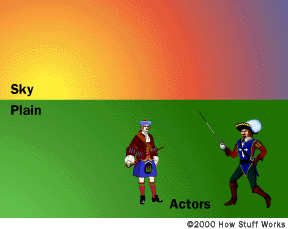
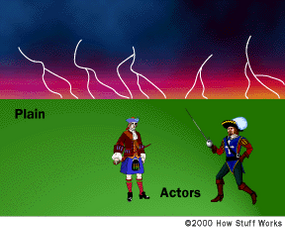
The original scene: Actors on a plain on a nice day Not very spooky.
Mattes have been used in the film industry practically forever to create special effects. A very common effect can be easily created using a double-exposure matte. Here is how this technique works.
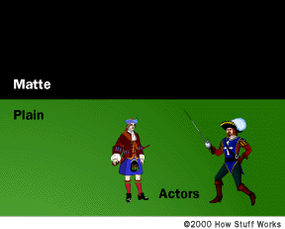
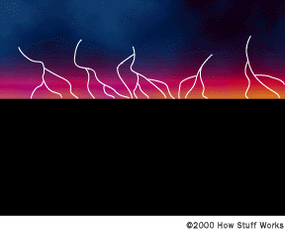
Let's say that the director would like to create a spooky scene where the actors are walking across a large, flat plain while the sky boils with dark clouds. To create this effect, the cameraman can first shoot the actors on the plain. When this shot is created, however, a piece of black paper or tape is used on the lens so that the area of the sky is masked out and left unexposed on the film. The scene is shot normally, but in the camera the film is exposed on only one half of the frame. Then, the camera operator rewinds the film in the camera, puts a piece of black paper on the lens to mask out the portion of the film already exposed, and films the clouds of a thunderstorm. Perhaps the clouds are filmed with a slow film speed, so that when played at normal speed they look like they are boiling across the sky.
Advertisement
Here are the steps:
The sky is matted out with black paper placed over the sky on the camera's lens. The sky portion of the film is not exposed in the first shot.The film is rewound and a dark, cloudy sky is filmed with a matte placed over the previously exposed portion of the film.When the film is developed, the two shots appear as one.Spooky.
There are two variations on this technique that are very common:
The sky might be computer generated rather than a real, outside sky.
The two scenes might be shot separately on two pieces of film and then brought into the special effects department to be combined onto a third piece of film using a technique called optical compositing. The two pieces of film are projected onto the third piece of film in a compositing machine that handles the film very precisely one frame at a time. Or, in a digital shop, the two pieces of film are digitized, combined frame by frame in the computer's memory and then written out to a third piece of film with a film printer.
This sort of matting is one of the oldest special-effect techniques used in the industry.
Advertisement
Traveling Mattes
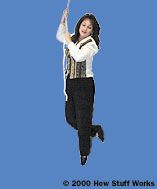
Film of the actress dangling from a rope in the studio,shot in front of a blue screen
Now let's say that you are a director and you would like to film a scene where the actress is dangling from a rope over a deep river gorge screaming for the hero to come save her. As the director, you have several options:
If the actress is up for it, you can actually have her dangle from the rope. Most actors and actresses are too valuable to risk in that way.
You can use a stunt person to stand in for the actress and shoot the scene with a long shot so people can't tell. In doing this, you will lose the emotional effect of seeing a close-up of the actress's face as she screams.
You can use blue screen photography to make it look like the actress is dangling from the rope. Or, you might use the blue screen for the close-ups and the stunt person for the long shots to get the best of both worlds.
The blue screen technique lets you combine two or more pieces of film into one piece that looks very real.
Advertisement
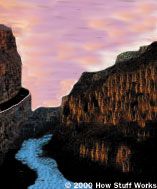
To use the blue screen technique, you first film the river gorge on location. This shot is called the background plate. You then film the actress dangling from a rope 2 feet off the ground in a studio. Behind the actress in the studio you place a bright blue background screen (hence the name "blue screen"). You end up with two pieces of film that look like this:
Film of the river gorge, known as a "plate"
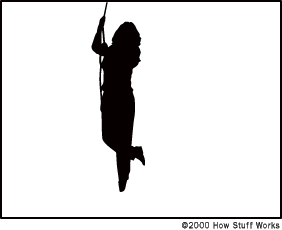
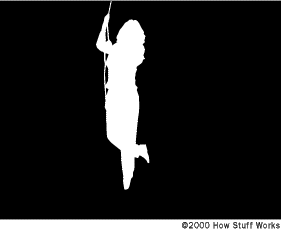
In the special effects department you can easily use special filters to form two mattes from the shot of the actress. One shows the actress's silhouette in black, and the other is the reverse, like this:
The matte of the actress's silhouetteThe reverse matte
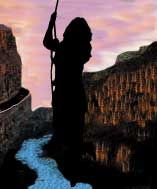
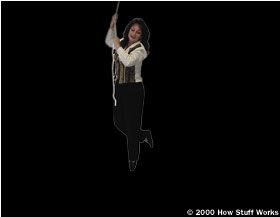
These mattes are easy to create because the bright blue color, when run through a red filter, turns black. By using high-contrast black-and-white film to create the mattes, you can create the silhouettes. So now you have four pieces of film: the two originals and the two mattes. By combining these pieces of film in layers you can create the final piece of film for the shot. First, you combine the background with the actress's silhouette:
Then, you rewind the film and re-expose it to lay the actress into the "hole" that the matte created. The actress now looks like this:
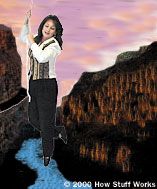
And the final shot looks like this:
This is called a traveling matte because the matte is different for each frame of the film. In a static matte, you simply tape black paper over the lens and that single matte is the same for the entire shot. In a traveling-matte shot, you need to create a matte that is exactly the same shape as the actress. In each frame, the actress moves, so a new matte is required for each frame. It is possible to create these individual mattes by hand, but it takes a tremendous amount of time. The blue screen behind the actress makes it easy to create all of the mattes automatically using optical or digital techniques.
The blue screen technique is also used extensively in science fiction films such as "Star Wars" and "Star Trek" to make the spacecraft models look real. The models are filmed separately on blue backgrounds and then combined in multiple layers to make the final film. Very complex shots with hundreds of layers have been created.
In order for a blue screen shot to look convincing, several things are important:
The actress (or model, in the case of space ships) has to have the right level of diffusion to match the background. You have probably seen bad blue screen techniques used in TV shows where the foreground actor is very crisp and the background plate is diffused. You immediately know it is fake because of the mismatch.
The blue screen's color cannot reflect onto the actor or model. If it does, the actor acquires a blue "fringe" around the edges that looks very bad.
The actor cannot wear anything blue -- blue will show up as a hole in the actor!
With computers, blue screen shots are even easier because the computer can create the mattes and combine the shots automatically. Many of the links on the next page describe different digital techniques.
The next time you go to a movie, you'll understand how they make some of these impossible shots -- but you can still be amazed at how real they look.
For more information on blue screens and other special effects techniques, check out the links on the next page.