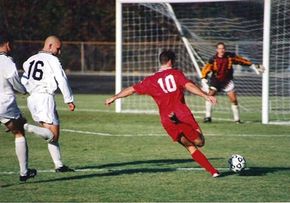
Introduction to How Soccer Works
Soccer (or football, if you're not American) is by far the most popular sport in the world. Tens of thousands of fans regularly show up for games played in stadiums on every continent except Antarctica, where they still play but the crowds are rather sparse. For major international matches, worldwide television viewers can number in the hundreds of millions. From its rough and tumble origins to the current crop of multimillionaire celebrity players, "the beautiful game" has thrilled and captivated sports fans for more than 100 years. Learn how to play soccer, where it came from and some tricks to win the game.
![]() Image courtesy Rick Dikeman GNU Free Documentation License A soccer game in progress |
Because soccer is a very simple game at its core, many cultures have claimed to have invented it. Games involving teams, balls and some kind of battle over territory have existed in various cultures worldwide since prehistory. Some of them allowed players to carry or throw the ball, while some were brutally violent. The origins of the modern game of soccer can be traced to Britain. There, some holidays were celebrated with mass games played in the streets in which young men from rival villages would strive to steal a ball and carry it to a certain place or goal. These were raucous affairs with hundreds of players, no rules and much damage to the players and village property.
|
More formal ball games were eventually developed by British schoolboys, but each school had their own set of rules. When different teams played against each other, they had to compromise on the rules used for that particular game. In 1848, representatives from many schools met at Cambridge to try and create a unified rule system, and several more meetings held over the next two decades formed the basis of modern soccer. The football community was divided, however. Some preferred a rougher game in which the ball could be carried, while others were playing something akin to today's soccer. The two sides eventually split, with the other game becoming rugby [Source: Murray]. The soccer clubs formed an organization that would codify and regulate the rules -- the Football Association. Thus, the game became known as Association Football. Today, most of the world simply calls it football, but Americans refer to it as soccer, a term taken from part of the word association.
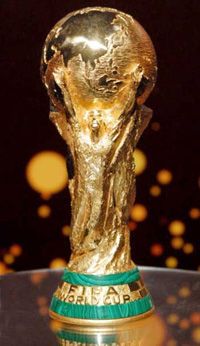
![]() Image courtesy Ulf Dietrich Creative Commons Atribution-Share Alike License 2.5 The FIFA World Cup trophy |
![]() Image courtesy Tony the Tiger/used under the GNU Free Documentation License The U.S. Soccer Federation building in Near South Side, Chicago |
The United States Football Association was formed in 1913. Known today as the U.S. Soccer Federation (or just U.S. Soccer), the governing body for soccer in the United States regulates and promotes soccer from the men's and women's national teams to Major League Soccer, the United States' primary professional soccer league. Development leagues at all levels also receive support from U.S. Soccer. Although the sport does not have a following approaching that of American football, baseball or basketball, soccer in the United States has grown tremendously in the last 20 years. Both national teams have achieved unparalleled success, MLS continues to thrive and youth soccer programs attract millions of young players every year.
|
Soccer Basics
Soccer is perhaps the most elemental team ball sport. Two teams, each with 11 players (including the goalkeeper) work to push a ball into the opposing team's goal using any part of their body other than their hands or arms. At the end of two 45 minute periods, whichever team has scored the most goals wins the game. Direct physical contact (pushing, checking, grabbing, etc.) is not allowed.
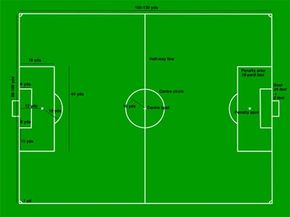
Matches are played on a field (often called a pitch) marked off on all four sides with white boundary lines. A typical field is 100 yards long and at least 50 yards wide, although some fields are larger. If the ball goes across the line on the sides of the field, it is returned to play via a two-handed overhead throw-in, the only situation where a non-goalie player can use his hands. If it goes out of play across an end line, it's returned to play by the goalie kicking it (if the offensive team played it out) or by a corner kick by the attacking team (if the defenders played it out).
![]() Image courtesy Ysangkok GNU Free Documentation License A soccer field, or pitch |
Fouls committed elsewhere on the field can result in a variety of penalties. Minor offenses, such as inadvertently touching the ball with the hands, tripping or holding an opponent or kicking at the ball while it's up in the air and dangerously close to people's heads results in a free kick for the other team. This change of possession usually happens quickly and keeps the game moving along.
More flagrant fouls can result in cards. Severe or repeated fouls, fighting, disrespecting the officials and intentional fouls give the referee the option of issuing a yellow card to the offending player. This is like a warning - the ref takes an actual yellow card out of his pocket and holds it in the air to let everyone know it's being issued. He then writes down the player's number in a notebook. A yellow card has no immediate effect, but if the same player receives another yellow card in the same game (and sometimes within the same tournament), he gets an automatic red card. A red card results in ejection from the game, and that player's team can't replace him, forcing them to play short-handed for the remainder of the match. Extreme offenses can result in an immediate red card, whether or not a prior yellow card was issued.
![]() Yellow card |
![]() Red card |
GNU Free Documentation License
The goalie can freely use his hands to catch, block and throw the ball within the goal area. He can move beyond the goal area, but must use his feet to move the ball.
![]() Image courtesy U.S. Air Force Goalkeeper diving to save the goal. |
If a game ends in a tie, the decision will depend on where and why the game is being played. In friendly matches and regular league games, the game simply ends and each team is credited with a tie, worth one point in league standings. In some tournaments, teams play two games against each other (several days apart) and the winner is determined by total goals scored. That can make a tie as bad as a loss for a team already behind on goals. In some tournaments, a tie is resolved with a shootout. This is a series of five penalty kicks, with teams alternating kicks. The team that scores the most goals with their five kicks wins.
![]() Courtesy of dustypuppy/Bjorn Laczay GNU Free Documentation License Penalty shot in the FIFA World Cup game between Ivory Coast and Serbia-Montenegro. |
![]() Public domain image A truncated icosahedron (left) compared to a football/soccer ball. |
Two officials watch from the sidelines and determine when someone has gone offsides. They will raise a flag and blow a whistle when this occurs. It is not always clear whether a player is offsides. Defenders may rush forward, 'trapping' opposing players and forcing them offsides. Also, if the ball is played to an attacking player from behind him, he only needs to be onside when the ball is played, not when it gets to him.
|
Soccer Techniques
Although any part of the body other than arms and hands can be used to play the ball in soccer, it's mostly a kicking game. Forceful, accurate passes can be made using the inside of the foot. More advanced players can make sudden shots with the outer edge of the foot, and can even use this technique to put spin on the ball, making it curve (or bend) in the air. When the ball bounces into the air, it can be struck with the head.
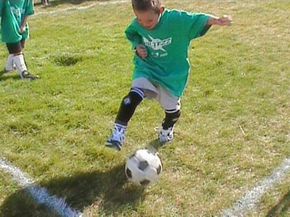
Individual players may "dribble" the ball with their feet to move it forward, but it is generally more efficient to pass the ball. One common offensive technique has an attacking player carry the ball at high speed down the sideline, toward the opponent's corner. Meanwhile some of his teammates run toward the front of the goal, being careful to stay onside. The player with the ball attempts to time a long cross pass to the front of the goal so that it reaches there just as the other players do, giving one of them a chance to kick or head it into the net.
![]() Image courtesy Libby A. Baker used under Creative Commons Attribution-ShareAlike License 2.5 A young player dribbles the ball |
Fullbacks generally stay behind their teammates, making sure the opponents are unable to generate scoring opportunities. When their goal is under attack, they will 'mark' an opposing player and stay close to him to keep him from receiving a pass. However, many teams have had success with fullbacks who occasionally make surprise attacks. Midfielders have a difficult job, as they must support the fullbacks in their defensive duties, but also control the center of the field and set up scoring chances for the forwards. Forwards tend to play in the opponent's half of the field, always working to bring the ball closer to the net for a shot at the goal.
![]() Public domain image A defender protects the ball |
Soccer Leagues and Championship Cups
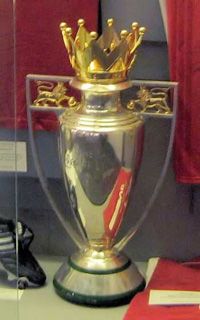
Most soccer playing nations have a domestic league in which teams associated with their home cities vie against each other for the league championship. Players from all over the world can sign on to these teams, although some leagues have rules requiring a minimum number of players from the league's home country per team. Many domestic leagues emulate the system used in England.
![]() Public domain image The Premiere League trophy |
Club teams from domestic leagues in Europe also compete against each other in various cup competitions, such as the Champions League and the Union of European Football Associations (UEFA) Cup. These prestigious tournaments pit the best teams from various domestic leagues each year. South American club teams have a similar tournament, Copa Libertadores de América. The major club competition in the United States is the Lamar Hunt U.S. Open Cup.
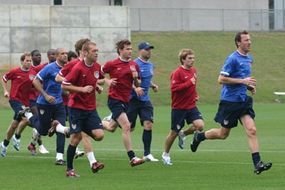
![]() Courtesy of Jarrett Campbell Members of the U.S. Men's National Soccer team during practice prior to the 2006 World Cup. |
Each soccer-playing nation also has a national team, made up of the best players who are citizens of that country. All national teams are part of FIFA, and they are also part of a regional division. For example, UEFA is FIFA's European division. Confederation of North, Central American and Caribbean Association Football (CONCACAF) is the division for that region. National teams compete within their division in a series of matches to determine rankings. They also compete in national cups, such as the CONCACAF Gold Cup and the UEFA European Football Championship. These competitions, along with a long series of qualifying matches, set up world rankings to determine which teams are eligible to enter the biggest international tournament of all: the World Cup. Held every four years (the last one was held in 2006), the World Cup is a massive event on par with the Olympics. The winners go down in history as one of the greatest football teams to ever play.
|
Soccer Worldwide
Soccer has grown to enormous levels of popularity since World War II, and FIFA has more member nations than the UN. The quadrennial World Cup tournament sets off a wave of soccer mania that encompasses the entire world. With that kind of popularity comes the chance for big profits.The average annual salary for a player in the English Premier League was about $1.3 million as of 2006 (based on May 2007 exchange rates). Lower-tiered leagues have lower salaries, but the average salary in England’s fourth division is still almost $90,000 [Source: The Sport Independent]. British Sky Broadcasting paid $1.77 billion for the rights to broadcast English Premier League games [Source: BBC]. England is a hotbed of football, though, and in countries where the sport is not quite as popular (or the economy can’t support such huge salaries), players earn considerably less. Players in the U.S.’s MLS make more than they did just a few years ago, but the numbers don’t compare to the money made in European leagues. A few players earn salaries with six digits, but some earn as little as $11, 700 per year, the league minimum [Source: The Washington Post]. Those players would almost certainly need to hold a second job to make ends meet.
Soccer’s legions of fans show their team or national pride in different ways around the world. They wear the team colors or paint them on their faces. Many international matches feature a great deal of flag waving in the stands. Unison chanting or singing is popular in Europe, with certain songs being associated with particular teams. Perhaps most famous is “You’ll Never Walk Alone,” sung by supports of Liverpool F.C. In some countries, fans light flares or even start celebratory fires in the stands, obviously dangerous practices.
The dark side of soccer is revealed by hooligans, fans whose behavior escalates to violence and vandalism. Some hooligans are fans who take devotion to their favorite team too far, attacking opposing fans and destroying property. Other hooligans have little interest in the sport and simply use it as an outlet for their antisocial tendencies. Hooliganism has been curbed by fierce crackdowns in Europe, with known offenders banned from attending matches (or even from traveling to the place where a match is being held), and teams being harshly penalized for the misbehavior of their fans. Club penalties include loss of league points or being forced to play matches in empty stadiums, denying the team any ticket sales revenue.
Even without malicious intent, the huge crowds at soccer matches can turn deadly. Stadium collapses and stampedes caused by overexcited fans have caused thousands of deaths. In 1946, an FA Cup match was played in Bolton, England with dead bodies lying along the sidelines after a barrier collapsed. Over 300 were killed during riots at an Olympic qualifier between Peru and Argentina in 1964. A stampede in Moscow in 1982 killed 340 people, and Britain’s worst football disaster occurred in 1989 when 96 fans were crushed in a stampede prior to an FA Cup match [Source: Hunt].
For lots more information on soccer, other sports and related topics, check out the links on the next page.
Lots More Information
Related HowStuffWorks Articles
- How Football Works
- How Baseball Works
- How Basketball Works
- How Hockey Works
- How the Super Bowl Works
- How 'Gracie' Works
More Great Links
Sources
- BBC News. 'Football TV rights bids submitted.' http://news.bbc.co.uk/2/hi/business/4949606.stm
- FIFA. '2002 FIFA World Cup TV Coverage.' http://www.fifa.com/en/marketing/newmedia/index/0,3509,10,00.html
- Harris, Nick. '£676,000: The average salary of a Premiership footballer in 2006.' The Indpendent. April 11, 2006. http://sport.independent.uk/football/news/article357006.ece
- Hornby, Hugh. "Soccer." Dk Pub, June 2000. ISBN 978-0789462848.
- Hunt, Chris. "The Complete Book of Soccer." Firefly Books (October 26, 2006). ISBN 978-1554071616.
- Murray, Bill. "The World's Game: A History of Soccer." University of Illinois Press, January 1, 1998. ISBN 978-0252067181.
- SoccerBallWorld.com. "Ball Construction and Design." http://soccerballworld.com/Construction.htm#Ball%20Construction
- Washington Post. "MLS 2006 Salaries." http://www.washingtonpost.com/wp-srv/sports/mls/ longterm/2006/mls.salaries.html
- Widdows, Richard. "Arco Book of Soccer Techniques and Tactics." MacMillan Publishing Company, July 1984. ISBN 978-0668058919.