|
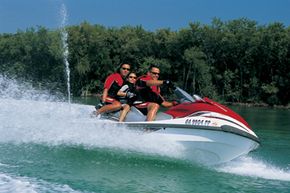
A few years later, Kawasaki Motors introduced the JET-SKIŽ watercraft, which became so popular that many people now refer to all personal watercraft as "jet skis." In the mid-1980s, other manufacturers developed their own models, and Bombardier re-introduced its SEA-DOO design.
Since then, demand for personal watercraft has skyrocketed. There were 1.48 million personal watercraft registered with the U.S. Coast Guard in 2004. About 28.7 million people rode personal watercraft in U.S. waters in the same year [Source: USDA].
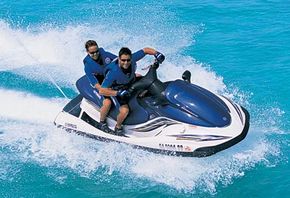
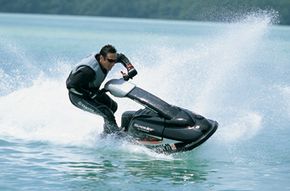
![]() Photo courtesy Yamaha Motor Corporation, U.S.A. Yamaha Superjet. See more pictures of personal watercraft. |
In this article, we will explore how these craft operate, and we'll examine the safety, environmental and legal concerns related to their use.
|
|
The Basic Principle
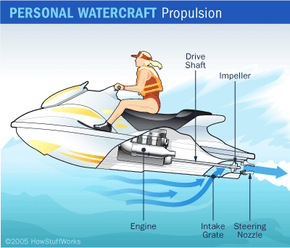
A personal watercraft moves through the water in the same sort of way a rocket moves through the atmosphere. But instead of using high-pressure gas to generate thrust, the craft uses a jet drive to create a powerful stream of water. In the jet drive, an impeller propels a large amount of water from underneath the craft through a steering nozzle at the rear of the craft.
![]() A personal watercraft's engine and jet drive |
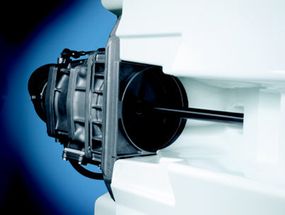
The impeller is a rotor-like device that sits inside a cylindrical passageway in the body of the craft. The craft's engine rotates the impeller via a drive shaft. The impeller's curved blades spin rapidly, forcing water up through the passageway and out through the nozzle.
![]() Photo courtesy Yamaha Motor Corporation, U.S.A. Yamaha FX High Output impeller and steering |
This moves the craft because of the principle described in Isaac Newton's third law of motion. According to Newton's third law, for every action, there is an equal and opposite reaction. In this case, the action is the expulsion of water through the nozzle. The reaction is the movement of the boat in the opposite direction. How Rocket Engines Work explains this principle in detail.
When you steer the craft, a cable linkage connected to the handles swivels the nozzle at the rear of the craft. This changes the direction of the "equal and opposite reaction." If the nozzle directs the water to the right side of the craft, the rear of the craft pushes to the left. That causes the front of the craft to turn to the right.
That's the basic idea of a personal watercraft. Now let's examine the details of this system.
More Options: