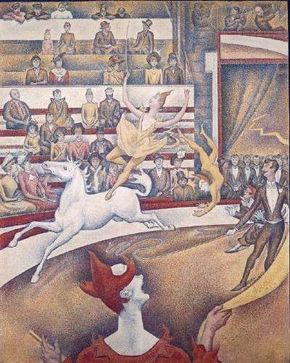
Georges Seurat joined the Impressionists after catching the interest of original member Camille Pissarro. Informed by recent discoveries in optical theory, Georges Seurat had developed a method of applying dots of pure pigment on his canvas in close juxtaposition, simulating the action of individual rays of light. Seurat proposed that the viewer's retina -- rather than the painter's brush -- would blend the colors, recreating in paint the luminous and vibrant effect of looking at nature.
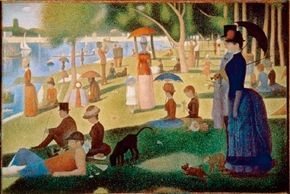
Georges Seurat made his triumphant debut at the Impressionists' eighth exhibition. Seurat's Sunday Afternoon on the Island of the Grande-Jatte was the centerpiece of the show's final room. Epic in scale, Seurat's painting addressed a subject long associated with Impressionist painting: people in a public park on a sunny afternoon. But in contrast to the fleeting sense of momentary observation that had become the hallmark of Impressionist plein air painting, Georges Seurat's painting featured rigorous formal organization, a strategy a contemporary critic termed Neo-Impressionism.
Advertisement
Although it shattered the now-conventional perception of Impressionism as an unmediated rendering of fleeting visual sensations, Sunday Afternoon on the Island of the Grande-Jatte by Georges Seurat embodied the independent and progressive spirit of the initial Impressionist experiment.
Below are some links to Seurat's most famous painting, Sunday Afternoon on the Island of the Grande-Jatte, as well as a few others that helped cement his reputation as one of the fathers of Neo-Impressionism.
- Sunday Afternoon on the Island of the Grand-Jatte: This Impressionist painting by Georges Seurat pioneered a more formal approach to art that came to be called Neo-Impressionism. Find out about Sunday Afternoon on the Island of the Grand-Jatte by Georges Seurat, which debuted at the final Impressionist exhibition.
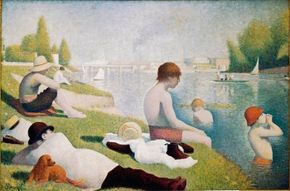
- Bathers at Asnières: Seurat's painting Bathers at Asnières exhibits Seurat's structural approach to painting that differed from traditional Impressionism. Learn about this painting, which Seurat completed in 1884.
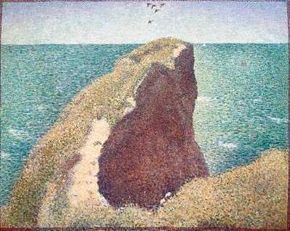
- Le Bec du Hoc, Grandcamp: Seurat's unique approach, sometimes called Pointillism, is evident in his painting Le Bec du Hoc, Grandcamp. Learn about Le Bec du Hoc, Grandcamp, by Georges Seurat.
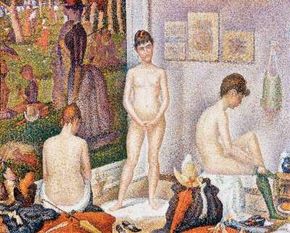
- The Models: Georges Seurat completed The Models in 1886-1887. Read about this Impressionist painting, which features a depiction of Seurat's own Sunday Afternoon on the Island of the Grand-Jatte in the background.
- The Circus: In The Circus, by Georges Seurat, the artist, like Pierre-Auguste Renoir and Edgar Degas, chose the Cirque Fernando as his subject. Read about The Circus by Georges Seurat.
Continue reading to learn about the painting that made Georges Seurat famous.For more on Impressionist paintings, artists, and art history, see:
Advertisement