Lucha Libre Competition and Stars
|
Lucha libre has seeped into popular culture in other ways, such as the popular Homestar Runner Internet cartoon character Strong Bad, based on a wrestler in an old Nintendo video game. The shirtless Strong Bad wears a luchadore's mask and acts slightly villainous, speaking with a faint Mexican accent. The children's cartoon "Mucha Lucha" takes place in a town where everyone is a luchadore, complete with masks and outlandish wrestling moves. "Nacho Libre" is a 2006 movie starring Jack Black, written by "Napoleon Dynamite" creator Jared Hess. In the film, Black plays a cook at a Mexican orphanage who takes up the identity of a luchadore to help provide for the orphans. |
The rules are very similar to American pro wrestling. In single matches, there are four basic ways to win: pinning the opponent to the mat for a count of three, knocking him out of the ring for a count of twenty, making him submit (which he signals by either waving his hands or telling the referee -- luchadores don't "tap out" like American pro wrestlers) or by disqualification. Performing an illegal move and removing an opponent's mask are just two ways to get disqualified. There's also an "excessive violence" (or exceso de rudezas) rule, in which the referee can stop the fight and award the win to a luchadore if he clearly giving his opponent a beating.
But singles matches aren't nearly as popular as tag team matches. In the three on three tag team match (also called trios matches or Relevos Australianos -- "Australian tag match"), each team appoints a captain. To win, two out of the three luchadores must be pinned, or the other team must score a pin-fall against the captain. This is the main type of lucha libre match, and there are usually two referees (often one tecnico and one rudo) to call the action. There are also four on four atomicos matches and five on five matches (like the WWF "Survivor Series"). In the latter, the goal is to pin the team captain.
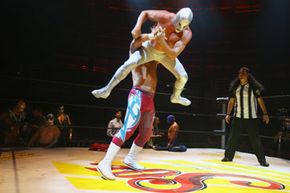
In two on two tag team matches, or parejas, both team members must be eliminated to win. Actual "tags" aren't necessary in any of the tag team matches; when a luchadore falls outside of the ring, his partner can immediately enter the ring. Because of this, lucha libre tag team matches often go much faster than American pro wrestling ones.
Most lucha libre wrestling moves are similar to American wrestling moves, though they have different names. In fact, a number of acrobatic moves that are common in American wrestling today were actually developed by Mexican wrestlers. Here are some of the major moves:
- Rana - a pin position in which one wrestler holds the opponent's shoulders down with his legs, and hooks the opponent's legs with his arms. The famous Huracan rana is a way to get into the rana pin by starting with a flying headscissor, created by Huracan Ramirez.
- Plancha - a move in which one wrestler is flat on his back and the opponent dives onto him from above with his full body.
- Tornillo - a plancha in which the diving wrestler twists in the air.
- Tope - any move involving a head-butt.
- Centón - a plancha in which the diving wrestler lands on his back.
![]() Photo courtesy Paramount Pictures; photo credit: Daniel Daza An example of a "two on two" tag team match, or parejas from "Nacho Libre" |
Stars of Lucha Libre
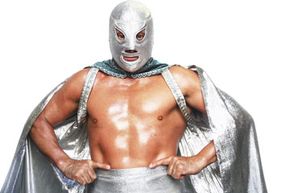
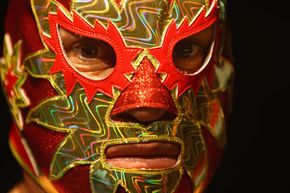
The most legendary star of lucha libre is undoubtedly El Santo. His full name was Santo, el Enmascarado de Plata (The Saint of the Silver Mask), and his real name was Rodolfo Guzmán Huerta. El Santo began wrestling under various names in the 1930s, then created the Santo identity in the 1940s. His legendary status began in the '50s, mainly by way of a comic book featuring the character. El Santo would go on to star in dozens of cheap, quickly produced films, including titles like "Santo vs. the Vampire Women," "Santo in the Vengeance of the Mummy," "Santo vs. Black Magic," and "The Fist of Death" [ref]. El Santo was never unmasked -- he was buried still wearing the mask after his death in 1984. Only one known photograph of Santo without the mask is known to exist, and it is not publically available.
The Blue Demon was a contemporary of El Santo. They were opponents in the ring, but appeared together in several movies. The Blue Demon starred in more than 20 of his own films.
Mil Máscaras, whose name translates as "Man of a Thousand Masks," was the first Mexican wrestler to have a major impact on American wrestling, appearing in many WWF events. He also wrestled in Japan and starred in several movies.
Rey Mysterio is perhaps the most popular luchadore who has made the jump into american wrestling leagues. Inspired by his great uncle, Rey Misterio, Sr., Mysterio's style typifies lucha libre. From his early days in ECW to high-profile work in WWE, Mysterio has become known for his colorful masks and astonishing aerial maneuvers.
![]() Photo courtesy Paramount Pictures; photo credit: Daniel Daza Another example of a two-on-two tag team match, or parejas from "Nacho Libre" |
Eddie Guerrero was an immensely popular star in the WWE, despite the fact that he was a rudo, or heel, for most of his career. Guerrero was part of an extended wrestling family with a lineage tracing back to his father, one of the original luchadores, along with three wrestling brothers, an uncle, a nephew and a cousin. His death in 2005 of a heart condition possibly aggravated by prior steroid use was highly controversial.
For more information about lucha libre and related topics, check out the links on the next page.