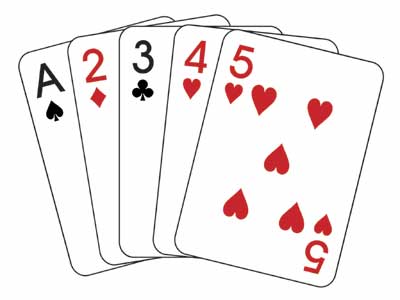
As in most forms of poker, the majority of a good player's profit in Omaha comes from the mistakes of opponents. Therefore, the first step in becoming a successful player is a thorough understanding of the rules of Omaha high-only (meaning the hand with the most points wins) and Omaha high-low split (meaning the highest hand and the lowest hand split the winnings) -- often called Omaha/8. In the following sections, we will discuss basic strategy and advanced strategies for starting hand selection, as well as playing on the flop, turn, and river.
The hi-lo (high-low) version of Omaha will be discussed in these pages since it is the more popular of the two versions. Moreover, the high-only version is played exactly the same way as the hi-lo version except the pot (the total amount of money bit on a single hand) is not split and the high hand is awarded the entire pot.
Omaha is also played at set limit or pot limit (raises can be up to the current size of the pot). Though it is occasionally available, no-limit Omaha is rarely played. In this article, limit Omaha will be discussed unless it is stated otherwise. It is strongly recommended that you play only limit Omaha until you have a great deal of experience because pot-limit Omaha can be a brutal game for the beginning player and can take a heavy toll on your bankroll. Rarely play pot-limit because, like no-limit, one mistake can be extremely expensive.
Now that we have the preliminaries out of the way, move on to the next section for basic strategy in Omaha poker.
For more information on Omaha poker and other variations, try the following links:
Up Next
|
Omaha is also played at set limit or pot limit (raises can be up to the current size of the pot). Though it is occasionally available, no-limit Omaha is rarely played. In this article, limit Omaha will be discussed unless it is stated otherwise. It is strongly recommended that you play only limit Omaha until you have a great deal of experience because pot-limit Omaha can be a brutal game for the beginning player and can take a heavy toll on your bankroll. Rarely play pot-limit because, like no-limit, one mistake can be extremely expensive.
Card Abbreviations and Rankings Abbreviations for cards and their ranks will appear throughout this article. You can refer to this list. A Ace (also known as a "bullet") K King (also known as a "cowboy") Q Queen J Jack T Ten 9 Nine 8 Eight 7 Seven 6 Six 5 Five 4 Four 3 Three 2 Two (also known as a "deuce" of a "duck") AA Pair of aces AK Ace and King Q9s Queen and nine, suited (of the same suit) (The "s" means suited, so if it were Q9 without the "s," that indicates the cards are of different suits.) |
For more information on Omaha poker and other variations, try the following links:
- See all of our articles on poker rules and advice, go to our main article How To Play Poker.
- For the more common form of Hold 'Em, what you want is to know How to Play Texas Hold 'Em Poker.
- Feel more like playing an old favorite. Knowing How to Play 7-Card Stud Poker will take you back a few years.
Advertisement