World wars, the Great Depression, and influenza outbreaks kept the young NHL in a state of flux. Teams joined the league and then folded under the financial pressure regularly. It wasn't until 1942 that a period of stability would allow the NHL to prosper. With the roster reduced to six solid teams (hockey's Original Six), new league president Clarence Campbell guided the NHL through 25 years of prosperity, and later took the reins for the first major NHL expansion.
The era of the Original Six came to an end in 1967, when the NHL doubled in size. Teams were added in Los Angeles, San Francisco, Philadelphia, Pittsburgh, Minneapolis, and St. Louis. Several more franchises joined the league in the early '70s. In 1979, a competing league, the World Hockey Association, folded. Four WHA teams joined the NHL. Meanwhile, financial troubles forced some teams to move, and some to fold altogether. For roughly a decade, the league was stable, adopting a four-division, two-conference system, with the groups named after important figures in hockey's past. The NHL underwent further expansion throughout the 1990s, helmed by commissioner Gary Bettman. The league roster stands at an even 30 teams, with no immediate plans for future expansion.
Pivotal Events Hockey history is punctuated by events whose repercussions are still felt today. We'll look at some of the events that have shaped the game.
The Richard Riot Maurice "Rocket" Richard was the French-Canadian hero of the French-Canadian fans in Montreal. He was the first player to score 50 goals in a season, doing it in just 50 games. But his talent for scoring was matched by a fiery temper. In 1955, he attacked an opponent with his stick, and then punched an official. League president Clarence Campbell announced that Richard would be suspended for the rest of the regular season and the playoffs.
In the province of Quebec, where there had always been tension between French and English Canadians, the suspension was a spark that set off an explosion. Campbell was not French-Canadian, and his decision was decried as anti-French. He received numerous death threats, but attended the next Canadiens game regardless. He was repeatedly assaulted at the arena, and was pelted with fruits, eggs, coins, and bottles. Finally, someone threw tear gas into the seats near Campbell, and the panicky crowd fled the arena. The game was forfeited to Detroit, but the debacle wasn't over.
Outside, the fleeing fans ran into thousands of angry French-Canadian protesters. The crowd whipped itself into a fury that moved down Rue St. Catherine, smashing windows and burning cars until 3 a.m. The next day, Richard pleaded for calm on the radio. His suspension stood. The Canadiens would lose the Stanley Cup to Detroit that year.
The Summit Series Canada had long dominated international hockey, but with its best players in the NHL, the remaining amateurs began to fall to more talented Russian teams in the '60s. The 1972 Summit Series was intended to pit the best professional Canadian players against the best Russia had to offer. Four games would be played in each country, and the Canadian fans had little doubt their pros would wipe the ice with the Russians.
It was no small shock, then, when Russia won the first game in Montreal 7-3. The Russian stars quickly made names for themselves, wrapping up the four Canadian games with two wins, one loss, and one tie.
Team Canada would face great adversity while trying to compete in Russia. They were disturbed in their hotel rooms. Their food was stolen. During a game, when Alan Eagleson got angry over a bad call, Russian police grabbed him and starting hauling him off. The Canadian players dove to his rescue, fighting off the Russian officials at rink side, and dragging Eagleson back to the bench.
It all came down to game eight, and virtually every Canadian was watching on TV or listening on the radio. Team Canada was bolstered by 3,000 fans who made the trip to Moscow, and Paul Henderson beat Russian goalie Vladislav Tretiak to win the series.
The Great One If the career of Wayne Gretzky can be considered a single event, then it is surely one of the most pivotal in hockey history. From 1979 to 1999, Gretzky set 61 NHL records. He has the most career goals (894) and most career assists (1,963). He holds the record for most goals in a single season, putting in an astonishing 92 goals during the 1981-82 campaign. The closest player to that mark is… Wayne Gretzky, who scored 87 goals in 1983-84. He not only holds the record for most assists in a season (163 in 1985-86), he actually holds the top eight spots for that record, and 11 out of the top 12.
Labor Pains The NHL's players formed their own union, the NHL Player's Association, in 1966. In the 1990s, negotiations between the NHLPA and the owners twice brought the game to a halt. In 1992, the players went on strike late in the season. That time, it took only 10 days to hammer out an agreement.
Only two years later, relations got far worse. With no collective bargaining agreement (CBA) in place at the start of the 1994 season, the owners locked the players out. Months went by, and it looked as if the entire season might be called off. At the last possible minute, a deal was reached, and the season finally began, nearly four months late.
Hockey owners and players went through yet another crisis in 2004. Although both sides made concessions, they could not reach an agreement in time and the 2004-2005 hockey season was cancelled.
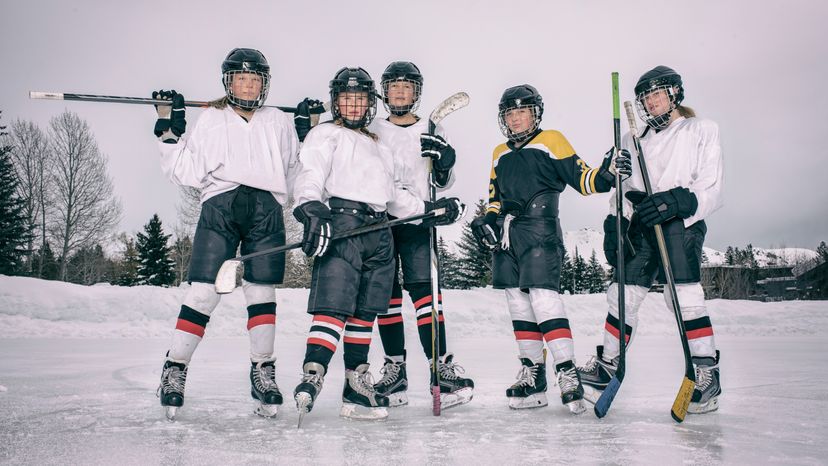
Hockey has evolved steadily throughout its long history. Each year, the NHL Board of Governors examines potential rule changes. Usually, these changes are subtle, but over time, hockey continues to change. Women's hockey is gaining prominence, mostly as an international sport. European players are an increasingly familiar presence in the NHL. Hockey is gaining popularity in non-traditional hockey countries like Japan and England.
For more information on hockey and related topics, check out the links on the next page.