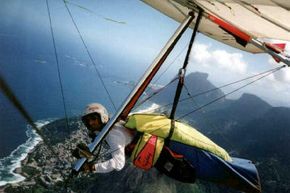
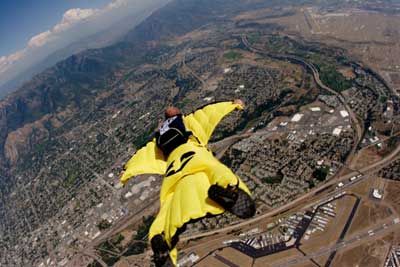
Imagine soaring like a hawk thousands of feet above the ground. Although the air is somewhat chilly, the view is tremendous and the solitude is relaxing. You search for updrafts of air to keep you aloft so that you can enjoy this feeling for hours. This is the experience of hang gliding.
The hang glider's wing, called a delta wing or Rogallo wing, is an outgrowth of NASA engineer Francis Rogallo's research on kites and parachutes in the 1960s. Rogallo had proposed the wing as a method of returning spacecraft to Earth. The delta-wing parachute was lightweight, durable and highly maneuverable. Later, John Dickenson, Bill Moyes, Bill Bennett and Richard Miller developed the Rogallo wing into the modern hang glider and launched an immensely popular sport shared by millions of people worldwide.
Advertisement
The hang glider is actually a triangle-shaped airfoil, a modified parachute (known as a flexible wing) made of nylon or Dacron fabric. The triangular shape is maintained by rigid aluminum tubes and cables and is designed to allow air to flow over the surface to make the wing rise. Newer, high-performance hang-glider designs use a rigid wing with stiff aluminum struts inside the fabric to give it shape, eliminating the need for supporting cables.
Hang gliding is often confused with paragliding, though the two sports are quite different from one another. Check out the paragliding article, video and images at Discovery’s Fearless Planet to learn more.
In this article, we will examine the sport of hang gliding. We'll show you the details of the aircraft, the equipment involved, how to fly it and how to become a certified hang glider.
To launch, the pilot must run down a slope to get air moving across the wing at about 15 to 25 miles per hour (24 to 40 kph). This movement of air over the surface of the wing generates lift, the force that counters gravity and keeps the glider aloft. Once aloft, gravity (the weight of the hang glider and pilot) pulls the glider back toward Earth and propels the glider forward, continually causing air to flow over the wing.
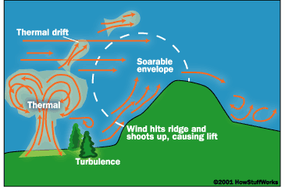
In addition to the horizontal movement of air, hang gliders can get lift from rising currents of air, such as columns of hot air (thermal lift) or air deflected upward by mountainous or ridge topography (ridge lift). As the hang glider and pilot move through the air, they collide with air molecules. The frictional force caused by these collisions is known as drag, which slows the glider down. The amount of drag is proportional to the airspeed of the hang glider: The faster the glider moves, the more drag it creates (see How Gliders Work for details).
Advertisement
How a pilot maneuvers a hang glider
As with soarplane gliders, the balance of these three forces (lift, drag, gravity) determines how high the hang glider can go, how far it can travel and how long it can stay aloft. The performance of a hang glider and the distance it can travel is determined by its glide ratio (lift/drag ratio), the ratio of the forward distance traveled to the vertical distance dropped. Unlike soarplane gliders, hang gliders have neither movable surfaces on the wing nor a tail to deflect airflow and maneuver the craft. Instead, the pilot is suspended from the hang glider's center-of-mass (hence the term "hang" glider) by way of a harness, maneuvering the hang glider by shifting his or her weight (changing the center-of-mass) in the direction of the intended turn.
The pilot can also change the angle that the wing makes with the horizontal axis (angle of attack), which determines the airspeed and the glide ratio of the hang glider. If the pilot pulls back on the glider, tipping its nose down, the glider speeds up. If the pilot pushes forward on the glider, tipping its nose up, the glider slows down or even stalls. In stalling, no air flows over the wing so the glider can't fly.
Advertisement
Hang-gliding Equipment
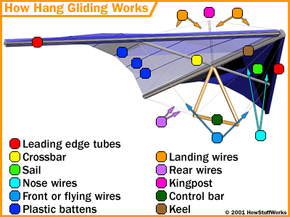
Parts of a hang glider
The basic equipment for hang gliding consists of the glider itself, the harness and a helmet. In addition, some pilots have instruments and an emergency reserve parachute.
Hang Glider
The basic hang glider (flexible wing) consists of the following structures:
Advertisement
Aluminum tubes (aircraft grade) - make up the skeleton of the glider
Leading-edge tubes (2) - form the triangle shape
Keel - bisects the forward angle (nose) of the triangle
Crossbar - sits back from the nose and provides support by rigidly connecting the keel with the leading edges
Control bar - smaller triangle-shaped tube connected at a right angle beneath the keel and behind the crossbar, used by the pilot to maneuver the glider
Sail - the flying surface, usually made of nylon or Dacron
Kingpost - attached to the keel on the other side of the control bar, supporting the wires on the top of the glider
Steel wires (aircraft grade) - support the various weights and stresses on the glider
Nose wires (2) - connect the nose with the control bar
Rear wires (2) - connect the control bar to the back of the keel
Front wires (2) - connect the control bar with the junction of the leading-edge tubes and crossbar
Landing wires (4) - connect the kingpost with the nose, the back of the keel and each crossbar leading-edge junction
Plastic battens - insert into pockets in the sail to stiffen certain spots
Hang gliding began with aviation pioneers like Otto Lilienthal, who created the first controllable gliders.
Hang gliding requires training, with focus on launch, control, and landing techniques to ensure a thrilling yet safe experience.
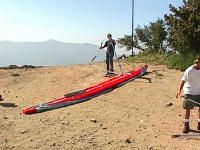
Assembling a hang glider: control bar (left), connecting wires (right). Click on the pictures for a larger view.
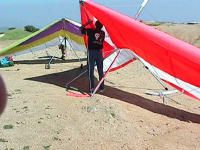
The aluminum tubes are hinged so that the glider can be easily assembled and folded up for transport. Basically, the pilot unpacks the glider, assembles the control bar, unfolds the crossbar, stretches the sail out, rigs the various wires and inserts the battens.
Tandem hang gliding. The student (front) is wearing a strap harness, while the instructor (rear) is wearing a bag-style harness.
Photo courtesy Footlaunched
Harness
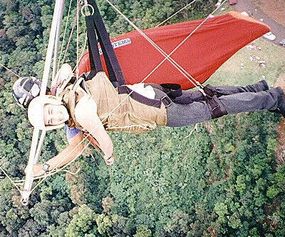
The harness attaches to the center-of-mass of the glider, just behind the control bar. It suspends the pilot from the glider in such a way as to allow him or her to move freely. Harnesses come in many styles and hold the pilot in a prone position. Some are insulated especially for high-altitude flights.
Safety Equipment
The most basic piece of safety equipment is the helmet, which protect the pilot's head. Other safety equipment includes goggles for eye protection and glare reduction (similar to ski goggles) and a reserve parachute, usually for high-altitude flights (several-thousand feet up).
Instruments
Some pilots carry instruments such as an altimeter, to keep track of the glider's altitude, and a variometer that keeps track of glider's climb or descent rate. In addition to visual displays, variometers have audio displays so the pilot doesn't have to look at the dial to know his climb or descent rate. Variometers and altimeters are especially important for high-altitude or long-distance (cross-country) flights.
Advertisement
A Basic Flight
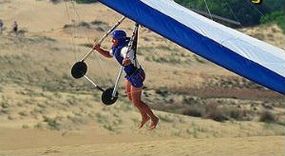
A pilot runs to launch his hang glider.
Photo courtesy Sky Masters School of Hang Gliding
Several years ago, I took a basic hang-gliding lesson from Kitty Hawk Kites at Jockey's Ridge, NC, which is a large sand dune (80 to 100 ft / 24 to 30 m high). The goal of our lesson was to take off, fly in a straight line down the ridge and land upright. Before the flight, the instructor conducted a pre-flight inspection of the glider, checking to make sure that all of the hardware was in good condition, including the sail, battens, cables, tubes, bolts and harness connections. Next, because Jockey's Ridge is a public park, he checked to make sure that our intended flight path was clear of obstacles and people.
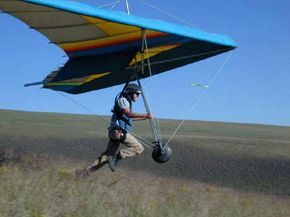
To take off, I lifted the hang glider (about 65 pounds / 29 kilograms) by the sides of the control bar and ran down the ridge (the instructor ran along side and shouted directions). The sail filled with air as I ran. When the airspeed reached about 17 mph (27 kph), I could feel the hang glider lift me off the ground. As I was lifted, I moved my hands from the sides of the control bar to either side of its base.
Advertisement
To fly, I had to do two things: maintain a constant speed and keep my direction in a straight line.
I had to sense my airspeed (no instruments to help me out). If I was moving too fast, I pushed the control bar away from me to slow down. If I was moving too slow, I pulled the control bar toward me to speed up.
I had to fly in a straight line. If I veered to the right, I had to shift my weight to the left to get back on course. If I veered to the left, I had to shift my weight to the right.
During the the entire flight, I was constantly adjusting my speed and position (beginners tend to over-adjust their speeds compared to advanced fliers). I flew about 600 ft (183 m) down the sand dune at an altitude of about 5 to 10 ft (1.5 to 3 m).
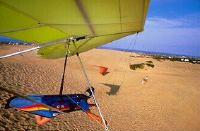
Hang glider over Jockey's Ridge, NC
Photo courtesy Kitty Hawk Kites
To land the hang glider, you have to stall it. As I approached the ground, I pushed the control bar as far out as I could. This tips the glider nose up, slows the glider down and eventually stalls it so you can land upright on your feet.
A pilot stalls her glider to land upright.
Photo courtesy Kitty Hawk Kites
Of course, not all beginners accomplish all of these tasks on the first try. It took me three flights to manage to take off, fly straight and land on my feet (On my first flight, I veered off to the right, landed on my abdomen and buried my wrist in the sand.).
Micrometeorological changes that pilots look for
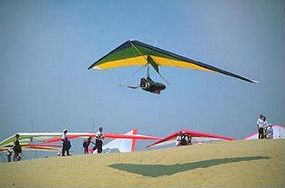
Experienced hang-glider pilots can take off from a slight slope or a steep mountain top and fly for hours. They look for micrometeorological changes to gain lift so that they can stay aloft. These changes include rising columns of hot air (thermals) found over places that take in plenty of sunlight, like sand or pavement. Often times, you can locate these currents by watching the birds, particularly seagulls or hawks. Pilots also look for updrafts of air deflected by ridges (ridge lifts) to provide additional lift. Upward currents of air between two mountain ridges, called wave currents, can provide additional lift as well. An experienced pilot tries to avoid turbulent air, which can slow the glider and cause it to tumble, and such obstacles as power lines and tall structures.
For more information on hang gliding and related topics, check out the links on the next page.