Claude Monet's personal life was marred with tragedy. In January 1910, a deluge of rain broke through the banks of the Epte, flooding Monet's property and causing extensive damage to the water garden. Two months later, his beloved Alice was diagnosed with myelogenous leukemia, and, when she died a year later, Monet became so depressed he could not paint.
The summer of 1912 brought more devastating news: Monet's fatigued vision, now more troublesome than ever, was caused by double cataracts. Although Claude Monet refused the recommended operation, in 1913 he broke his long spell of inactivity, painting the rose-covered trellises at the entrance to the water garden.
Advertisement
Monet Image Gallery
By April 1914, Monet's confidence returned, for, as he explained in a letter to friend Gustave Geffroy, he had revived an old idea he had put aside and was now working with vigor on some large paintings. Throughout the summer, Monet worked with his old speed and intensity, painting in his water garden on canvases so big he had to climb on a tall stool to reach them.
To accommodate his failing eyesight, he painted outdoors only in the early morning and late afternoon, avoiding brilliant sunlight, and spent the middle of the day in the studio. He worked from the moment he awoke until he could no longer wield his brush.
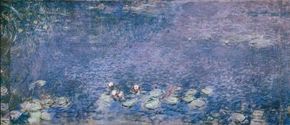
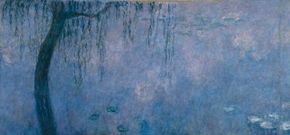
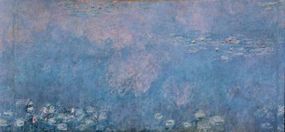
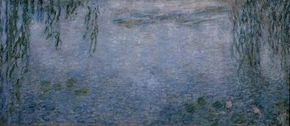
Claude Monet called his current project The Grandes Decorations. He was now working on an even larger scale, and, later in the year, he built a vast new studio, illuminated by northern light streaming from a glass ceiling. Monet's concept was now clear: He transferred the fleeting effects he painted on site at the water garden onto canvases that were six and a half feet high and 14 feet wide. He mounted his easels on wheeled dollies so he could move his panneaux (panels) around the studio and arrange them in different combinations.
Claude Monet painted more than 40 panneaux for The Grandes Decorations. He covered his vast canvases with a large brush, building his surface with layers of color. He would first apply shades of a dominant tone -- a pale violet or a golden green -- and then work in his motifs over the plane of modulated color in broad gestural strokes. He attained an unprecedented surface texture, ranging from delicate hues applied in thin, translucent glazes to areas of thickly encrusted pigment.
The last years of Claude Monet's life were absorbed in preparing the panneaux of The Grandes Decorations. He continually repainted them, discarding some canvases but always feeling compelled to start new ones. Monet had to stop working when he submitted to a series of cataract operations in January 1923. Despite corrective glasses, his full vision never recovered, but he returned to work in the summer of 1925.
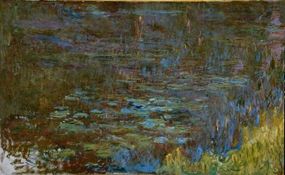
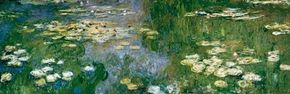
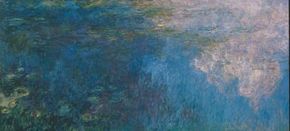
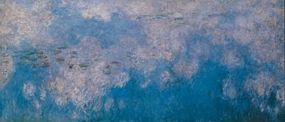
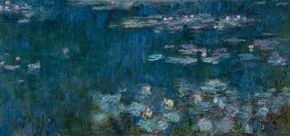
In the new year, he selected 22 panels to be installed in two elliptical rooms in Musée de l'Orangerie in Paris. The first room would follow the changing effects of light -- in Morning, Green Reflections, The Clouds, and Sunset -- seen as fleeting reflections on the waters. Weeping willows would be the dominant motif in the second room, with a panoramic view of the glassy waters glimpsed between randomly placed trunks and drooping branches.
Monet did not live to see his panneaux installed, but, as he wished, the canvases were removed from their stretchers and affixed directly to the curving walls. He also requested that his paintings remain unvarnished and be viewed in natural light. A ceremony was held to open Musée de l'Orangerie on May 17, 1927. The work housed there bore the legacy of Monet's lifelong pursuit to express his feeling before nature.
Find out more about Claude Monet's paintings from 1914 though 1926:
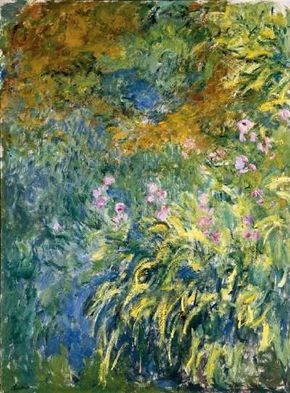
- Claude Monet's Irises by the Pond depicts Monet's favorite flower, the iris. Learn more about the technique behind Monet's Irises by the Pond.
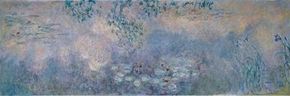
- Claude Monet's Water Lily Pond with Irises included panels over six feet tall and 14 feet wide, immersing the viewer into the world of the water lilies. Check out the spectacle of Monet's Water Lily Pond with Irises.
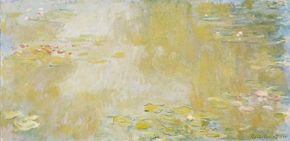
- Claude Monet's Waterlilies at Giverny is an immersion into water and light. Learn more about Monet's Waterlilies at Giverny.
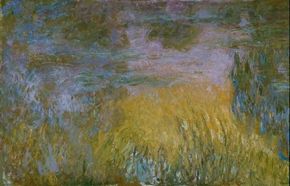
- Sunset by Claude Monet is an ensemble of light observations, ranging from deepest violet-red to shining yellow gold. See Monet's Sunset.
- Claude Monet's Water Lily Pond is part of the Grandes Decorations series, sharing motifs and light effects. Learn more about Monet's Water Lily Pond.
- The Clouds by Claude Monet employs the basic element of water as a mirror, with an ever-changing appearance of life. Check out Monet's The Clouds.
- Claude Monet's work The Morning evokes the morning's cool air and serene silence in order to create a sensuous visual experience. See Monet's The Morning.
- Morning by Claude Monet shifts to focus on the perceived rhythm of the lilies and light on the water. Discover the beauty of Monet's Morning.
- Green Reflections by Claude Monet features a cooler palette of greens and blues and employs a different angle of vision. Discover Monet's Green Reflections.
- Claude Monet's The Two Willows is a four panel ensemble that continues the cool hues seen in The Morning, but the reflections of the clouds deepen to a warm pink. See how Monet's honed his observation with The Two Willows.
- The Morning by Claude Monet reflects Monet's dedication to observing the fleeting effects of natural light. Learn more about Monet's The Morning.
Irises by the Pond by Claude Monet employs various techniques to capture the essence of the irises. View the brush strokes Monet used in the next section.To learn more about art, famous artists, and art history, check out:
Advertisement