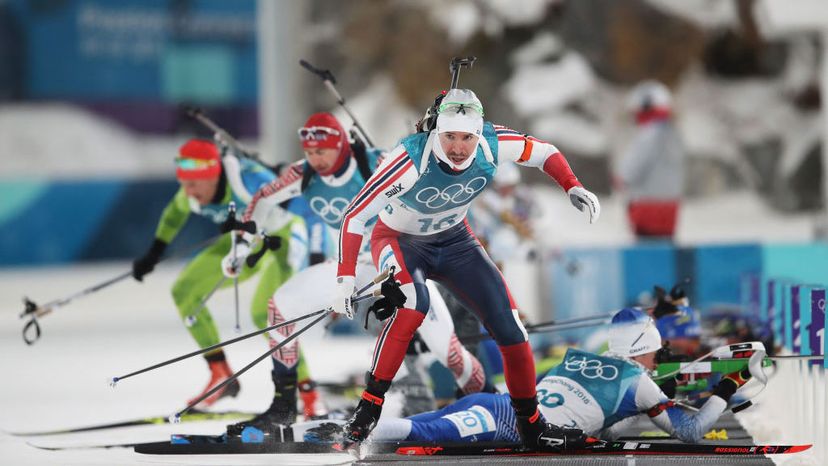
Timofei Lapshin of Korea competes during the Men's Biathlon 12.5km Pursuit on day three of the PyeongChang 2018 Winter Olympic Games at Alpensia Biathlon Centre on Feb. 12, 2018. Sean M. Haffey/Getty Images
Imagine cross-country skiing for 5 kilometers, then, with your heart pounding, your legs shaking, and your fingers chilled from the cold weather, shooting five targets at 50 meters with exactly five shots. Then you pack up your rifle and ski for another 5 kilometers to the next set of targets. This strange combination of grueling endurance race and marksmanship competition is known as biathlon. It's been an Olympic sport since 1960, and is regularly one of the most watched events for European sports fans.
Having to be very aerobically fit and aggressive for the fast-paced cross country skiing and then having to be very calm and precise to take accurate shots makes the biathlon a sport unlike any other.
Advertisement
In this article, we'll learn about the rules and regulations of biathlon, find out what it takes to be a biathlete and learn how it came to be an internationally recognized sport.
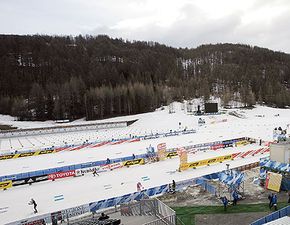
Part of the 2006 Torino Olympic biathlon course in Cesana, San Sicario, Italy
Photo courtesy La Presse
The word biathlon has Greek origins, and translates to "the joining of two contests." Any sport that combines two different disciplines into a single event can be referred to as a biathlon. Events that involve running and bicycling, running and swimming, or even skiing and running are also biathlons, but the official Olympic biathlon combines skiing and shooting.
A typical biathlon event requires participants to ski for a certain distance, usually between 3 and 5 kilometers (between 1.86 and 3.1 miles), with .22 caliber rifles strapped to their backs. When they reach the firing range, they must shoot five targets placed 50 meters (165 feet) away. They only have five shots, and for each shot that misses a target, the competitor must ski around a penalty loop of 150 m. This process repeats over three or four additional segments of skiing and shooting.
Advertisement
Although skiing and shooting might seem unconnected, the sport actually grew out of hunting and military practices in use for centuries. In Scandinavian countries, skiing to get around while hunting for food was a common practice. Rock carvings (petroglyphs) in Norway indicate that ski hunting goes back to prehistoric times.
Finnish soldiers were able to fight off a 1939 Russian invasion although they were heavily outnumbered. The Finns used the cold weather and terrain to their advantage, striking quickly with ski-mounted units and targeting Russian food supplies. Inspired by this, the U.S. Army formed the 10th Mountain Division in 1941. This specially trained unit comprising experienced skiers and rock climbers fought towards the end of World War II in the Apennine Mountains in Italy.
Various "rifle and ski" clubs had competed informally in Scandinavian countries in the 18th and 19th centuries. Early biathlons differed in some important ways from the modern biathlon. There was one basic event, a 20 kilometer ski, with rifle targets placed 150 to 250 m downrange.
Recreational skiing and shooting has a long history as well. In the early 1900s, the Norwegian military began holding organized biathlon contests, which developed into a demonstration Olympic event known as Military Patrol.
By 1948, the biathlon was governed by the Union Internationale de Pentathlon Moderne et Biathlon (UIPMB). It then became an Olympic sport in 1955. The first Olympic biathlon event was held in 1960 at the Squaw Valley Olympics. Additional events were added through the years, and 1984 saw the first women's biathlon world championships. Women's biathlon became an Olympic event at the Albertville Winter Games in 1992. Biathlon finally got its own international governing body in 1993, when the International Biathlon Union (IBU) split from the UIPMB in an amicable agreement.
Alternatives to Traditional Biathlon
An event that began as a summer training program for biathletes has become an event all its own: summer biathlon. Officially sanctioned by the U.S. Biathlon Association, summer biathlon replaces the skiing with running. The formats are very similar to winter biathlons, but the distances are shorter.
Some ski clubs host paintball biathlons. These events allow people to try out the sport, and it gives children a chance to get involved as well. Although paintball guns don't have enough accuracy to compare with an actual rifle, paintball biathlons present an opportunity to experience an Olympic event. Many other variations have been attempted, substituting both the mode of transportation (rollerblade biathlon, and the type of shooting (archery biathlon).
Advertisement
Rules of Competition
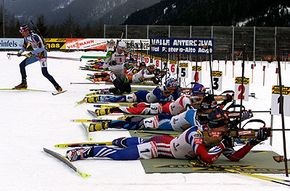
Biathletes firing in the prone position, 2002 Winter Olympics
Photo courtesy La Presse
In a biathlon event, competitors cross-country ski for a pre-determined distance, and then stop at a rifle range to fire at targets. In all events, the targets are 50 meters downrange. In some events, the skiing portion is truly cross-country. In others, skiers race around a course. After each lap around the course, they stop at the shooting range.
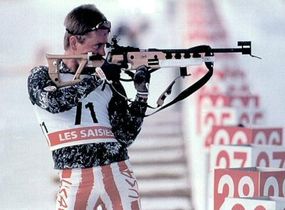
Shooting portions are conducted in either the prone or the standing (sometimes known as off-hand) positions. The athletes do not choose the position -- each event requires different shooting positions at specific points in the race. In the standing position, the target area is 11.5 centimeters in diameter. In the prone position, the target is only 4.5 cm wide. In addition, the wrist can't touch the ground while in the prone position.
Advertisement
At the firing range, each competitor has five targets, with one round of ammunition per target. In every event except individual, each missed target results in a 150 m penalty. The penalty includes skiing around a 150 m loop off to the side of the main course. In the individual event, each missed target adds a penalty of one minute to the competitor's final time.
The relay event differs slightly in that the athletes have three extra rounds at each firing range. They still have to strike five targets, but if they miss on any of the first five shots, they can load additional bullets to get the remaining targets. Loading a bullet takes five to seven seconds. Each target that remains standing after all eight shots have been fired results in a trip around the 150 m penalty loop.
Famous Olympic Biathletes: Myriam Bédard
Myriam Bédard, from L'Ancienne-Lorette, Quebec, Canada gave the 1994 Lillehammer Olympics one of the most thrilling moments in recent history. She had already become the first Canadian to medal in biathlon, taking bronze in 1992. At Lillehammer, Bédard dominated the 15 km event. She took a big lead in the 7.5 km event, but missed her final two shots, forcing her to ski 300 meters as a penalty. She went into the final 2.5 km 16 seconds behind the leader. At 1 km, she cut the lead to seven seconds. Bédard sprinted flat out for the last kilometer, winning the event by slightly more than one second. Not only was she the first North American gold medal winner in biathlon, she was the first Canadian woman to win double gold.
Advertisement
Biathlon at the 2018 Winter Olympics
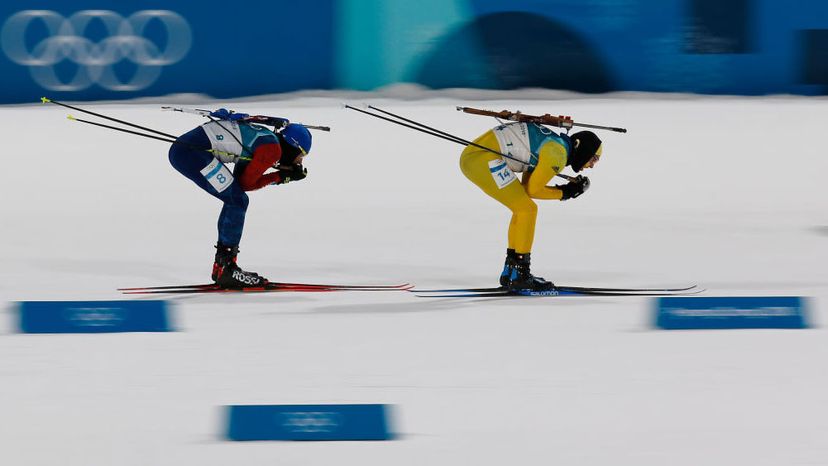
Sebastian Samuelsson of Sweden wins the silver medal, Martin Fourcade of France wins the gold medal during the Biathlon Men's and Women's Pursuit at Winter Olympics on Feb. 12, 2018 in PyeongChang, South Korea. Alexis Boichard/Agence Zoom/Getty Images
The 2018 PeyongChang Winter Olympic biathlon includes five main event types: individual, sprint, pursuit and relay. These events are divided into different distances and split between men's and women's competitions for a total of 11 different events:
Men's 20 km Individual
Women's 15 km Individual
Men's 10 km Sprint
Women's 7.5 km Sprint
Women's 10 km Pursuit
Men's 12.5 km Pursuit
Men's 4 x 7.5 km Relay
Women's 4 x 6 km Relay
Men's 15 km Mass Start
Women's 12.5 km Mass Start
2x6km Women and 2x7.5 km Men Mixed Relay
Daily Schedule
Let's look at each type of event in more detail.
Advertisement
Individual
This is the original biathlon event. Competitors each start 30 seconds apart, skiing five laps around a 3 or 4 km loop. At the end of each lap (except the final lap), competitors shoot. The four shooting portions in order are prone, standing, prone, standing, with five shots each round. Each missed shot adds a one-minute penalty. Standings are determined by overall time, which runs continuously from the moment a competitor leaves the starting line to when he or she crosses the finish line. The winners of this event will finish in under 50 minutes.
Sprint
Sprint is similar to the individual, but the distance is shorter (about 10 km total), and there are only two shooting portions: prone, then standing. Each missed target results in one lap around the 150 m penalty loop.
Pursuit
The Pursuit is unusual among Olympic events in that a previous event's results determine its competitors. The top 60 competitors from the Sprint qualify for the Pursuit. They start the 12.5 km (10 km for women) event at intervals based on their Sprint finishing times, but the race is actually head-to-head. This means that whoever does well in the Sprint and starts the Pursuit first has an actual head start over the rest of the field, who are constantly in "pursuit." The Pursuit has four shooting portions: prone, prone, standing, standing.
Relay
Each relay team has four members. All the first-leg skiers line up at the starting line and begin at the same time. They tend to arrive at the first firing range in the same manner. Each team member skis about 3 or 4 km, shoots prone, then skis the rest of his 7.5 km leg (6 km for women) and shoots standing. Competitors must tag the next team member to start the next leg of the relay. This event is head-to-head. The athletes are not racing against the clock, but directly against each other. Whoever crosses the finish line first wins. Each athlete is given three additional rounds of ammo as way to encourage faster shooting.
Mixed Relay
Each team has two women and two men. The order of departure is woman, woman, man, man. The women shoot two rounds at the 6 km mark, the men shoot two rounds at the 7.5 km mark. The competition rules are the same as for Relay.
Mass Start
This biathlon event is meant to appeal to spectators. Like Pursuit, entry is determined by prior events. Medal winners in the individual events qualify for Mass Start, with world IBU rankings determining the remaining field of 30. The men ski for 15 m and the women ski for a total of 12.5 km. The four shooting portions are prone, prone, standing, standing. Every time they miss, they must ski a 150 m penalty loop. This is a head-to-head competition, with all the competitors leaving the starting line at the same time.
Getting Involved in Biathlon
If you want to get involved, you can start by training off-course. In northern areas, it is usually easy to find a good cross-country ski trail and buy some equipment. Rifle ranges and .22s are also not hard to come by. Basic endurance training, either running or biking, is also a good idea.
Eventually, though, you'll want to get on an actual biathlon course. The best way to do this is to find a nearby biathlon club. These clubs hold regular events, and can put you in touch with coaches and other biathlon organizations. The U.S. Biathlon Association provides a list of biathlon groups here.
Advertisement
Biathlon Equipment
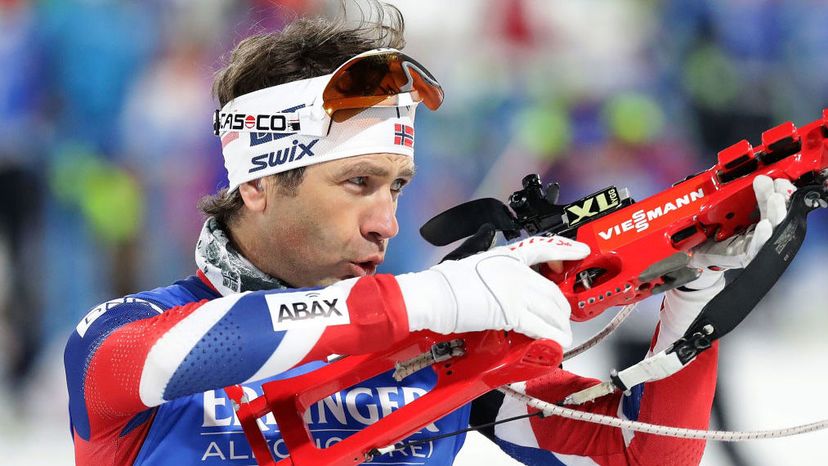
Ole Einar Bjoerndalen of Norway at the zeroing for the Men 10km Sprint during the BMW IBU World Cup Biathlon 2017, a test event for PyeongChang 2018 Winter Olympic Games. Chung Sung-Jun/Getty Images
Biathletes need equipment for both cross-country skiing and rifle marksmanship. For the skiing portion, their equipment is identical to that of cross-country skiers. They wear skintight Lycra racing suits designed to cut down on wind resistance and provide the wearer with maximum movement. In colder temperatures, a base layer provides insulation. In addition, biathletes wear gloves and hats made of lightweight materials, and goggles, if necessary. Tinted goggles are effective at cutting down on the glare from the sun reflecting off snow.
Because biathletes use the freestyle method of skiing they use skis that are shorter and stiffer than classical cross-country skis. The tips don't curve as much, either. Biathletes apply special glide wax to the bottom of each ski.
Advertisement
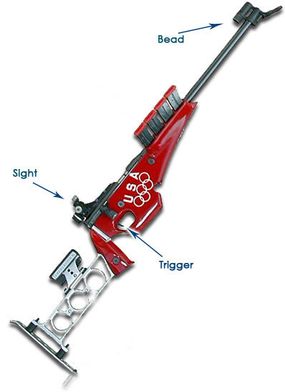
A regulation .22 biathlon rifle
Photo courtesy Eberlestock
The bindings of cross-country skis only attach at the toe, allowing the foot to flex and move more freely than alpine bindings, which attach at the toe and the heel. Cross-country boots are lighter and more flexible than boots used for downhill skiing.
Ski poles intended for freestyle cross-country skiing are long (about chin-height on the skier) and stiff. Each pole is a lightweight metal tube with a handgrip and a disc at the bottom to prevent it from spearing too deeply into the snow. Early biathlons used high-powered military rifles. In 1978, the .22 caliber rifle became the international standard. Today's biathlon rifle uses non-optic sights and straight-pull-bolt action (no full or semi-automatics). The rifles have a specially made lightweight stock, though by international rule they must weigh a minimum of 7.7 pounds.
Competitors carry their rifles in a harness that is essentially a backpack made just to hold one rifle. A cover goes over the rifle whenever it is off the range, and a flip-up cap covers the muzzle to prevent snow and moisture from entering the barrel of the rifle.
Ammunition must be the international standard .22 caliber long-rifle shot made from lead or a lead alloy. It is loaded into a magazine that holds five rounds. For the relay, three extra rounds are stored in the bottom of the magazine. Competitors place them into a cup at the range, and only use them if they need them. The magazines are stored in the rifle stock while skiing, and the rifle is only loaded at the range.
When it is time to fire, biathletes hook an arm sling made of webbing to a firing cuff on their upper arm. This connects to the rifle, and provides stability.
The targets are metal discs in a small box. When a biathlete hits a target, a different-colored disc flips up to show the hit. Computers also track modern targets to record whether a shot is a hit or a miss.
Famous Olympic Biathletes: Ole Einar Bjoerndalen
Norway's Ole Einar Bjoerndalen is often called "The King of Biathlon." He set a stunning record at the 2002 Olympics in Salt Lake City, winning gold in four biathlon events, including anchoring Team Norway in the relay. He also earned gold and silver in 1998 in Nagano, Japan. In all, he has won 13 medals at the Winter Olympic Games, the most of any Olympic athlete in any winter sport. He also won 45 medals at the Biathlon World Championships, more than twice anyone else but France's Martin Fourcade. Now at age 44, Bjoerndalen has participated in six different Olympics but was left off the 2018 Norwegian team for poor performance.
Advertisement
Biathlon Techniques
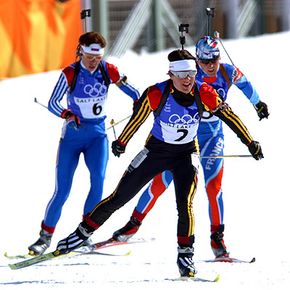
Female biathletes skiing freestyle in the 2002 Winter Olympics
Photo courtesy La Presse
Skiing
Biathlon skiing demand cross-country skiing techniques. The classical style, in which the skier "runs" on the skis, keeping the entire ski bottom in contact with the snow, is extinct in high-level competition. Instead, biathletes use the freestyle or skate method. In this method, skiers angle each ski to the side and pushes off, digging the leading edge into the snow and alternating between each ski. This basic style varies slightly, depending on the speed and incline of the section. For example, for fast, downhill sections, the poles aren't used, while for uphill sections, the skier gains thrust by pushing off of the poles.
There is one exception to the "no classical" rule, however. Because freestyle skating chews up the snow, the first 100 meters or so of the relay event are skied classical to keep the snow cleaner for the other team members.
Advertisement
Shooting
Before every biathlon event, competitors and their coaches take to the rifle range to "zero" their rifles. They take a few practice shots and adjust their rifle sights to compensate for temperature, wind and light conditions. Metal hand-screws on the sights click for each adjustment. A coach may look at a shot and tell the athlete to adjust four clicks down, for example. In some events, coaches can give the athletes sighting advice between shooting segments. Coaches are also important during timed events. Because these races aren't run head-to-head, it be difficult for a competitor to know where she stands in relation to her opponents. A coach can give her "splits," or split times that show how many seconds behind or ahead she is in the race. This is more than merely informative -- it can provide biathletes with the competitive drive to beat the next skier.
Josh Thompson, the first American to win a medal at the World Biathlon Championships
Photo courtesy Eberlestock
One of the most important techniques in biathlon is almost invisible to the casual viewer -- "easing in" to a range. Due to the penalties for missing shots, it is vital to hit as many targets as possible. This is difficult when your heart is racing and your lungs are burning from the exertion of a long ski segment. For this reason, most skiers don't sprint full-bore into the range. As they approach a shooting portion, they slow down. Instead of racing, their focus shifts to controlling their breathing and resting their muscles. This can make a huge difference when the time comes to hit a target just a few centimeters wide.
Training
Training techniques for biathlon involve racing in lower level biathlon events, cross-country skiing and taking thousands of practice shots at the rifle range, sometimes using air rifles. In summer months, biathletes use alternative forms of biathlon, as well as basic endurance training. Some biathletes use various methods to duplicate cold, harsh, or distracting conditions while firing (see Magnar Solberg's training in the sidebar below). High-altitude training gives all athletes stronger respiratory systems, but this is especially important for biathletes. Not only does their rifle accuracy depend in part on them not arriving at the shooting portion gasping for breath, but the Winter Olympics are often held in high-altitude regions.
Finally, safety is an important part of biathlon training. All biathlon teams and clubs have safety experts who teach everyone how to properly handle and care for rifles.
Famous Olympic Biathletes: Magnar Solberg
Norwegian Magnar Solberg was an unknown heading into the 1968 Olympics in Grenoble. He was not favored to compete well, much less win. However, a bizarre and brutal summer training regimen devised by his coach allowed Solberg to concentrate on his shooting even under the pressure and exhaustion of the 20 km event. His coach forced him to fire at a target 50 meters away while lying on an anthill, with ants crawling into his clothes and on his face.
Although not an especially fast skier, Solberg hit 20 of 20 targets. His perfection earned him a gold medal. He repeated at the podium four years later, taking gold despite missing two targets.
Brooks, Richard. "Troops from the 10th Mountain Division are protecting a key air base near Afghanistan."Global Security, November 7, 2001. http://www.globalsecurity.org/org/news/2001/011107-attack02.htm
Greenspan, Bud. "Frozen In Time." General Publishing Group, 1997. ISBN 157544027x.
"Biathlon: History." International Olympic Committee, 2006. http://www.olympic.org/uk/sports/programme/history_uk.asp?DiscCode=BT&sportCode=BT
"Biathlon History." US Biathlon Association. http://www.usbiathlon.org/history.html
"Biathlon Terminology." US Biathlon Association. http://www.usbiathlon.org/terminology.html
"Competition Descriptions." US Biathlon Association. http://www.usbiathlon.org/compdescript.html
"Frank-Peter Roetsch: The First Biathlete to Win Two Gold Medals in One Year." IOC, 2006. http://www.olympic.org/uk/athletes/profiles/bio_uk.asp?par_i_id=75713
"Inside this sport: Biathlon." NBC Olympics, 2006. http://www.nbcolympics.com/biathlon/inside.html?qs=;ch=0
International Biathlon Union http://www.biathlonworld.com/
"Ole Einar Bjoerndalen: Quadruple Biathlon Gold." IOC, 2006. http://www.olympic.org/uk/athletes/profiles/bio_uk.asp?par_i_id=59507
"Paintball Biathlon at Mountain Top XC Ski Center last Saturday." The New England Nordic Ski Association News, January 26, 2006. http://www.nensa.net/news/news_more_rss.php?id=1406
"Summer Biathlon." New South Wales & Australian Capital Territory Biathlon Association, 2001. http://www.faezor.com/NABA/summer_biath.htm
Wallechinsky, David. "The Complete Book of the Winter Olympics." Overlook Press, 2001. ISBN 1585671851.
Cite This!
Please copy/paste the following text to properly cite this HowStuffWorks.com article: